
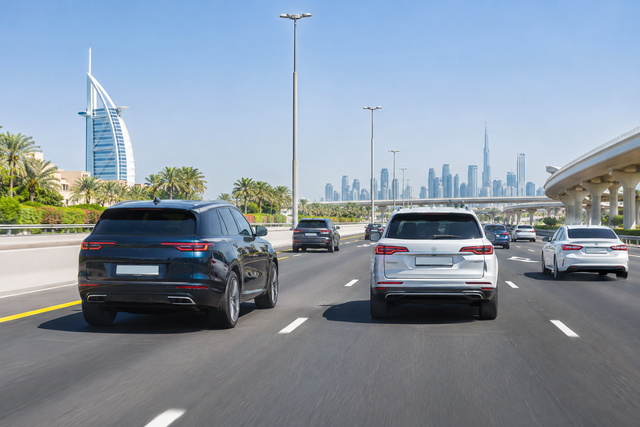
Overtaking is part of everyday driving on UAE roads, but from 1 January 2027, motorists will have a clearer set of rules explaining exactly when passing another vehicle is permitted and when it must be avoided.
The updated requirements are contained in Cabinet Decision No. 174 of 2026, which introduces the Executive Regulation of Federal Decree-Law No. 14 of 2024 on traffic regulation. Rather than completely changing how drivers overtake, the regulations provide more detailed guidance on lane discipline, passing from the right, returning to the correct lane and situations where overtaking is prohibited.
For UAE motorists, particularly those regularly travelling on busy multi-lane roads in Dubai, Abu Dhabi and Sharjah, understanding these rules can help reduce sudden lane changes, unsafe passing and confusion over the use of the fast lane.
Also read: Abu Dhabi Launches Variable Speed Limit System on Sheikh Zayed bin Sultan Road
Overtaking Should Normally Be Done From the Left
The starting point under Article 20 is straightforward: motorists should normally overtake another vehicle from its left side.
This means the left lane should primarily be used for passing slower traffic rather than as a lane in which a driver remains indefinitely.
Once the overtaking manoeuvre has been safely completed, the driver should move back towards the right without interfering with the vehicle that has just been passed.
However, a driver may continue using the overtaking lane when preparing to pass another vehicle immediately ahead.
There is an important condition. The driver must not block, delay or inconvenience faster traffic approaching from behind.
In practical terms, simply travelling at the posted speed limit does not mean a motorist should remain unnecessarily in the overtaking lane when another vehicle is approaching from behind.
Can You Overtake From the Right in the UAE?
This is one of the most important areas clarified by the regulation.
As a general rule, motorists should not routinely use the right side to overtake.
There is, however, a specific exception.
A vehicle may be passed on the right when the vehicle ahead has moved towards the left because its driver intends to turn into another road.
For the manoeuvre to be permitted:
The vehicle ahead must have moved towards the left to make a turn.
Its driver must have indicated the turn.
There must be sufficient room to pass safely.
The manoeuvre must not create danger for another road user.
This exception should not be interpreted as permission to weave between lanes or use slower lanes to repeatedly pass traffic on the right.
Six Situations Where Overtaking Is Prohibited
Article 21 of the updated regulations identifies several conditions in which motorists must not attempt to overtake.
1. When Visibility Is Poor
Drivers should not attempt to pass another vehicle if they cannot clearly see the road ahead or the surrounding traffic.
This becomes particularly important during fog, dust, heavy rain or other conditions that reduce visibility.
A driver needs enough visible road ahead to complete the entire manoeuvre safely, not simply enough space to begin overtaking.
2. When Oncoming Traffic Makes Passing Unsafe
On roads carrying traffic in both directions, motorists must make sure there is sufficient distance from approaching vehicles before attempting to overtake.
If an approaching vehicle could prevent the driver from safely completing the manoeuvre and returning to the correct lane, overtaking should not be attempted.
3. At Intersections and Roundabouts

Overtaking is prohibited at intersections, roundabouts and traffic squares.
These areas already involve vehicles merging, turning, changing direction and giving way. Adding an overtaking manoeuvre increases the risk of conflict with another road user.
Drivers should therefore maintain their position and follow the designated lane markings when approaching or travelling through these areas.
4. When Traffic Has Stopped
Drivers are also prohibited from overtaking a group of vehicles that has stopped because of a traffic obstruction or a stop signal.
For example, a queue of cars waiting at a junction or because of an obstruction ahead should not be treated as an opportunity to drive past the line of traffic.
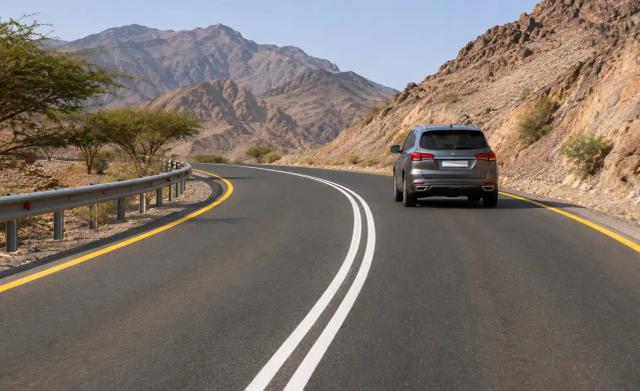
5. On Curves, Slopes and Other High-Risk Sections
The regulations specifically restrict overtaking in several road conditions where drivers may have reduced control or visibility.
These include:
Curves and bends
Inclines
Downhill sections
Slippery roads
Areas near pedestrian crossings
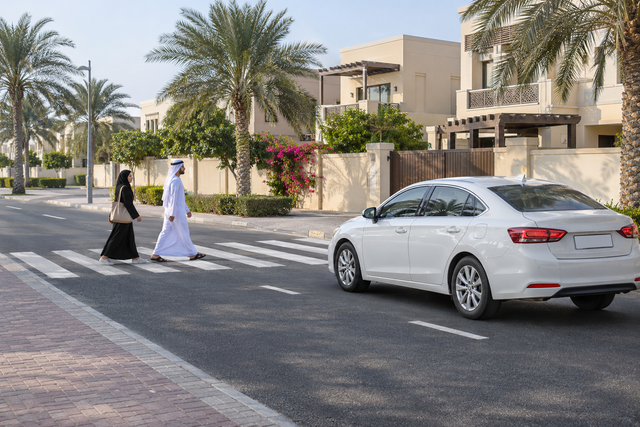
Continuous road markings are particularly important. If a continuous line separates lanes or traffic directions, motorists should not cross it simply to get around a slower vehicle.
6. Wherever Signs Prohibit Overtaking
Road signs, traffic signals and official instructions take priority.
If a sign indicates that overtaking is prohibited, motorists must follow it even when the road appears clear.
The same principle applies to temporary restrictions introduced because of roadworks, accidents or traffic-control measures.
What Drivers Must Check Before Pulling Out
Safe overtaking begins before the steering wheel is turned.
Article 20 requires motorists to consider several factors before attempting to pass another vehicle.
Also read: UAE Sets New Driving Test Rules That Let Learners Fail Despite a 75% Score
The driver should confirm that:
The road ahead is clearly visible.
There is no danger from approaching traffic.
The intended lane is clear.
No vehicle is approaching in that lane.
The driver ahead has not signalled an intention to overtake.
The speed difference between the vehicles allows the manoeuvre to be completed safely.
There is enough distance between the vehicles.
The reported requirements also include alerting the driver of the vehicle being overtaken and ensuring that the driver has responded. Maintain adequate space throughout the manoeuvre.
The aim is to ensure that overtaking is planned and controlled instead of being a sudden reaction to slower traffic.
What Happens After You Overtake?
Completing the pass does not mean immediately cutting back in front of the other vehicle.
Drivers must leave sufficient distance before returning to the right-hand lane so that the vehicle they have passed is not forced to brake or change direction.
If another slower vehicle is immediately ahead, a motorist may continue overtaking without returning to the right between every vehicle.
However, this is only acceptable when doing so does not obstruct vehicles approaching from behind.
This is an important distinction for UAE motorway driving. The left lane remains an overtaking lane, not a permanent cruising lane.
Why Lane Discipline Matters on UAE Roads
Consistent lane behaviour is especially important across the UAE’s high-speed road network.
Better lane discipline also improves traffic flow.
When motorists overtake, return to the appropriate lane and avoid sudden movements between vehicles, other drivers have more time to predict what is happening around them.
Do the Rules Apply Only to UAE Residents?
No.
The regulations govern driving on UAE roads, meaning the same road-safety principles are relevant to residents as well as visitors driving rental or privately owned vehicles.
Tourists unfamiliar with UAE motorway driving should pay particular attention to fast-lane discipline, road markings and local signs before attempting to overtake.
When Do the UAE's 2027 Traffic Regulations Start?
The new Executive Regulation takes effect on 1 January 2027.
It sits under the wider federal traffic framework established through Federal Decree-Law No. 14 of 2024 on Traffic Regulation. The federal legislation provides for executive regulations and gives authorities powers to establish measures designed to improve road safety.
For motorists, the biggest takeaway is simple: overtaking should be deliberate rather than aggressive.
Use the left to pass, move back when the manoeuvre is complete, do not block faster traffic, and never attempt to overtake when road conditions, markings or signs make it unsafe.