

For UAE families, the choice between a conventional petrol seven-seater and a hybrid SUV is no longer a simple question of power versus fuel economy. Family buyers now have hybrid models with six, seven or even eight seats, while familiar petrol SUVs remain firmly established across the Emirates for long-distance driving, desert use and heavy-duty family work.
The short answer is that hybrids increasingly make sense for families whose driving is dominated by school runs, city commuting and stop-start traffic. Petrol seven-seaters still have a strong case for buyers who prioritise proven 4x4 hardware, frequent highway travel, desert capability, towing or a wider choice of traditional large SUVs.
That balance matters more in September 2026, with UAE pump prices set at AED 3.80 per litre for Super 98, AED 3.69 for Special 95 and AED 3.61 for E-Plus 91. Fuel is not prohibitively expensive, but a large family's annual mileage can make consumption increasingly important to the ownership calculation.
Why petrol seven-seaters still have a strong argument
The petrol SUV remains a highly practical family vehicle for many Gulf households. The format is familiar, the choice is broad and several of the region's established family SUVs are built around petrol powertrains and proper four-wheel-drive systems.
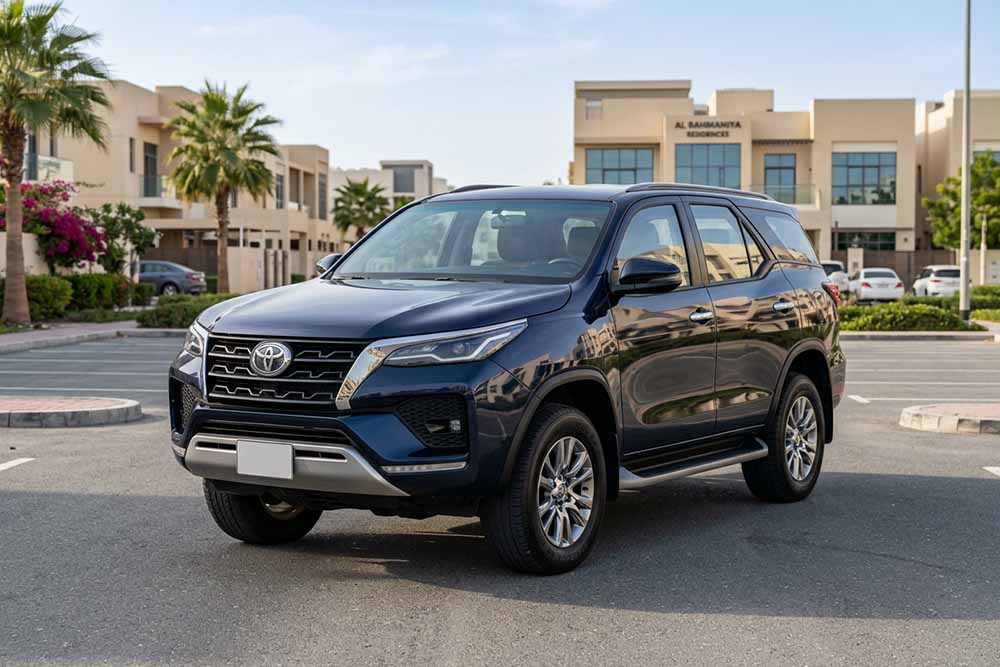
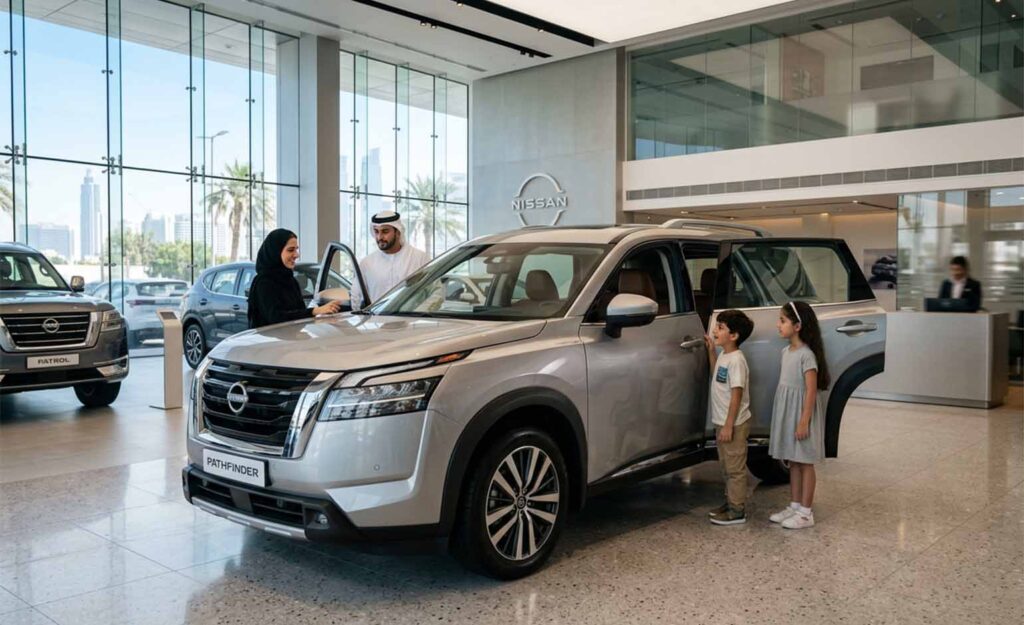
The 2026 Toyota Fortuner, for example, is offered in the UAE with 2.7-litre four-cylinder and 4.0-litre V6 petrol engines, both with four-wheel drive, and starts at AED 128,900. Nissan's current Patrol offers seating for eight, showing how much passenger capacity remains available in the conventional petrol end of the market.
Capability still matters outside the city
For families who regularly leave Dubai, Abu Dhabi or Sharjah for desert camps, mountain trips or longer inter-emirate journeys, drivetrain layout can matter more than a headline fuel-economy figure.
Traditional petrol 4x4s can bring hardware that buyers specifically want for this use, including low-range gearing on certain models, generous ground clearance and drivetrains developed around more demanding off-road use.
Petrol remains particularly convincing when the family SUV is expected to do several jobs:
- Regular desert or rough-road driving.
- Towing, heavy loading or carrying seven people and luggage.
- Repeated long-distance motorway trips across the UAE or GCC.
- Serving as the household's single do-everything vehicle.
That does not mean every petrol seven-seater is automatically better off-road. Buyers still need to check the exact drivetrain, tyres, cooling system, ground clearance and towing limits of the specific grade.
Purchase price and choice can still favour petrol
Hybrid technology is no longer automatically confined to expensive cars, but petrol buyers still have a broad spread of established seven- and eight-seat SUVs in the UAE.
The Fortuner's AED 128,900 starting price is one example. At the larger end of the market, petrol versions of models such as the Land Cruiser and Patrol continue to give buyers the traditional full-size SUV formula.
The important point is to compare like with like. A less expensive petrol body-on-frame SUV and a more expensive hybrid crossover may have very different equipment, ride comfort, four-wheel-drive systems and intended use.
Why hybrid SUVs now make serious sense for UAE families
The strongest case for a hybrid is not environmental branding. It is everyday efficiency without forcing the owner to change how the vehicle is refuelled.
Full hybrids can recover energy through regenerative braking and use an electric motor to reduce the petrol engine's workload. A conventional self-charging hybrid does not require a home charger or regular visits to public charging stations. Toyota, for example, states that its RAV4 Hybrid battery is recharged through regenerative braking and the engine rather than by plugging the vehicle in.
That matters in the UAE, where a family living in an apartment or rented property may want some of the efficiency benefits of electrification without installing charging equipment.
Three-row hybrid choice is no longer limited
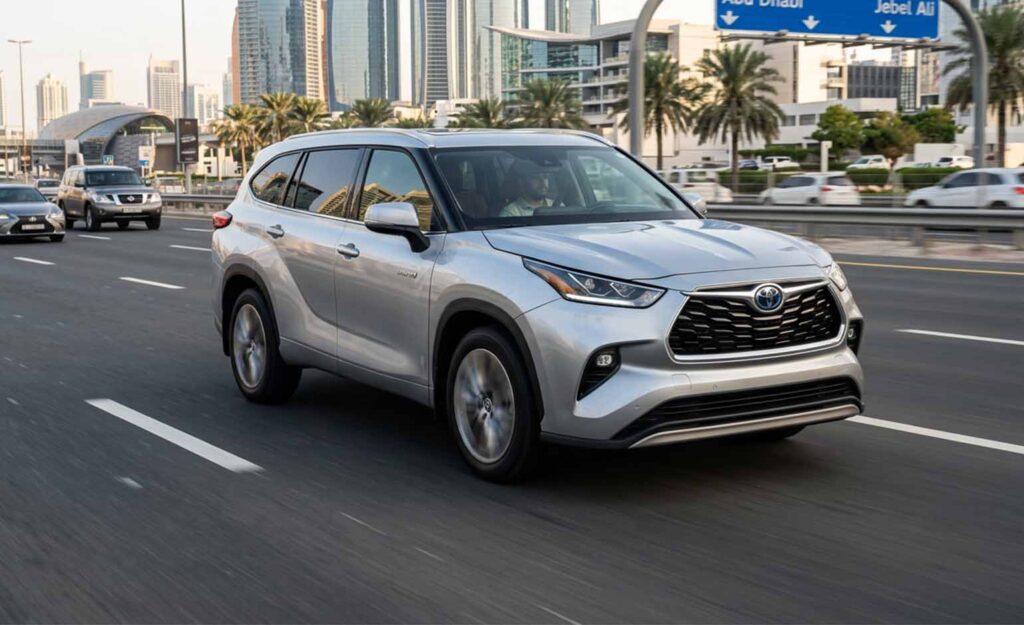
There are now credible family-sized hybrid options in the UAE. Toyota's 2026 Highlander Hybrid combines a 2.5-litre hybrid system with all-wheel drive and seven seats. The 2026 Innova Hybrid is offered with eight seats, while Hyundai lists six- and seven-seat configurations for the Santa Fe, including its hybrid powertrain.
That changes the argument. Choosing a hybrid no longer necessarily means giving up the third row.
Families considering one should still check the details that matter every day:
- Third-row legroom with adults or older children aboard.
- Boot space with every seat raised.
- Access for child seats and ISOFIX positions.
- Rear air-conditioning performance in peak summer heat.
- Payload when passengers, luggage and accessories are combined.
A test drive with the whole family can reveal more than comparing brochure dimensions alone.
City driving is where a hybrid makes its strongest case
School runs, supermarket trips and daily commuting around Dubai, Abu Dhabi and Sharjah involve repeated acceleration, braking and periods of slow traffic.
Those are conditions in which a full hybrid can make greater use of its electric motor and regenerative braking. The petrol engine may also spend less time running unnecessarily while the vehicle is moving slowly or stationary.
The difference can be less dramatic during a steady motorway journey, where there are fewer opportunities to recover braking energy and the petrol engine may run for longer periods.
A family doing mostly Sheikh Zayed Road or Abu Dhabi to Dubai mileage should therefore compare real-world consumption carefully rather than assuming a hybrid will always deliver its biggest advantage.
For households covering significant annual mileage in mixed urban use, however, reduced fuel consumption can become meaningful over several years, especially when pump prices increase.
Petrol seven-seaters vs hybrid SUVs in the UAE: the ownership costs buyers should compare
Fuel is only one part of the calculation. The better comparison is total ownership cost across the period you expect to keep the vehicle.
A lower fuel bill can be cancelled out by a higher purchase price if annual mileage is low. Equally, a cheaper petrol SUV can become expensive to run if it spends most of its life in congested city traffic.
Before deciding, families should compare:
- Purchase price and finance cost for equivalent specifications.
- Expected annual kilometres and city-to-highway driving split.
- Scheduled servicing and consumable costs.
- Insurance quotes for the exact model and grade.
- Warranty duration, especially hybrid-system and battery cover.
- Likely resale demand for the specific model, not only its powertrain.
Hybrid battery warranties also deserve attention. Toyota UAE currently lists hybrid battery coverage of eight years or 160,000 km, whichever comes first. That does not guarantee zero repair costs once the warranty expires, but it addresses one of the main concerns buyers often have about long-term hybrid ownership.
What makes this debate different in the UAE and GCC?
A powertrain that looks ideal on paper can feel very different after several Gulf summers. The region's climate, road network and ownership habits change the priorities.
Heat and dust put maintenance discipline first
Extreme summer temperatures place demands on every vehicle. Petrol engines, turbochargers, hybrid electronics, batteries, air-conditioning systems and cooling circuits all depend on proper thermal management.
For UAE buyers, the more useful question is not whether petrol or hybrid can cope with the heat. Both types are sold officially by major manufacturers in the local market.
The bigger considerations are whether the vehicle is suitable for GCC conditions, has proper authorised distributor support and is maintained according to its manufacturer's schedule.
Dust matters too. Air filters, cabin filters, radiators and cooling systems all require attention in local conditions. A neglected petrol SUV is not automatically less vulnerable to heat-related problems than a properly maintained hybrid.
Long highways reduce the hybrid advantage
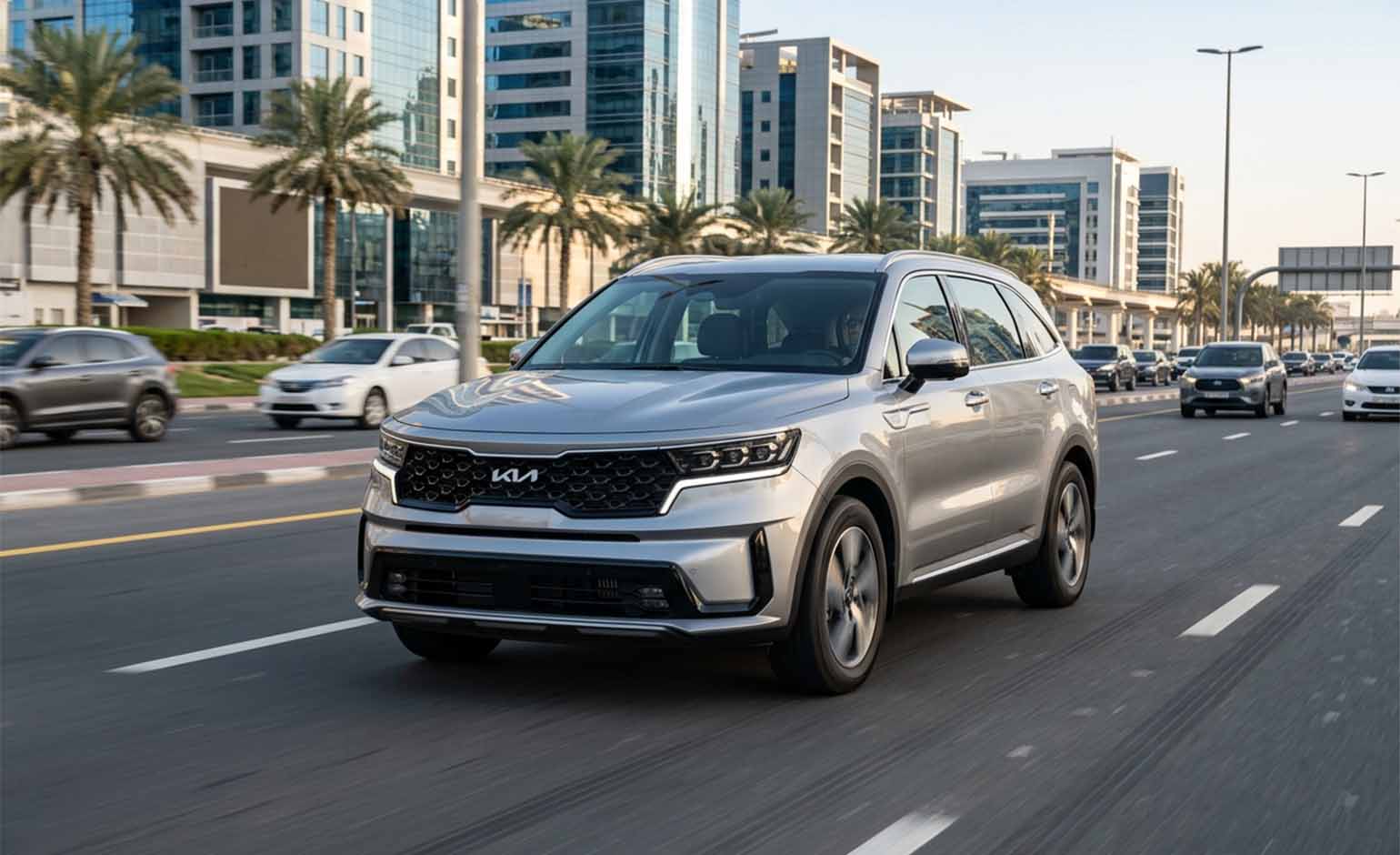
The UAE's road network encourages long-distance driving. Motorists travelling frequently between Abu Dhabi and Dubai, or making longer GCC journeys, can spend much of their time at a steady motorway cruise.
Hybrids can still be efficient, but the gap can narrow compared with stop-start urban driving. A large petrol SUV with a comfortable engine, substantial fuel capacity and strong highway refinement may remain completely rational for a high-mileage intercity family.
This is where owners should use their actual weekly driving pattern rather than concentrating only on an official efficiency figure.
Desert driving still favours the right hardware
A hybrid badge does not automatically rule out serious performance or off-road capability.
Toyota now sells the Land Cruiser Hybrid in the UAE with a 3.5-litre twin-turbo V6, an electric motor and a claimed combined output of 457 hp and 790 Nm. The arrival of vehicles such as this shows that hybrid technology and large Gulf-focused 4x4s are no longer mutually exclusive.
But for a family choosing between ordinary three-row crossovers and traditional 4x4s, the real questions remain mechanical:
- Does it have the required four-wheel-drive hardware and terrain modes?
- Is its ground clearance suitable for the intended route?
- Are the tyres appropriate?
- Does the manufacturer approve the towing or off-road use planned?
For serious dune driving, the vehicle's underlying capability matters more than whether the engine receives electric assistance.
Charging is not a problem for a conventional hybrid
One misconception can distort the comparison. A full hybrid is not the same as a plug-in hybrid or an electric vehicle.
A self-charging full hybrid recovers energy while driving and does not require a charging point. That makes it particularly relevant to UAE apartment residents who cannot install private charging.
Plug-in hybrids are different. Their ownership case becomes much stronger when they can be charged consistently at home or work.
For many UAE families, this makes a conventional full hybrid the easiest step away from petrol-only ownership.
Resale value is becoming more model-specific
Traditional petrol SUVs such as the Land Cruiser, Patrol and Fortuner have decades of familiarity among Gulf buyers. That gives consumers a well-understood used-car market when they start thinking about resale.
It would still be too simplistic to assume every petrol SUV will retain value better than every hybrid.
Brand reputation, vehicle supply, mileage, condition, service history, remaining warranty and buyer demand all affect resale.
A well-supported hybrid from an established distributor could prove easier to sell than an unpopular petrol model. Buyers should therefore research the actual vehicle rather than relying on assumptions about the powertrain alone.
Insurance and repair support deserve a closer look
Insurance should be quoted before purchase, rather than estimated based on whether a vehicle is hybrid or petrol.
A hybrid may contain costly electrical components, but a premium petrol SUV can also bring expensive bodywork, sensors, turbochargers and advanced driver-assistance technology.
Before buying, ask about:
- Agency repair eligibility and its duration.
- Accident coverage relating to hybrid components.
- Parts availability and expected repair procedures.
- Roadside assistance and authorised service locations.
For buyers living outside Dubai and Abu Dhabi, workshop coverage across the wider UAE can sometimes matter more than a small difference in fuel consumption.
RTA inspection rules do not make one powertrain an obvious winner
Vehicle inspection requirements are largely about roadworthiness rather than giving conventional hybrids a blanket advantage over petrol vehicles.
RTA's Dubai inspection service checks vehicle roadworthiness for registration, renewal and other licensing requirements. UAE government guidance also states that vehicles must undergo inspection through authorised testing centres when required, with vehicles produced within the previous three years exempt from inspection before registration under the stated conditions.
For family buyers, inspection is therefore largely a powertrain-neutral issue. Proper maintenance and roadworthy condition matter more than whether the petrol engine is assisted by an electric motor.
Who should choose a petrol seven-seater?
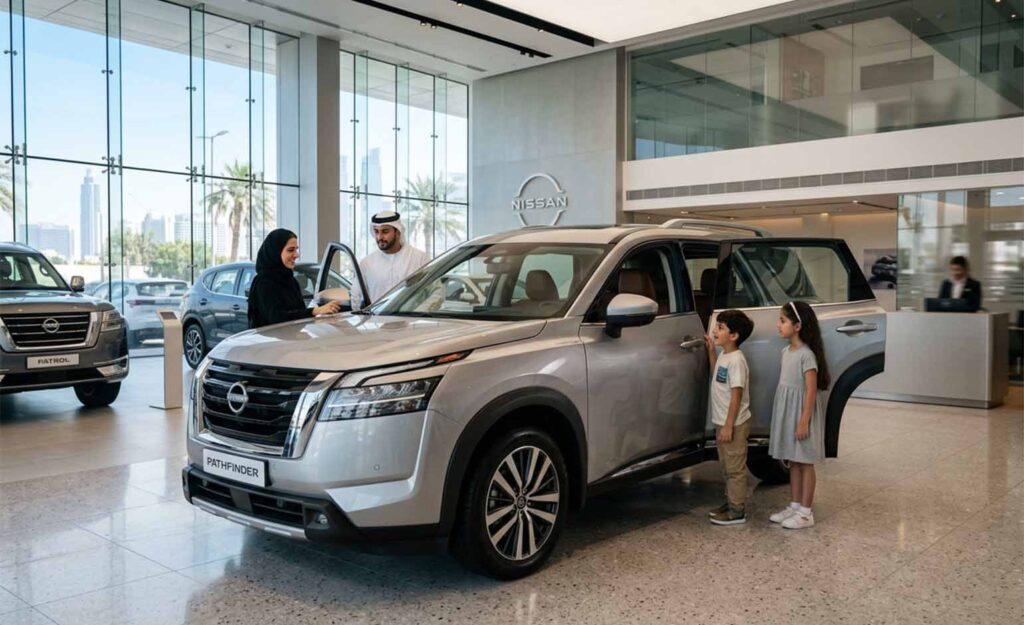
A conventional petrol SUV still makes the stronger case when capability and versatility sit at the top of the shopping list.
It is likely to suit:
- Families that regularly drive in the desert or on rough tracks.
- Owners who tow or frequently travel fully loaded.
- Buyers who specifically want a traditional body-on-frame 4x4.
- Drivers covering mostly long, steady motorway distances.
- Households prioritising broad model choice and familiar ownership.
For these buyers, fuel cost matters, but it is not the only measure of value.
Who should choose a hybrid SUV?
A hybrid becomes more persuasive when everyday use is urban, predictable and mileage is high enough for fuel savings to accumulate.
It is likely to suit:
- Families doing frequent school runs and city commuting.
- Drivers spending significant time in stop-start traffic.
- Apartment residents who want electrification without charging.
- Buyers keeping the vehicle long enough to benefit from reduced fuel use.
- Families who can find a hybrid with the seating and luggage capacity they actually need.
The hybrid should still be bought on the strength of the whole vehicle rather than its fuel-economy claim alone.
The balanced verdict
For the average UAE family whose SUV spends most of its life in Dubai, Abu Dhabi or Sharjah traffic, a well-supported full hybrid is becoming the more logical everyday choice.
It can reduce fuel consumption without introducing the charging dependency of a fully electric vehicle, and the UAE now has genuine three-row hybrid options rather than forcing family buyers into smaller SUVs.
But the petrol seven-seater is far from obsolete.
For desert use, towing, regular long-distance GCC driving or buyers who specifically need a rugged traditional 4x4, petrol remains practical and may be better suited to the job.
The real dividing line is not old technology versus new technology. It is urban efficiency versus broader capability.
A family covering 20,000 km a year mostly through school runs, commuting and city errands should look very seriously at a hybrid. A family spending weekends in the dunes, towing equipment or crossing long stretches of highway with seven people and luggage aboard may still find greater value in a conventional petrol SUV.
The smarter purchase is the one that matches how the vehicle will actually be used after the showroom handover.