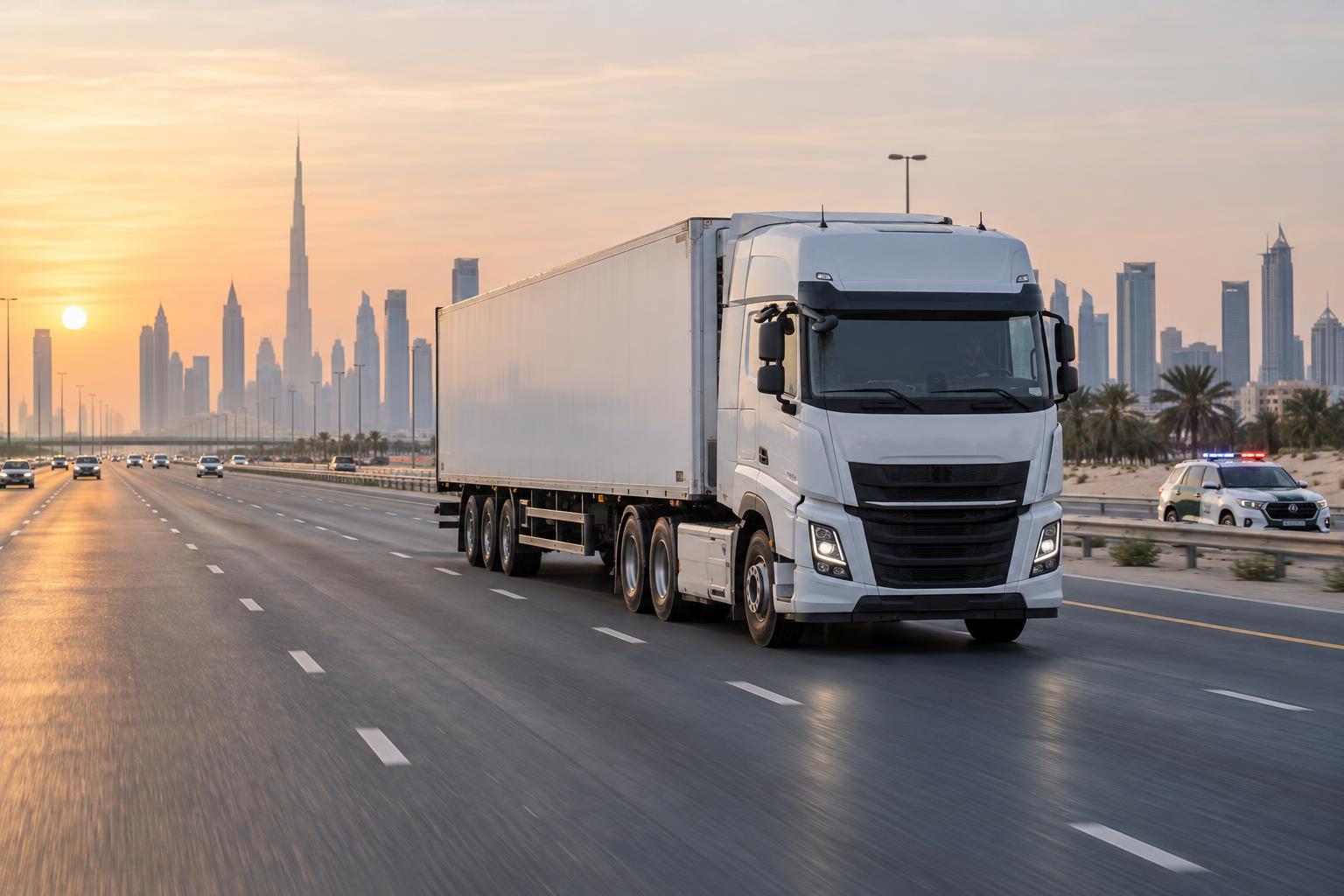
Dubai’s Roads and Transport Authority and Dubai Police have confirmed new truck movement restrictions that take effect on October 1, 2026. The changes are intended to reduce congestion, improve traffic flow and separate heavy vehicles from busy passenger-car corridors at key times. Commercial drivers and fleet operators should review their normal routes well before the start date, particularly where journeys use Al Qudra Street, Sheikh Zayed Road or the Airport Tunnel.
The restrictions do not amount to a citywide truck ban. Instead, they apply to specific roads and can differ by time of day, direction, vehicle category and road section. Emirates Road remains an important alternative for through-moving freight traffic because it is exempt from the newly announced restrictions.
What RTA and Dubai Police have announced for October 1, 2026
From October 1, 2026, trucks will face tighter access controls on selected high-demand roads in Dubai. The announced measures combine peak-hour movement bans on certain corridors with round-the-clock restrictions on roads where heavy vehicles are considered unsuitable because of tunnel design, traffic density or the volume of passenger vehicles.
For logistics businesses, the key point is that a route which has historically been usable may no longer be available during the morning and afternoon peaks. Dispatch teams should account for the restrictions when calculating delivery windows, driver hours, fuel planning and customer arrival times.
- Some roads will have truck bans during defined peak periods.
- Some locations, including the Airport Tunnel, will have continuous restrictions.
- Restrictions apply to truck movement, not necessarily every commercial vehicle.
- Emirates Road remains available as a strategic freight route.
- Drivers should follow roadside signs and any vehicle-class instructions issued by RTA and Dubai Police.
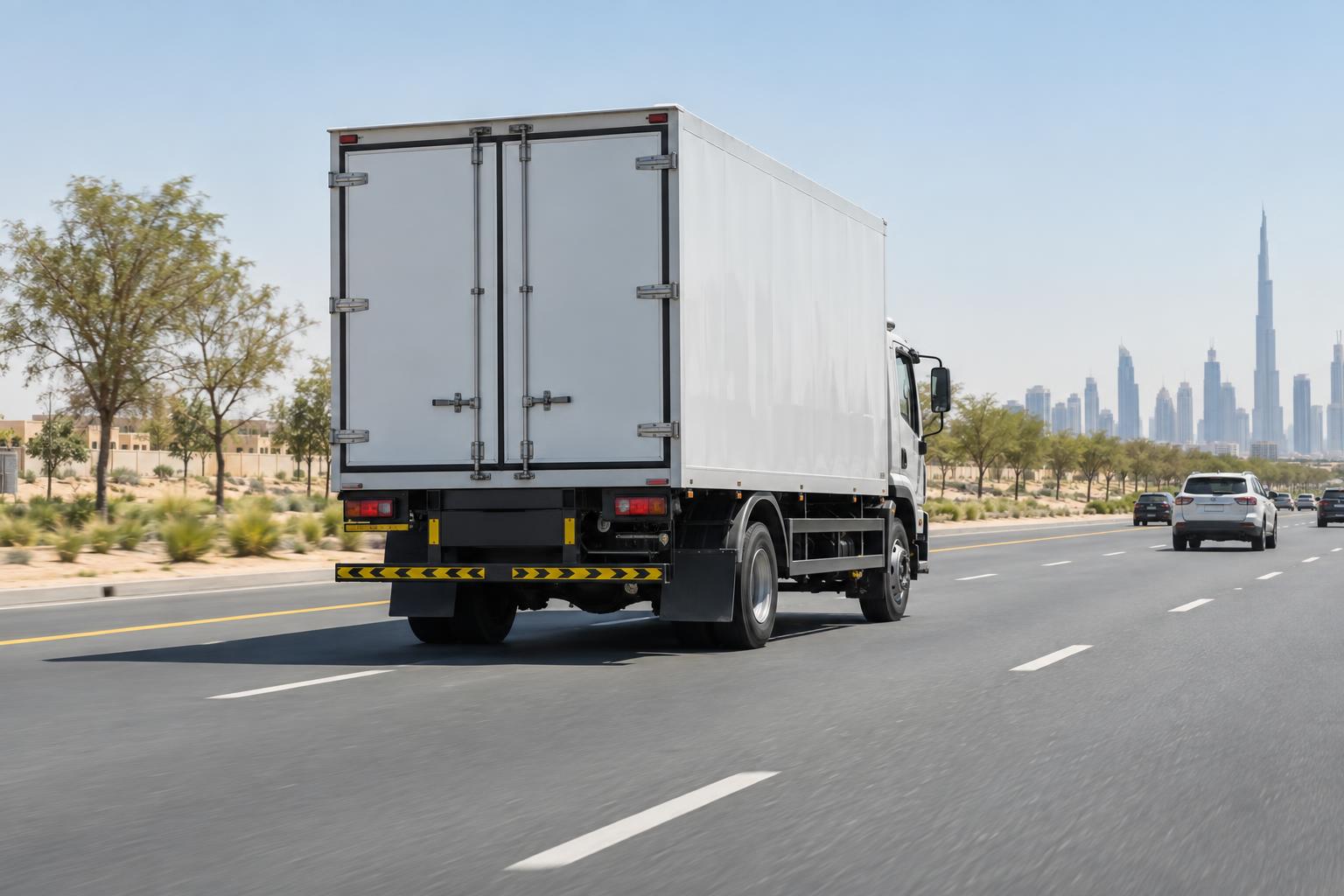
Which Dubai roads are affected by the new truck restrictions?
The announcement identifies several important corridors used by commercial traffic travelling between Dubai’s industrial areas, residential communities, ports, airports and inter-emirate highways. The exact treatment depends on the route, so operators should not assume that one restriction applies in the same way everywhere.
Before October 1, fleet managers should map all regular journeys that use the affected corridors. This is especially important for construction fleets, concrete mixers, waste collection vehicles, delivery trucks and long-haul vehicles moving between Dubai and neighbouring emirates.
Al Qudra Street
Al Qudra Street is a major connection for communities in Dubai’s south-western areas and for vehicles accessing routes towards Sheikh Mohammed Bin Zayed Road and Emirates Road. It also carries substantial passenger traffic during school, office and commuting periods.
Under the new approach, truck movements on affected sections of Al Qudra Street will be controlled during the busiest times of day. Operators that currently use the road as a shortcut between industrial areas and outer Dubai should plan an alternative route or adjust departure times to avoid peak-period delays and enforcement action.
Sheikh Zayed Road
Sheikh Zayed Road is one of Dubai’s busiest urban highways, serving the central business districts, residential towers, hotels and major interchanges. Heavy vehicle restrictions on this corridor are aimed at keeping traffic moving safely where lane changes, merging and high vehicle volumes are constant.
Truck operators should confirm which sections of Sheikh Zayed Road are covered and whether the restriction applies in one direction or both. A journey that is permitted on an outer section of the highway may still be restricted closer to central Dubai or at specific interchanges.
Airport Tunnel
The Airport Tunnel is subject to a more stringent approach because it is a confined, high-traffic route serving Dubai International Airport and surrounding districts. The announced policy treats this as a round-the-clock truck restriction, rather than a measure limited to peak commuting periods.
Drivers should not rely on the Airport Tunnel as a fallback route when peak-hour bans apply elsewhere. Fleet route plans should instead use approved alternatives that are suitable for the vehicle’s height, weight, cargo type and final destination.
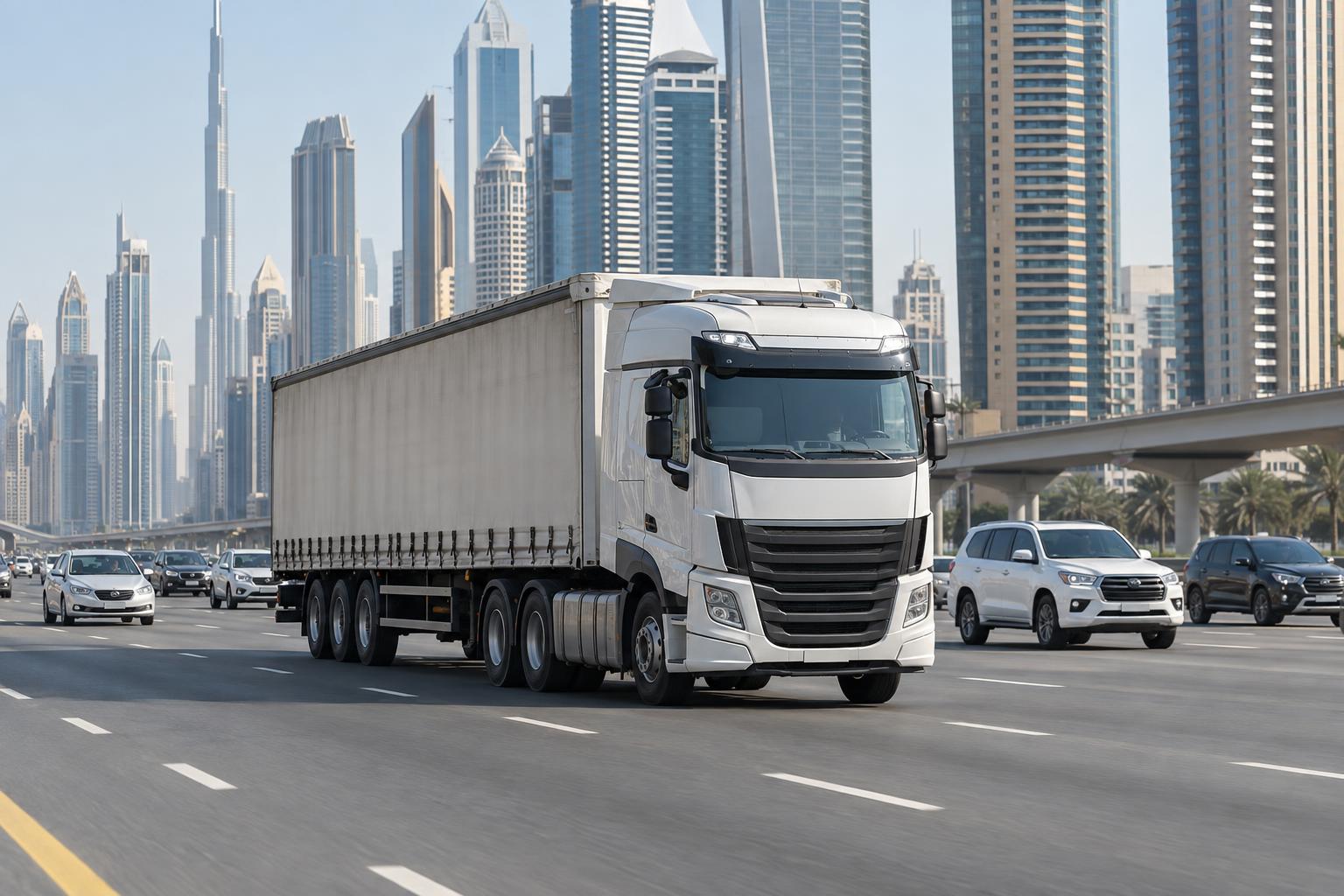
Other key routes named in the announcement
In addition to the headline roads, the updated controls cover other strategically important links where heavy vehicles can add to congestion or create conflict with high volumes of private cars. These may include road sections around major junctions, urban access roads and routes that feed into restricted corridors.
Roadside signs, official traffic notices and route-specific instructions should be treated as the final authority. A driver should not assume that a truck is permitted simply because the road is physically wide enough or because it was allowed there before the October 2026 changes.
How the restrictions work: peak-hour bans versus round-the-clock bans
Dubai’s new approach separates roads that need temporary traffic management from locations where truck access is unsuitable at all times. Understanding that difference will help operators plan routes that are compliant without adding unnecessary distance.
Peak-hour truck movement bans
Peak-hour restrictions target the periods when Dubai’s roads are busiest with commuters, school traffic and passenger vehicles. Trucks may be allowed to use these roads outside the restricted windows, subject to other posted controls and vehicle-specific rules.
This means a delivery schedule can sometimes be adjusted rather than completely rerouted. For example, a fleet may choose earlier loading, later dispatch or staggered departure times so that vehicles reach a restricted road after the applicable ban has ended.
Round-the-clock bans
Round-the-clock restrictions mean that trucks cannot use the affected route at any time of day. These restrictions are more significant for route planning because waiting until the evening or overnight period will not make the road available.
For roads such as the Airport Tunnel, fleets need a permanent alternative. Dispatch software, driver navigation systems and printed route cards should be updated so drivers are not directed towards a prohibited access point.
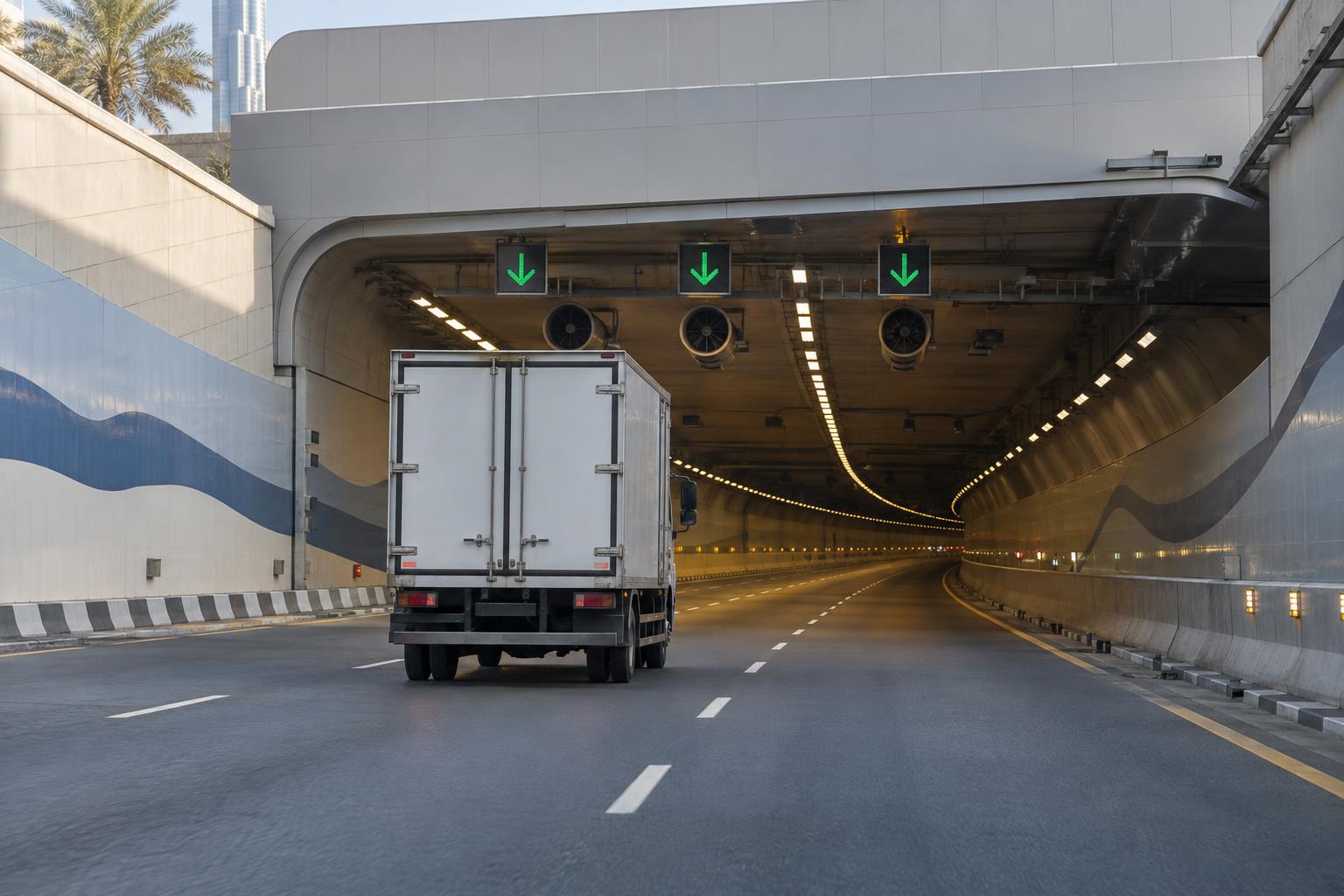
Why is Emirates Road exempted from the new rules?
Emirates Road is designed to function as a major cross-Dubai and inter-emirate corridor, with a role that is particularly important for freight and heavy vehicles. Keeping it available helps move commercial traffic around, rather than through, Dubai’s most congested urban areas.
The exemption gives logistics operators a more predictable route for longer journeys, even if it may add kilometres compared with a direct path through central districts. In practice, a slightly longer route with fewer restrictions can be more reliable than a shorter route that carries a risk of waiting, diversion or penalties.
That does not mean every truck can use every Emirates Road interchange without limitation. Drivers must still observe posted lane rules, turning restrictions, dangerous-goods requirements, vehicle-size limits and instructions at connecting roads.
Expanded truck rest area capacity across Dubai
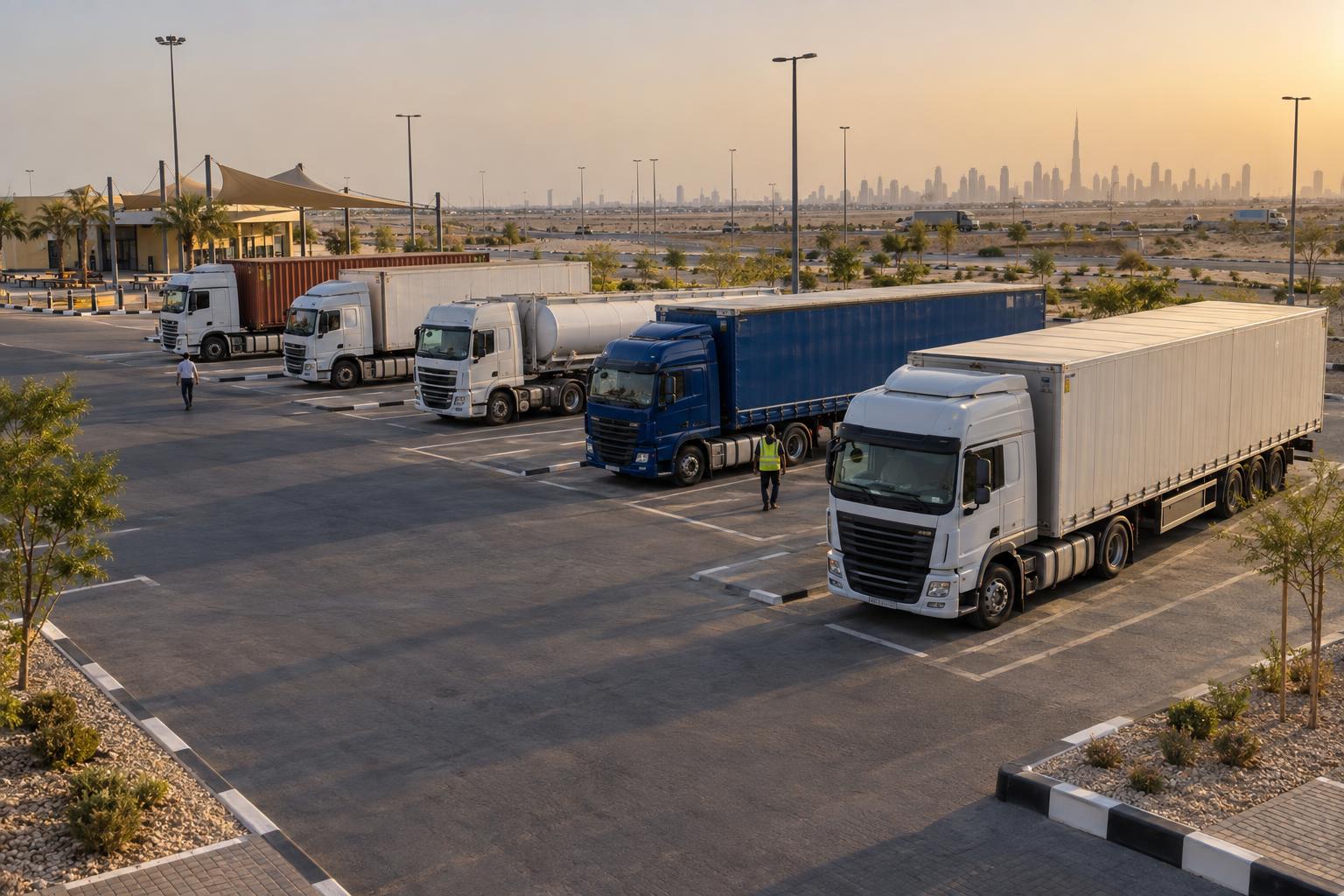
The restrictions are being supported by expanded truck rest area capacity across Dubai. This matters because drivers may need a safe and legal place to wait before entering a road that is restricted during the peak period.
Proper rest facilities can also reduce the temptation for trucks to stop on road shoulders, vacant plots or unsuitable service roads. For fleet operators, designated parking and rest areas offer a better place to manage arrival timing, driver breaks, vehicle checks and communication with dispatch teams.
- Plan waiting time into deliveries that approach a restricted road before the ban ends.
- Tell drivers which approved rest areas are suitable for the vehicle and cargo.
- Allow for mandatory rest breaks and internal driving-hour policies.
- Do not use hard shoulders or unapproved roadside areas as informal waiting locations.
- Keep dispatch teams informed if a driver must hold outside a delivery time window.
What this means for commercial drivers and fleet operators
The practical impact will vary by business. A courier van making urban deliveries may face different rules from a heavy articulated truck, while a construction fleet may need to reconsider the timing of material movements to sites near restricted roads.
Businesses should begin by identifying every journey that uses the affected routes. From there, they can decide whether each trip should be rerouted, rescheduled or assigned to a different type of vehicle where legally appropriate.
Steps to take before October 1, 2026
- Audit regular routes: Identify trips that use Al Qudra Street, Sheikh Zayed Road, the Airport Tunnel and connected urban corridors.
- Update navigation settings: Ensure dispatch systems and driver navigation tools avoid prohibited roads for the relevant vehicle type.
- Review delivery appointments: Build realistic buffers into customer delivery windows and site access bookings.
- Brief drivers: Share route maps, restriction times, approved rest locations and escalation contacts.
- Check subcontractors: Make sure third-party carriers understand that compliance remains essential when they operate on your behalf.
- Monitor official notices: Restrictions can include route-specific signs, exemptions or operational instructions that need to be reflected in fleet planning.
Drivers should also avoid relying solely on consumer navigation apps. These tools may not always reflect truck-specific restrictions, vehicle dimensions, prohibited cargo routes or recent traffic management changes.
How this differs from Abu Dhabi's earlier E311 speed limit update
Dubai’s October 2026 truck restrictions are access and movement controls. They determine whether heavy vehicles may use certain roads at specific times or, in some cases, at all. This is different from Abu Dhabi’s earlier update to the E311 speed limit, which focused on how fast vehicles may legally travel on a designated highway section.
Both measures affect logistics planning, but they require different responses. A speed limit reduction can change journey time and fuel assumptions, while a truck restriction can require a completely different route, a revised delivery slot or a waiting period at an approved rest area.
Companies operating across the UAE should therefore keep emirate-specific compliance information separate in their transport plans. A rule on E311 in Abu Dhabi should not be treated as a substitute for checking Dubai’s truck access restrictions, and vice versa.
Key takeaways for GCC logistics and transport companies
For companies running UAE and wider GCC freight operations, the Dubai changes reinforce the value of route planning that considers more than distance. Urban access rules, peak restrictions, road class, parking availability and customer delivery timing can all affect the real cost and reliability of a journey.
- October 1, 2026 is the key implementation date for the new Dubai truck movement controls.
- Al Qudra Street, Sheikh Zayed Road and the Airport Tunnel require particular attention.
- Some restrictions are time-based, while others apply around the clock.
- Emirates Road remains a key freight alternative and is exempt from the newly announced restrictions.
- Expanded truck rest facilities should help drivers wait safely when access is not yet permitted.
- Fleet operators should update routing, driver briefings and delivery schedules before the rules begin.
The best preparation is to treat the restrictions as an operational planning issue rather than a last-minute driver instruction. A clearly mapped route policy, backed by current official notices and practical driver training, will help businesses reduce avoidable delays and maintain safer, more predictable deliveries across Dubai.
People Also Ask
When do Dubai's new truck movement restrictions start?
The new restrictions take effect on October 1, 2026. Fleet operators should update route plans, driver instructions and delivery schedules before that date.
Are trucks banned from Sheikh Zayed Road in Dubai?
Truck access on Sheikh Zayed Road is subject to the new movement controls on affected sections, particularly during periods identified by the authorities. Drivers should follow posted signs and official route-specific instructions.
Can trucks use the Airport Tunnel in Dubai?
The Airport Tunnel is covered by a round-the-clock truck restriction under the announced measures. Heavy vehicle drivers should use an approved alternative route instead.
Is Emirates Road open to trucks in Dubai?
Yes, Emirates Road is exempt from the new truck movement restrictions and remains an important freight route. Normal road signs, lane rules and vehicle-specific restrictions still apply.
What should fleet operators do before the Dubai truck restrictions begin?
Operators should audit affected routes, update navigation systems, brief drivers, plan approved waiting locations and revise delivery windows where peak-hour restrictions may affect arrival times.