

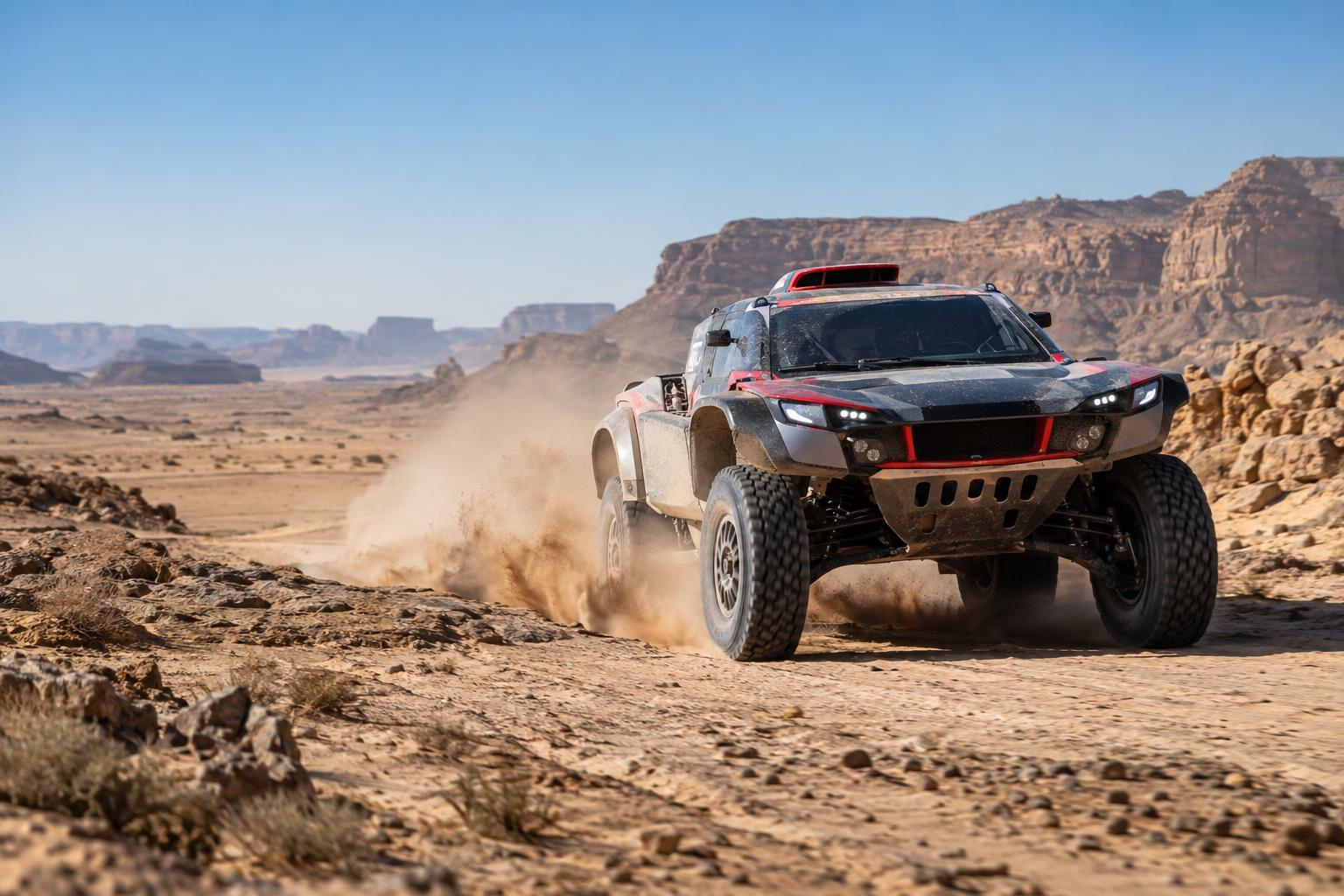
ASO has denied reports that the 2027 Dakar Rally has been cancelled, despite renewed discussion around regional security risks and the separate cancellation of a World Rally Championship round in Jeddah. The event remains scheduled to take place in Saudi Arabia, subject to the usual sporting, logistical and security planning that surrounds a rally of this scale.
For competitors, teams and fans in the GCC, the important distinction is that concern or speculation does not equal an official cancellation. Dakar organisers have indicated that preparations for the 2027 edition are continuing, while any operational decisions will be communicated through official Dakar and FIA channels.
What ASO has said about the Dakar 2027 cancellation rumours
Amaury Sport Organisation, better known as ASO, has pushed back against claims that Dakar 2027 has been called off. The organiser has maintained that the rally remains on its calendar and that there has been no official decision to cancel the Saudi Arabian event.
This matters because Dakar is not a conventional single-venue race. It requires years of route planning, permissions, medical support, security coordination, bivouac logistics and team transport. A genuine cancellation would be announced clearly by the organiser and reflected in official competitor communications.
- Dakar 2027 remains planned for Saudi Arabia.
- ASO has denied that a cancellation has been confirmed.
- Teams should rely on official Dakar, ASO and FIA notices rather than social-media claims.
- Security and route planning can still evolve before the start of the event.
Is the Dakar Rally 2027 actually cancelled?
No official cancellation of Dakar 2027 has been announced. At the time of the organisers' response, the rally was still expected to proceed in Saudi Arabia as planned.
That does not mean every detail is fixed years in advance. Dakar routes, stage distances, start locations and operational procedures are often refined as the event approaches. A route change or revised timetable would not automatically mean that the rally itself has been cancelled.
Why did cancellation rumours start now?
The rumours appear to have gained momentum because of wider concerns about security in the region, combined with news involving another major motorsport event in Jeddah. In fast-moving news cycles, separate stories can be linked online even when they involve different organisers, different championships and different risk assessments.
Dakar also attracts more attention than most off-road events because it crosses remote areas and involves thousands of people, including competitors, mechanics, media crews, medical staff, support personnel and local organisers. Any perceived change in the regional situation can therefore lead to speculation about its viability.
Regional security concerns in Saudi Arabia
Security is a major planning factor for any international event in Saudi Arabia, especially one that operates across long distances and remote terrain. Dakar's footprint is much wider than a circuit race, with stages, liaison roads, bivouacs, refuelling areas and spectator zones requiring coordinated protection and emergency access.
Organisers typically work with national and local authorities on route access, security procedures, weather contingencies, medical evacuation plans and communications. These assessments are ongoing rather than one-off decisions made when the route is first announced.
For fans, the practical point is that official travel advice and event guidance should take priority over assumptions based on rumours. Anyone considering attending should wait for confirmed spectator information, accommodation guidance and access rules closer to the event.
The separate cancellation of the WRC Jeddah round
The cancellation of a World Rally Championship round in Jeddah is a separate matter from Dakar 2027. The WRC is governed by its own sporting structure, promoter arrangements, event contracts and safety process, while Dakar is organised by ASO under a different operational model.
It is understandable that fans may view one event's cancellation as a warning sign for another. However, it does not establish that Dakar has been cancelled or that the same decision-making applies. A city-based WRC event and a multi-region cross-country rally have very different locations, schedules, infrastructure requirements and contingency options.
Dakar 2027 key dates and route details
Full event dates and the final route are expected to be confirmed through Dakar's official channels as planning progresses. The published direction for the event points to another demanding Saudi Arabian edition, with a route designed to test navigation, endurance, vehicle reliability and team strategy.
Drivers and teams should expect the usual Dakar format: a pre-event technical and administrative process, a ceremonial start, timed special stages, liaison sections between competitive sections, rest-day operations and a final finish. The exact order of stages and bivouac locations can change before the rally begins.
An 8th consecutive edition in Saudi Arabia
Dakar 2027 is set to be the eighth consecutive Saudi Arabian edition of the rally. The Kingdom first hosted Dakar in 2020, giving the event a long-term home after its earlier eras in Africa and South America.
Saudi Arabia's scale and terrain have allowed organisers to create routes through dunes, rocky tracks, open desert, mountain regions and fast gravel roads. That variety is one reason the country has become central to modern cross-country rallying.
A record 5,320km of special stages
The proposed 2027 route is expected to include a record 5,320km of timed special stages. Special stages are the sections where competitors race against the clock, unlike liaison sections, where crews travel on public or controlled roads to reach the next competitive area.
That figure would underline the physical and mechanical challenge of the event. More competitive kilometres place greater pressure on tyre management, navigation, fuel planning, suspension durability, spare-parts strategy and the ability of crews to recover after difficult days.
- Cars and trucks need reliable cooling, filtration and suspension systems for heat, dust and rough terrain.
- Motorcycles and quads demand exceptional rider fitness, navigation discipline and careful tyre use.
- Teams must balance outright pace against the risk of damage or navigation errors.
- Support crews face a major logistical task moving equipment and maintaining vehicles across the country.
What this means for motorsport in the GCC
Dakar's continued presence in Saudi Arabia remains significant for motorsport across the GCC. It brings international teams, manufacturers, suppliers and media to the region, while also giving local drivers, co-drivers and mechanics a high-profile reference point for rally raid competition.
The rally has helped broaden interest beyond circuit racing and drag racing. Off-road enthusiasts in the UAE, Saudi Arabia, Qatar, Kuwait, Bahrain and Oman can see how professional rally-raid preparation differs from recreational desert driving, particularly in navigation, recovery planning, vehicle safety and mechanical durability.
For the wider automotive industry, the event also provides a demanding real-world showcase for four-wheel-drive systems, tyres, cooling packages, hybrid powertrains and durability engineering. Motorsport results do not directly prove that a road car will suit every buyer, but Dakar remains one of the toughest environments in which manufacturers can test components and technical ideas.
Key takeaways for fans and teams following Dakar 2027
The clearest message is to separate confirmed information from speculation. Dakar 2027 has not been officially cancelled, and ASO has rejected the rumours surrounding the event's status.
- Follow the official Dakar website, ASO announcements and FIA communications for confirmed updates.
- Do not treat a decision affecting another championship as confirmation of a Dakar cancellation.
- Expect security, travel and route details to be reviewed as the event gets closer.
- Watch for final dates, entry information, route announcements and spectator access guidance.
- For teams, maintain normal preparation while allowing for practical contingency planning around freight, travel and support operations.
Saudi Arabia has become an established Dakar host, and the planned 2027 edition is expected to continue that relationship with an especially long competitive route. Unless ASO issues a formal update, the rally should be regarded as proceeding.
People Also Ask
Where will the Dakar Rally 2027 be held?
Dakar 2027 is planned to be held in Saudi Arabia. It would be the eighth consecutive edition of the rally hosted by the Kingdom.
Has Dakar 2027 been cancelled?
No. ASO has denied cancellation rumours, and no official cancellation of the 2027 Dakar Rally has been announced.
Why is Dakar held in Saudi Arabia?
Saudi Arabia offers large areas of varied desert terrain, long-distance route possibilities and the infrastructure needed to host a major international rally raid. The country has hosted Dakar since 2020.
What are special stages in the Dakar Rally?
Special stages are the timed competitive sections of the rally. Competitors' stage times determine the standings, while liaison sections are non-competitive journeys between stages or bivouacs.
How long is the Dakar Rally?
Dakar usually runs for around two weeks, including administrative checks, racing days, a rest day and the finish. The proposed 2027 event is expected to include 5,320km of timed special stages.


