

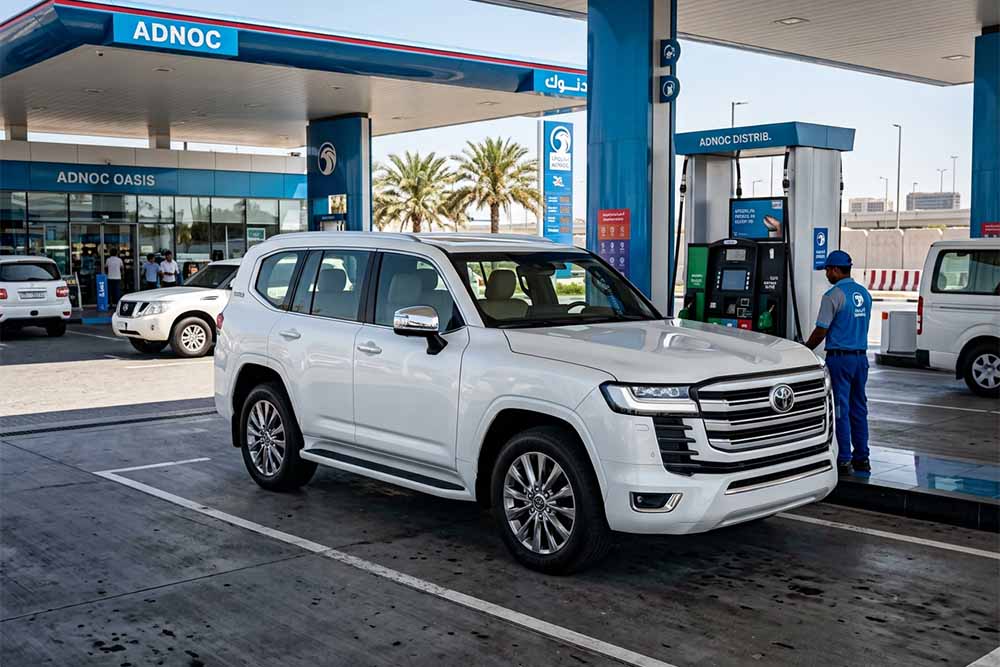
For decades, a large SUV has been one of the easiest vehicle choices to justify in the UAE. Toyota Land Cruisers, Nissan Patrols, GMC Yukons, Chevrolet Tahoes and Ford Expeditions suit large families, long motorway journeys, desert trips and the Gulf's preference for substantial, comfortable cars.
But the financial argument is becoming harder to ignore.
UAE petrol prices increased again for August 2026. Super 98 rose to AED 3.60 per litre, Special 95 to AED 3.49 and E-Plus 91 to AED 3.41. Each petrol grade increased by 20 fils per litre compared with July. Prices were even higher in June, when Super 98 reached AED 3.95 per litre.
So, are big SUVs in the UAE still worth owning? For families and drivers who genuinely use their space, towing ability, four-wheel drive or long-distance comfort, absolutely. For someone doing mostly solo commuting between home, office and mall, the financial case is much weaker than it used to be.
The answer increasingly depends on whether the owner is using the SUV's capabilities or simply paying for them.
The Case Against Big SUVs Is Getting Harder To Dismiss
The strongest argument against a large petrol SUV is straightforward: every increase at the pump affects it more heavily than a lighter and more efficient vehicle.
Full-size SUVs have to move more weight, push a larger body through the air and often power permanent or selectable four-wheel-drive systems. Add heavy UAE air-conditioning use and stop-start city traffic, and fuel consumption becomes difficult to ignore.
Fuel is no longer a background ownership cost
The UAE still offers a motoring environment where long-distance driving is common, but fuel prices are adjusted regularly rather than remaining fixed indefinitely.
August's increase illustrates the exposure. A hypothetical 100-litre fill using Special 95 costs AED 349 at August prices, compared with AED 329 in July.
That AED 20 difference on one tank may not concern every owner. Repeat it several times each month, however, and the yearly impact becomes more noticeable.
An illustrative calculation makes the difference easier to see. These are not official figures for any specific vehicle.
- A vehicle averaging 14 L/100 km over 20,000 km would consume about 2,800 litres annually.
- A more efficient family vehicle averaging 8 L/100 km would use about 1,600 litres.
- At AED 3.49 per litre, that hypothetical difference is around AED 4,188 a year.
Fuel prices will change, as will real-world consumption, but the principle remains. The more fuel a vehicle uses, the more exposed its owner becomes when prices rise.
City driving exposes the compromise
A seven or eight-seat SUV makes perfect sense when those seats regularly carry people. It becomes harder to defend when one driver uses a five-metre-long vehicle mainly for short journeys around Dubai or Abu Dhabi.
Large dimensions can also mean tighter parking, heavier urban fuel consumption and more expensive consumables.
For drivers considering a full-size SUV primarily for daily urban use, the questions should be practical:
- How often will the third row actually be occupied?
- Is four-wheel drive regularly needed?
- Will the vehicle travel beyond city roads?
- Could a midsize SUV, hybrid or MPV perform the same role?
If most answers point towards ordinary commuting, downsizing can reduce running costs without giving up much real usefulness.
Big tyres and heavy hardware matter too
Petrol is only one part of SUV ownership.
Larger wheels, heavier tyres, bigger brake components and complex suspension or four-wheel-drive systems can increase maintenance expenditure compared with simpler family cars.
That does not mean every large SUV is expensive or unreliable. It means buyers should calculate ownership costs beyond the monthly finance payment.
Why Big SUVs Still Make Serious Sense In The Gulf
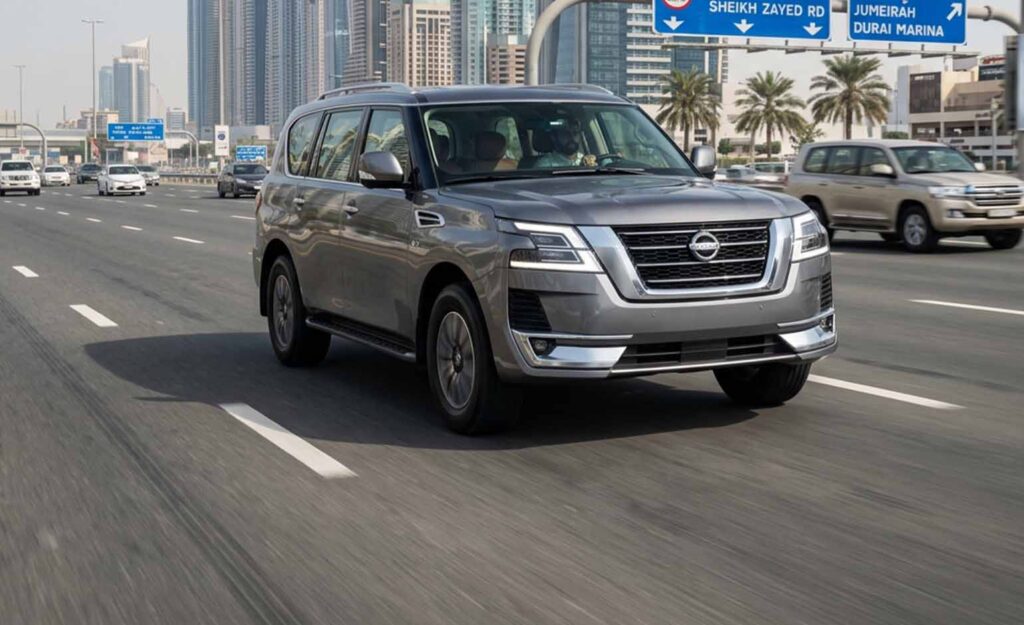
Reducing the debate to fuel consumption would miss why these vehicles remain so well suited to the UAE.
A proper full-size SUV can combine passenger capacity, luggage room, strong engines, high-speed motorway comfort and genuine off-road ability in one vehicle.
Current models demonstrate just how much capability remains available.
The 2026 Toyota Land Cruiser sold in the UAE can be specified with a 3.5-litre twin-turbo V6 producing 409 hp and 650 Nm. Nissan Dubai lists the latest Patrol with a 3.5-litre twin-turbo V6 producing 425 hp and 700 Nm in several grades, while Ford's UAE Expedition offers seating for up to eight.
These are not simply oversized city crossovers. Their capabilities can solve real Gulf ownership requirements.
A large SUV earns its additional running costs more convincingly when it is used for:
- Regular seven or eight-person family journeys.
- Long UAE or cross-GCC motorway trips with passengers and luggage.
- Desert driving, camping or travel to remote areas.
- Owners who need substantial towing or load-carrying capability.
- Households wanting one vehicle to cover several different roles.
For these buyers, replacing a full-size SUV with something much smaller may create compromises that matter more than the fuel saving.
Long-Distance Comfort Still Counts In The UAE
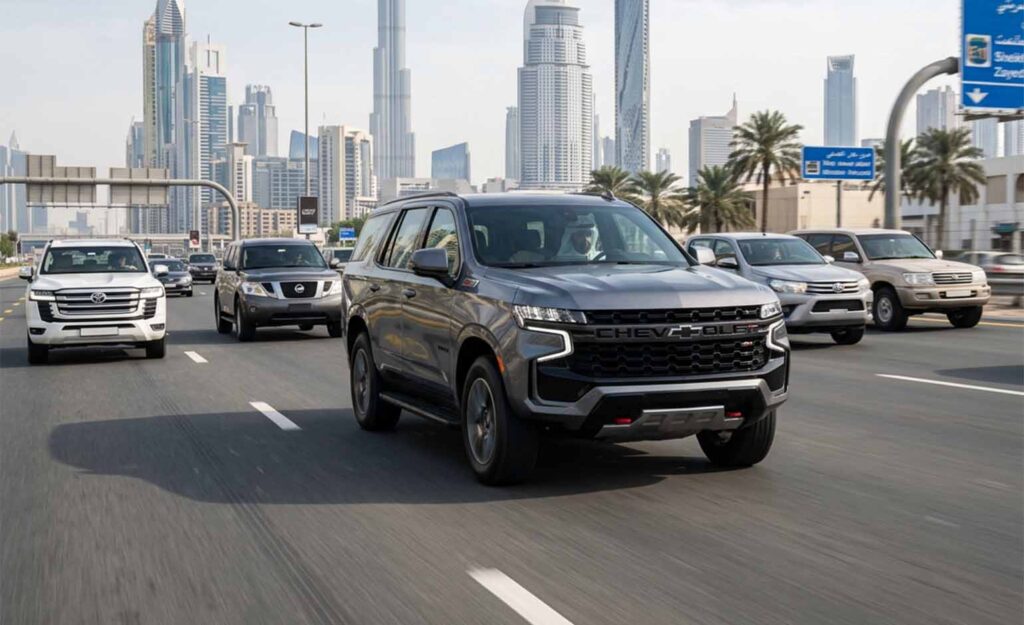
The geography of Gulf driving is particularly friendly to large vehicles.
Dubai to Abu Dhabi, Abu Dhabi to Al Ain, Dubai to Ras Al Khaimah or longer cross-border GCC journeys involve sustained motorway driving where cabin space, stable cruising and luggage capacity matter.
A large SUV carrying five people and their bags can feel significantly more suitable in this environment than a compact crossover loaded to capacity.
That is especially true for households where one vehicle must handle weekday commuting, school runs, airport trips and weekend travel.
The important distinction is utilisation.
A big SUV that regularly transports six people is doing a job. A big SUV transporting one person through city traffic most days is primarily a lifestyle choice.
Both are legitimate, but only one has a particularly strong economic defence.
Petrol Prices Are Also Changing The SUVs Themselves
The debate is no longer simply about choosing between a thirsty petrol SUV and a small economical car.
Manufacturers are electrifying larger vehicles too.
Toyota now sells a 2026 Land Cruiser Hybrid in the UAE. Its 3.5-litre twin-turbo V6 works with an electric motor, with Toyota quoting combined output of 457 hp and 790 Nm.
Its arrival is significant because it demonstrates that electrification has reached one of the Gulf's most established full-size 4x4 nameplates.
However, buyers should not assume that every vehicle carrying a hybrid badge will deliver small-car running costs. The Land Cruiser Hybrid remains a large, powerful four-wheel drive, and Toyota's UAE positioning emphasises performance as well as electrification.
The alternatives to a conventional petrol SUV are nevertheless expanding:
- Hybrid SUVs can reduce dependence on the engine in some driving conditions.
- Midsize three-row SUVs may provide enough seats with less mass.
- MPVs can offer more passenger space for families that do not require off-road ability.
- Electric SUVs remove petrol consumption but introduce charging and purchase-price considerations.
The old assumption that a large petrol 4x4 is automatically the default family vehicle is therefore facing much stronger competition.
What Makes This Debate Different In The UAE And GCC?
The Gulf cannot be judged using exactly the same ownership logic as Europe or other markets. Local climate, driving distances, infrastructure and buyer preferences materially change the calculation.
Several UAE-specific factors deserve attention before deciding whether to downsize.
- Heat and air-conditioning: UAE summers place heavy demands on climate control, making laboratory efficiency figures less useful than realistic local driving expectations.
- Dust and desert conditions: Drivers regularly travelling away from paved roads may genuinely benefit from ground clearance, four-wheel drive and tougher SUV hardware.
- Highway distances: Large cabins and luggage areas become more valuable when families cover hundreds of kilometres between cities.
- Fuel volatility: Monthly UAE petrol pricing means running costs can move significantly even when annual mileage stays unchanged.
- Family demand: Seven and eight-seat layouts remain useful for larger households and extended-family travel.
- Dealer support: Established Gulf-market SUVs often benefit from long-standing authorised service networks, an important factor for high-mileage ownership.
- Resale value: Demand for particular SUVs can support the used market, but resale should be judged by model, specification, age and condition rather than reputation alone.
- Insurance and warranty: Higher vehicle values and repair costs can influence insurance premiums, while warranty coverage varies considerably between manufacturers and models.
There is also no special shortcut around vehicle compliance simply because a vehicle is a traditional Gulf SUV. In Dubai, private vehicles must follow the RTA's applicable registration and technical inspection requirements, including the stated inspection exemption period for qualifying new vehicles.
EV charging makes the alternative stronger, but not universal
Electric vehicles are becoming more realistic in Dubai as charging infrastructure expands.
DEWA said in January 2026 that Dubai had more than 1,860 EV charging points across its network and licensed operators. That removes some of the infrastructure argument against switching away from petrol, particularly for drivers who can also charge at home.
Charging convenience still varies by household, however. A villa owner with private charging has a very different ownership experience from an apartment resident dependent on shared or public infrastructure.
That makes the petrol-versus-EV decision highly dependent on where and how the vehicle is used.
Resale Value Could Be The Big Unknown
One traditional defence of popular Gulf SUVs is that strong local demand can make them easier to sell than niche vehicles.
That remains relevant, but buyers should be careful about treating past resale performance as a guarantee.
Future used-car buyers will also consider fuel consumption, technology, warranty history and competing hybrid or electric models. If fuel prices remain elevated for a prolonged period, demand could gradually move towards more efficient vehicles.
At the same time, proven full-size SUVs with recognised dealer networks may continue attracting buyers precisely because their intended uses have not disappeared.
Resale therefore strengthens the argument for choosing the right big SUV, not necessarily for buying any big SUV.
Big SUV Versus Smaller Alternative: Who Should Choose Which?

The most sensible decision comes from matching the vehicle to the household rather than following the market's default choice.
A big SUV still makes sense if you:
- Regularly travel with five to eight occupants.
- Drive long motorway distances with substantial luggage.
- Frequently camp, tow or drive in desert conditions.
- Need one vehicle for commuting, family transport and recreation.
- Accept higher fuel and consumable costs in return for capability.
A smaller SUV or hybrid may suit you better if you:
- Spend most of your time commuting alone or with one passenger.
- Rarely use a third row.
- Drive high annual mileage primarily on paved roads.
- Want predictable running costs to matter more than maximum capability.
- Have no realistic need for heavy-duty four-wheel drive.
An EV becomes particularly interesting if you:
- Can charge reliably at home or work.
- Do predictable daily mileage.
- Primarily drive within urban areas.
- Want to reduce exposure to monthly petrol-price movements.
None of those categories is universal. A Dubai commuter and an Al Ain family that regularly heads into the desert can have completely different answers to the same question.
The Balanced Verdict: Capability Has To Justify Consumption
Big SUVs are still worth owning in the UAE, but they are becoming harder to justify as a default purchase.
The strongest argument for keeping them remains unchanged. Few vehicles combine seven or eight-seat practicality, long-distance comfort, luggage capacity, towing potential and genuine desert capability as effectively.
But rising and fluctuating petrol prices make unused capability increasingly expensive.
If a household regularly fills every seat, drives across the Emirates or takes its vehicle off-road, paying more for fuel can be a reasonable exchange for what the SUV provides.
If the vehicle spends almost every journey carrying one person between Dubai traffic lights, a smaller SUV, hybrid or EV deserves serious consideration.
The UAE is unlikely to stop loving large SUVs soon. What may change is the assumption that everyone needs one.
The best big SUV is therefore not necessarily the one with the largest engine, the most imposing body or the strongest badge. It is the one whose capabilities an owner actually uses enough to justify the running costs.