Lucid $1.4 Billion Reset: Why Saudi Arabia’s EV Ambitions Now Face an Execution Test
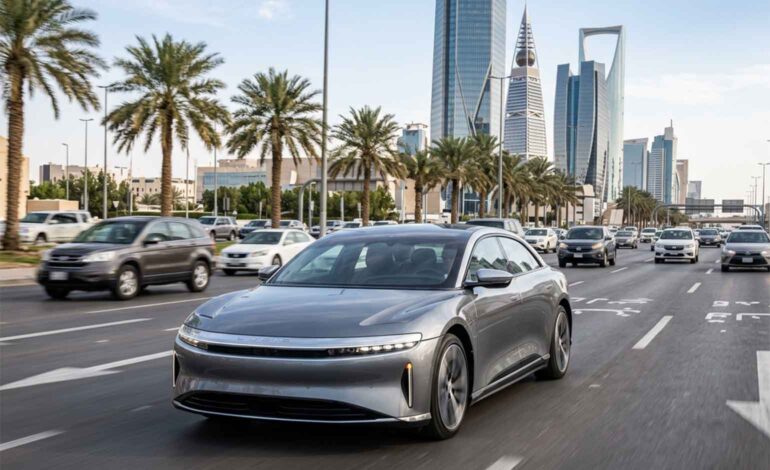
Lucid’s latest restructuring matters far beyond its California headquarters. The Lucid $1.4 billion reset is directly connected to Saudi Arabia because the Kingdom is not simply an investor in the electric car manufacturer. Saudi Arabia is home to Lucid’s AMP-2 factory, its controlling shareholder is an affiliate of the Public Investment Fund, and the government has a long-term agreement covering as many as 100,000 Lucid vehicles.
The encouraging part for Riyadh is that AMP-2 has survived Lucid’s cost review as one of the company’s priority projects. The more difficult question is whether Lucid can move from expensive expansion to sustained production, healthy demand and better cash discipline quickly enough for the Saudi factory to fulfil its intended role.
That distinction matters across the Gulf. Saudi Arabia wants a domestic automotive manufacturing industry, while neighbouring markets such as the UAE are steadily expanding EV sales and charging infrastructure. A functioning high-volume Lucid operation in King Abdullah Economic City could eventually give the region something it has historically lacked: a locally based premium EV manufacturer with meaningful global ambitions.
For now, however, the factory story is still about industrialisation rather than mass production.
What the Lucid $1.4 billion reset actually changes
Lucid announced its operational reset on 4 August 2026 after another quarter in which vehicle deliveries increased but the company continued consuming substantial amounts of cash. It produced 4,774 vehicles and delivered 3,953 during the second quarter, generating $405 million in revenue. Lucid ended the period with $3.0 billion in total liquidity, while its regulatory filing showed a quarterly net loss of approximately $1.03 billion.
Management says the programme has identified approximately $1.4 billion of potential cash-flow improvements during 2026. This is not a new investment package, nor is it a single $1.4 billion budget cut. It combines reductions in inventory, planned capital spending and operating expenses.
The planned improvements break down into three main areas:
- Inventory could provide roughly $600 million to $800 million of the improvement. Lucid has deliberately moderated production so that the number of cars being built is closer to expected deliveries. That matters because unsold vehicles absorb working capital even when they have already generated manufacturing and logistics costs.
- Capital expenditure is being reduced by approximately $500 million. Lucid still expects around $1.0 billion of capital expenditure during 2026, including spending on manufacturing capacity, products, technology, studios and service operations. The challenge is therefore not stopping investment, but deciding which programmes deserve scarce capital first.
- Operating expenses are targeted for approximately $200 million of savings. A June restructuring includes an approximately 18 per cent reduction in Lucid’s US workforce, while the company expects that plan alone to create about $158 million in annualised cost savings. Lucid also eliminated the second production shift at its AMP-1 factory in Arizona.
This makes the reset more significant than another round of redundancies. Lucid is changing how much it builds, how quickly it spends and which programmes receive priority.
And one of the projects management has explicitly protected is Saudi Arabia.
Saudi Arabia has far more riding on Lucid than its share price
Ayar Third Investment Company, an affiliate of Saudi Arabia’s PIF, is identified in Lucid’s latest filing as the company’s controlling shareholder. In April 2026, Ayar committed another $550 million through convertible preferred stock as part of a wider financing package that also included additional investment from Uber.
Saudi exposure to Lucid extends well beyond equity ownership. Three parts of the relationship are particularly important.
- AMP-2 is part of Saudi Arabia’s industrial policy. Lucid opened its initial Saudi assembly operation in King Abdullah Economic City in 2023, making it the Kingdom’s first automotive manufacturing facility. The site is now being developed into a much more substantial factory capable of complete vehicle manufacturing.
- Saudi Arabia is also a major customer. The current agreement allows the Saudi government and associated entities to purchase a minimum of 50,000 Lucid vehicles, with an option for up to another 50,000, during a ten-year period. That gives Lucid a potentially significant domestic demand base, although the company itself warns that materially lower purchases would affect its outlook.
- The project is tied to Saudi financing and incentives. Lucid has agreements covering support for AMP-2 construction, while the Saudi Industrial Development Fund has committed financing of up to SAR 5.19 billion, approximately $1.4 billion, subject to conditions. No amount was outstanding under that SIDF facility as of 30 June 2026.
That final figure is worth highlighting because it can easily be confused with Lucid’s new restructuring.
The $1.4 billion operational reset and the separate approximately $1.4 billion SIDF facility are not the same thing. One is Lucid’s company-wide cash-flow improvement programme for 2026. The other is Saudi financing established specifically around development and construction of AMP-2.
AMP-2 has become the most important Gulf test for Lucid
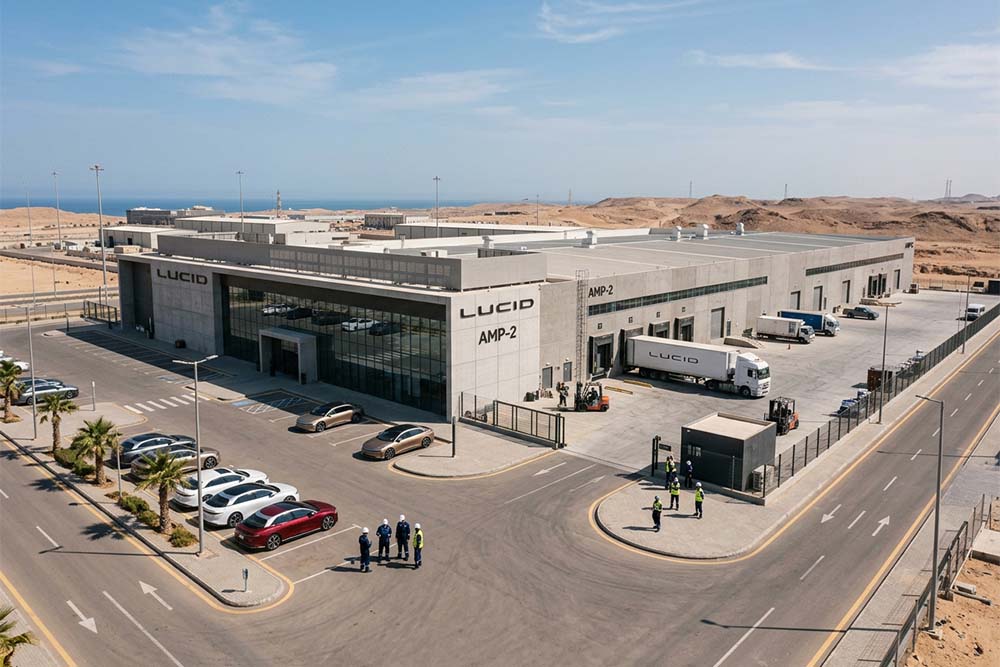
The Saudi factory is where Lucid’s corporate turnaround and Riyadh’s automotive strategy intersect.
The first stage of AMP-2 was based on semi knocked-down assembly. Vehicles were substantially produced in the US before being shipped to Saudi Arabia for final assembly. What comes next is much more ambitious.
Construction is giving way to industrialisation
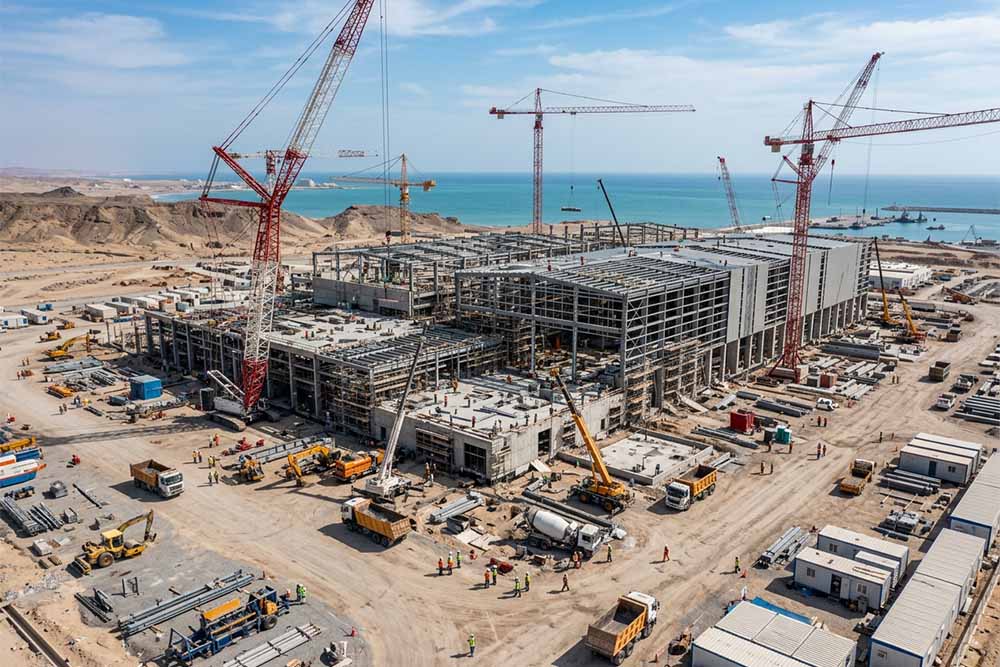
Lucid’s June 2026 filing described the complete-build portion of AMP-2 as substantially constructed, with remaining work focused on commissioning and fit-out. Its August update went further, saying manufacturing systems for stamping, body, paint and final assembly were being installed and commissioned ahead of production trials.
That is a meaningful transition. A factory that assembles imported kits contributes jobs and operating experience, but complete vehicle manufacturing requires a much deeper industrial base, more complex processes, greater supplier coordination and considerably tighter quality control.
Lucid currently expects complete vehicle production in Saudi Arabia to begin in 2027.
The 150,000-car figure is capacity, not a production forecast
Lucid has previously said AMP-2 is designed to scale towards approximately 150,000 EVs per year once its complete-build operation is developed. Its April 2026 Saudi update again referenced a designed capacity of roughly 150,000 vehicles annually.
That number should not be interpreted as a near-term production target.
Lucid is currently producing vehicles globally at a fraction of AMP-2’s theoretical future capacity. Filling a plant of that size would require higher-volume products, stronger worldwide demand and probably an export role extending well beyond Saudi Arabia.
This is why the next Lucid platform could matter even more to Saudi Arabia than the Air luxury saloon.
Lucid’s midsize EV is now central to the factory equation
Lucid says it expects to ramp production of its midsize platform during the second half of 2027. Prototype vehicles and Atlas drive units are still undergoing development, testing, regulatory work and manufacturing validation.
The company previously said vehicles based on the platform were planned with a starting price below $50,000, although that is a programme target rather than a confirmed Saudi or UAE retail price. No GCC pricing for those future vehicles should be assumed at this stage.
For Saudi Arabia, a midsize Lucid is strategically useful because an expensive flagship such as the Air can help build brand credibility, but a significantly more accessible vehicle has a better chance of generating the volumes needed to support manufacturing, suppliers and exports.
The risk is timing. Every delay pushes out the point at which AMP-2 can begin demonstrating whether Saudi automotive manufacturing can operate competitively at meaningful scale.
Saudi Arabia’s EV plan is bigger than Lucid alone
Lucid is important, but Saudi Arabia has deliberately avoided building its entire automotive strategy around a single manufacturer.
The wider King Salman Automotive Cluster in KAEC includes Saudi EV brand Ceer and Lucid, while PIF-backed projects also involve Hyundai and Pirelli. PIF has separately established Tasaru Mobility Investments to develop automotive supply chains and mobility businesses.
Saudi officials have previously stated a target of manufacturing more than 300,000 vehicles annually by 2030. Riyadh has also set an ambition for EVs to represent around 30 per cent of vehicles in the capital by 2030.
Lucid therefore represents one important piece of a broader industrial system.
That means a successful turnaround could strengthen confidence in Saudi Arabia as a manufacturing location. A serious deterioration at Lucid would be a setback, particularly because AMP-2 was the Kingdom’s first car plant, but it would not automatically end Saudi Arabia’s wider automotive programme.
Charging infrastructure has to develop alongside manufacturing
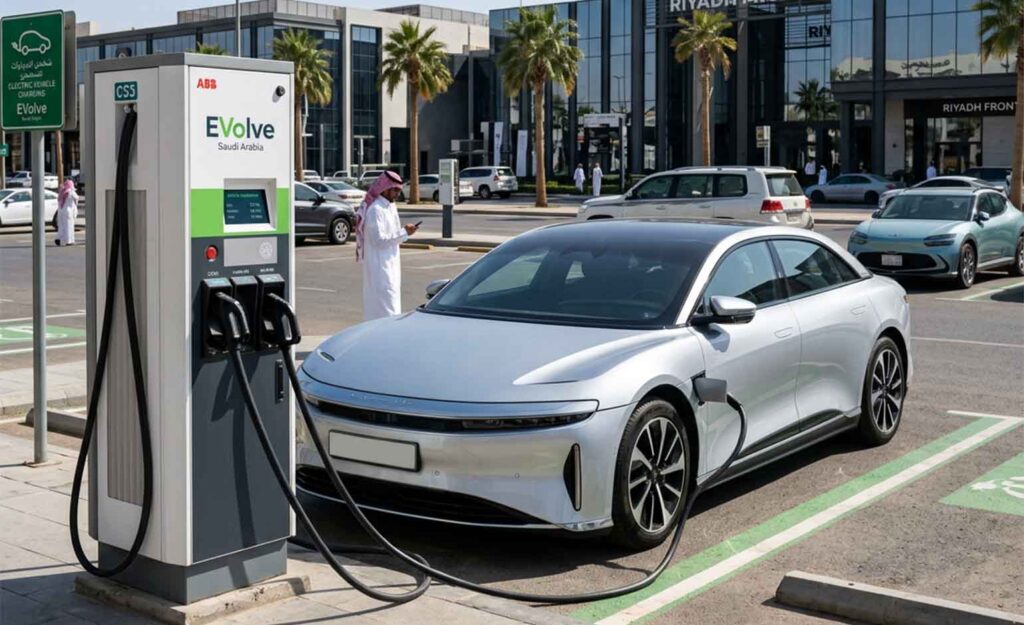
Building EVs locally solves only one part of the adoption problem. Saudi buyers also need dependable charging at home, in cities and along the long highway corridors connecting Riyadh, Jeddah, Dammam and other major centres.
EVIQ, the charging infrastructure company backed by PIF and Saudi Electricity Company, has stated plans for more than 5,000 chargers across 1,000 strategic locations around Saudi Arabia by 2030. Its expansion includes urban and highway charging sites.
For Lucid and other EV manufacturers, three areas will matter as that network develops:
- Long-distance GCC driving needs reliable fast charging, not simply more charging pins on a map. Saudi Arabia’s distances make dependable intercity locations particularly important for drivers travelling between major urban areas. Network reliability and convenient highway placement will have a direct effect on whether an EV can replace a petrol vehicle for regular cross-country use.
- Home charging remains especially relevant for premium EV owners. Drivers in villas in Riyadh, Dubai or Abu Dhabi may be able to start most journeys with a full battery, reducing reliance on public infrastructure. Apartment residents and drivers without dedicated parking face a different ownership calculation, making public and workplace infrastructure considerably more important.
- Heat changes what Gulf buyers expect from an EV. Air conditioning demand, battery thermal management and repeated high-speed motorway use place different stresses on a vehicle than mild-weather commuting. Regional ownership confidence will depend on cars, charging systems and service networks continuing to perform through peak Gulf summers.
Producing an EV in Saudi Arabia does not automatically resolve these issues, but local manufacturing could give Lucid stronger incentives to engineer its ownership operation around regional conditions.
Customer service may be as important as factory capacity
One of the less spectacular parts of Lucid’s reset could prove particularly relevant in the Gulf.
The company says its new customer and quality programme will focus on product readiness, delivery experience, parts availability and service responsiveness, with an objective of reducing service wait times by one third during 2026.
That matters for a premium manufacturer. Range figures and acceleration attract buyers, but a luxury EV that spends too long waiting for parts can quickly damage brand loyalty and resale confidence.
Lucid reported 62 studios and service centres globally as of 30 June 2026. Only four were in Saudi Arabia and one was in the UAE.
For buyers in Dubai, Abu Dhabi and the rest of the Gulf, expansion of the Saudi manufacturing operation could eventually improve regional parts availability and logistics. That is an expectation rather than a confirmed outcome. Lucid has not announced that AMP-2 will automatically transform UAE delivery or parts lead times.
The same caution applies to exports. AMP-2 has obvious geographic potential to serve GCC markets, but the scale, timing and model mix of future Saudi-built exports have not yet been confirmed in sufficient detail to treat them as guaranteed.
Three signals will show whether the Saudi strategy is working
The next stage should be judged less by factory renderings and more by measurable industrial progress. Three indicators are particularly worth watching through 2027.
- AMP-2 needs to move from installation to repeatable complete-vehicle production. Production trials, commissioning and the start of complete vehicle manufacturing will show whether Lucid can turn the physical factory into a functioning automotive operation. Utilisation will matter more than headline theoretical capacity once production begins.
- The midsize programme needs to arrive with quality and enough demand to raise volumes. Lucid has made the platform one of its protected growth programmes despite the wider cost cuts. If the vehicle launches successfully in the second half of 2027 and gains consumer or fleet demand, Saudi manufacturing has a stronger route towards meaningful scale.
- Saudi localisation needs to extend beyond final assembly. The larger economic prize for the Kingdom comes from suppliers, skilled employment, training, logistics and component manufacturing rather than simply attaching a Saudi-made label to imported content. Lucid’s role inside the wider KAEC automotive cluster means its progress can help determine whether supporting businesses see enough future volume to invest locally.
These measures are more useful than focusing exclusively on Lucid’s quarterly share-price movements. Saudi Arabia is trying to establish an industry, not merely hold an EV stock.
What the reset could mean for UAE and wider GCC buyers
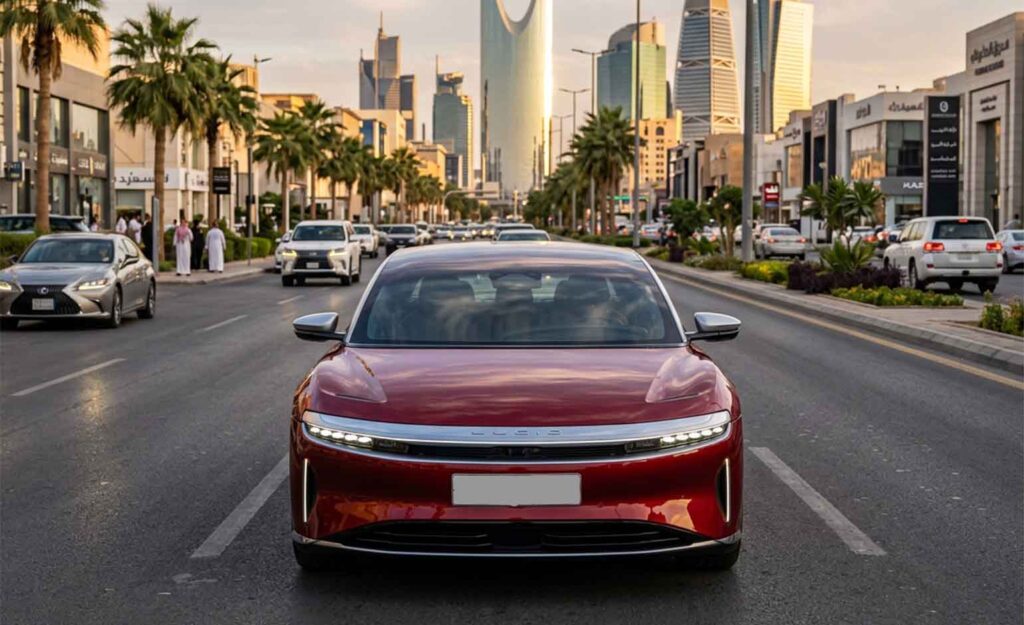
The immediate effects for UAE motorists are limited. Lucid’s $1.4 billion programme does not change UAE vehicle prices, warranties or model specifications by itself, and no such changes should be inferred from the restructuring.
The longer-term effects could be more interesting.
Saudi Arabia sits next to some of the Gulf’s strongest premium-car markets. Dubai and Abu Dhabi have established luxury-car customer bases, while Saudi Arabia itself is large enough to support substantial premium and family-SUV demand. Lucid’s Gravity is therefore arguably better aligned with regional buying habits than a large luxury saloon alone.
A properly utilised Saudi factory could also give Lucid a regional manufacturing base closer to GCC customers than Arizona. In theory, shorter regional supply chains could assist vehicle allocation, parts distribution and service support.
But those benefits depend on scale. Running a technically advanced plant far below capacity can leave unit costs high, while rapidly increasing production before quality systems are mature creates a different set of problems.
Lucid’s decision to prioritise cash discipline and quality therefore makes sense for Gulf customers even if it results in slower expansion. A smaller number of properly built cars with better parts and service support would ultimately do more for the brand than chasing production figures that demand cannot absorb.
Saudi Arabia now needs Lucid’s factory story to catch up with its investment story
Saudi Arabia has already supplied many of the ingredients Lucid needs: a controlling strategic investor, a major government vehicle agreement, factory support, access to development financing, an emerging automotive cluster and a national charging programme.
What it cannot provide indefinitely is commercial proof on Lucid’s behalf.
The Lucid $1.4 billion reset matters because it is an attempt to make the company financially and operationally disciplined enough to reach the next phase. Crucially for the Kingdom, Lucid has not placed AMP-2 on the list of projects to abandon. It has placed the Saudi factory among the programmes that management says must succeed.
That is positive for Saudi Arabia’s EV ambitions, but it also raises the standard by which AMP-2 will now be judged.
The plant has to move beyond being a symbol of industrial diversification. It needs complete vehicle production, dependable quality, higher-volume models, local skills, stronger supplier activity and eventually enough demand to justify its substantial capacity.
If Lucid delivers those pieces, Saudi Arabia gains much more than a premium EV factory. It gains evidence that its emerging automotive ecosystem can attract technology, manufacture complex vehicles and potentially supply markets across the Gulf and beyond.
If Lucid continues consuming capital without converting AMP-2 into a competitive production base, Riyadh’s wider automotive strategy will survive, but one of its earliest and most visible EV investments will have provided a far more expensive lesson.