How the Nissan Patrol Went From GCC Desert Workhorse to Luxury SUV Icon
The Nissan Patrol became a GCC luxury SUV icon by first earning something more valuable than prestige: trust.
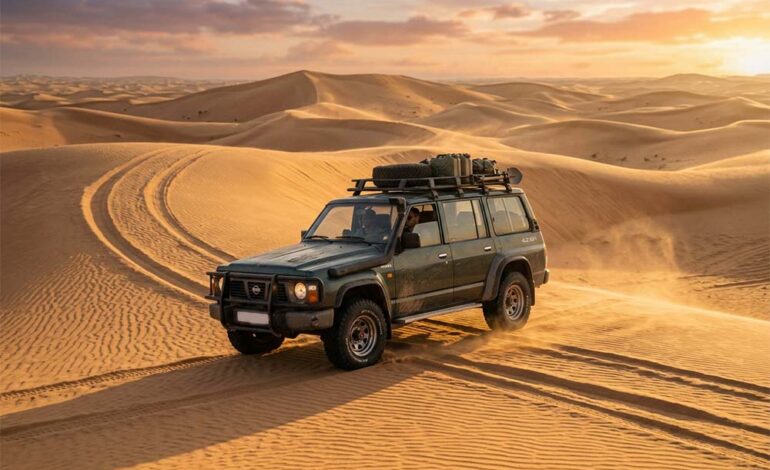
Long before the Patrol was fitted with twin digital displays, premium audio systems and adaptive air suspension, it was used across the UAE, Saudi Arabia, Oman, Kuwait, Qatar and Bahrain as dependable transport through sand, heat and remote terrain. Early generations built their reputation as tough four-wheel drives that could carry families, workers and equipment far beyond paved roads.
Over more than seven decades, that practical desert credibility became the foundation for a very different kind of vehicle. The modern Patrol is now a large, technologically advanced flagship used for family journeys, urban commuting, luxury transport and high-speed GCC highway driving. Yet its continued popularity still depends on the rugged identity created by the older models.
The Patrol did not become luxurious by distancing itself from its workhorse past. It became a luxury icon because Gulf buyers believed that the capability underneath the polished exterior was genuine.
The Nissan Patrol’s GCC story started with necessity
The first Nissan Patrol appeared in 1951. Its early purpose was straightforward: provide durable four-wheel-drive transport capable of handling difficult terrain and limited road infrastructure.
That formula was particularly relevant in the Gulf during the second half of the twentieth century. Road networks were expanding, but travel outside major settlements could still involve loose sand, gravel tracks and long distances in high temperatures.
Earlier Patrols were basic by modern standards. Their cabins were functional, equipment levels were modest and refinement was secondary to durability. For Gulf drivers, however, these characteristics were often strengths rather than shortcomings.
The Patrol earned its place through qualities that mattered in everyday regional use:
- Its four-wheel-drive system served a genuine purpose. The Patrol was used in deserts, farms, mountain areas and developing communities where road conditions could change quickly. Owners valued a vehicle that could keep moving when an ordinary passenger car could not.
- Mechanical simplicity made remote ownership more practical. Earlier generations had fewer electronic systems and could often be understood by local mechanics without highly specialised diagnostic equipment. This mattered when workshops and replacement vehicles were not always nearby.
- The upright body provided useful passenger and cargo space. Patrols could transport large families, work crews, camping equipment or supplies. One vehicle could handle several roles without becoming too delicate for demanding use.
These early experiences established the Patrol as more than another imported 4×4. It became part of daily Gulf life.
Desert credibility was built one journey at a time
Automotive reputations in the GCC are often shaped by ownership experience rather than launch campaigns.
Drivers notice which vehicles cope with repeated summer use, which engines tolerate long highway journeys and which four-wheel drives remain manageable once they have covered high mileages. That knowledge is shared through families, workshops, desert groups and used-car buyers.
The Patrol benefited from decades of this accumulated experience. As more examples entered the region, the supporting ownership network became stronger. Mechanics understood common repairs, parts suppliers carried frequently needed components and drivers became familiar with how the vehicle behaved in sand.
This created a powerful cycle:
- A large vehicle population improved workshop knowledge. Independent technicians and authorised Nissan centres gained experience with the Patrol’s engines, gearboxes, suspension and four-wheel-drive systems. Buyers therefore had more places to seek maintenance than owners of low-volume imported SUVs.
- Parts supply became commercially worthwhile. Popular service items and replacement components were supported by strong regional demand. Availability still depends on the model, age and specification, but the Patrol’s scale gave it an advantage over more obscure rivals.
- Used Patrols remained useful long after newer models arrived. Older vehicles continued to attract desert drivers and buyers seeking straightforward four-wheel-drive transport. This helped the Patrol name remain visible across multiple generations at the same time.
The resulting loyalty was not based on the idea that every Patrol was indestructible. It came from familiarity, repairability and a belief that the vehicle had been tested in the same conditions its owners faced.
The Y60 brought comfort without losing the Patrol character
The Y60 Patrol, introduced internationally in the late 1980s, marked an important stage in the model’s evolution.
Coil-spring suspension improved ride comfort and wheel control, while the overall design remained recognisably rugged. It was still a traditional four-wheel drive, but it became more suitable for family use and longer journeys.
That balance was critical. Gulf buyers increasingly wanted vehicles that could operate in the desert without feeling crude on the road. The Y60 showed that the Patrol could become more civilised without weakening the identity that had built its reputation.
It also helped establish a pattern that later generations would follow. Each new Patrol would add refinement, power and equipment while retaining enough genuine off-road ability to remain credible in the GCC.
The Y61 became the Patrol Gulf enthusiasts refused to forget
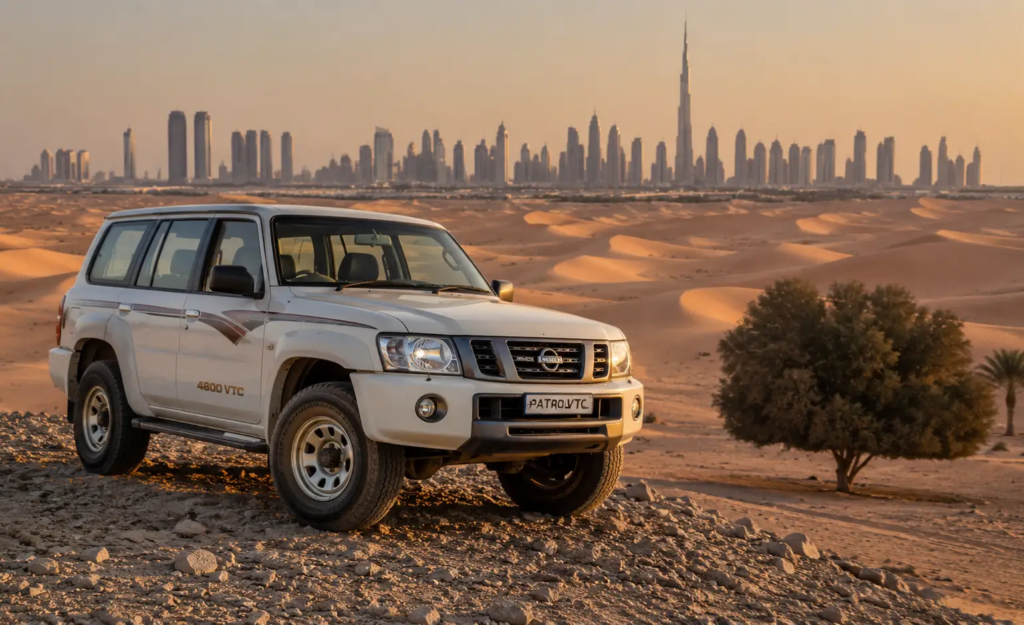
The Y61 generation, launched in the late 1990s, became one of the most recognisable Patrols ever sold in the Middle East.
Its combination of a strong chassis, substantial body, traditional four-wheel-drive hardware and large petrol engines suited regional tastes. The 4.8-litre petrol versions developed an especially loyal following among drivers who valued naturally aspirated power, predictable throttle response and extensive modification potential.
For many Gulf enthusiasts, the Y61 represented the ideal middle ground. It was more comfortable and spacious than the earlier workhorse models but still felt mechanical, direct and purpose-built.
Why the Patrol Super Safari remained in demand
When Nissan introduced newer and more luxurious Patrol generations, demand for the Y61 did not disappear.
In 2017, Nissan revived the Patrol Super Safari specifically for the Middle East, describing it as a response to strong regional customer demand. The company later returned the three-door Hard Top version and expanded the Safari range with Falcon, Gazelle and Gazelle X editions developed exclusively for Middle Eastern buyers.
Nissan reported that Patrol Safari sales increased by 30 per cent year on year during the first half of its 2018 Middle East financial year. It also said Safari sales had risen by 152 per cent between fiscal years 2012 and 2017, demonstrating that demand for the older platform remained commercially significant.
The Super Safari survived because it represented qualities that were becoming harder to find:
- Its character remained relatively analogue. Drivers appreciated the straightforward relationship between engine response, steering and terrain. Electronic aids were present, but they did not dominate the experience in the same way as on newer flagship SUVs.
- The platform was well understood by desert enthusiasts. Suspension upgrades, off-road tyres, recovery equipment and cooling improvements were widely available. Modifications still required professional installation, but owners were working with a platform that had years of regional knowledge behind it.
- Its appearance carried cultural meaning. The high stance, side graphics and rear-mounted spare wheel became familiar throughout the Gulf. For many younger enthusiasts, the Super Safari was connected with family journeys and desert trips from childhood.
By remaining available alongside newer Patrols, the Y61 demonstrated that the market wanted both heritage and modern luxury.
The Y62 transformed the Patrol into a true flagship
The Y62 generation, introduced in 2010, represented the Patrol’s most decisive move away from traditional utility-vehicle compromises.
It adopted independent suspension, more sophisticated electronics and a far more refined cabin. Nissan positioned the new Patrol as its flagship large SUV, combining off-road ability with the comfort and equipment expected from a premium vehicle.
The Y62 also became closely associated with V8 power. Higher-specification models used a 5.6-litre petrol V8, giving the Patrol the effortless acceleration and imposing character that many full-size SUV buyers wanted.
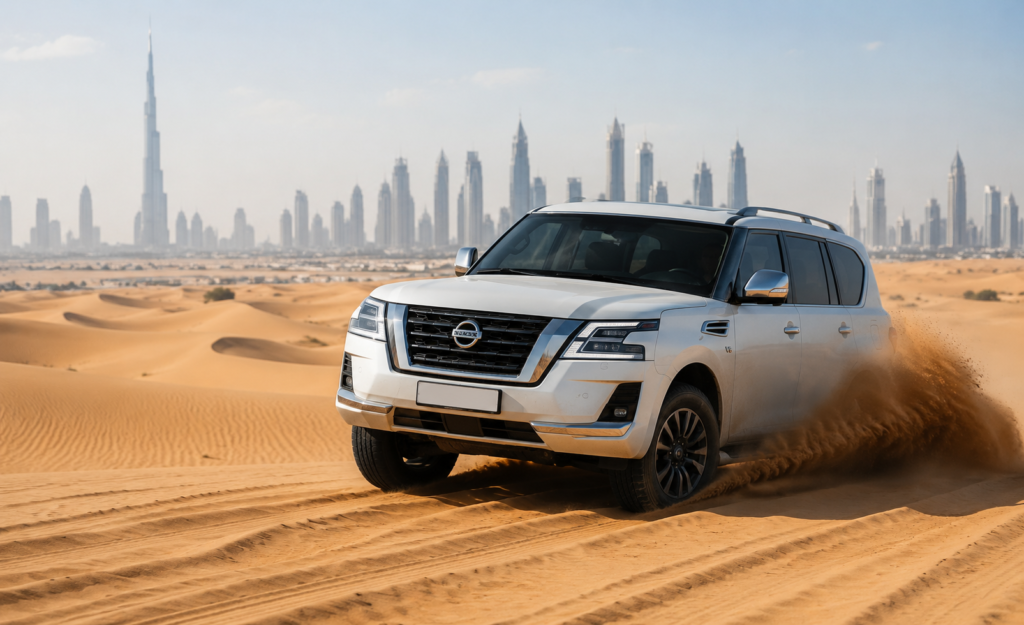
The change was about more than the engine. The Y62 was quieter, smoother and better suited to urban life. It could spend the working week carrying a family through Dubai or Abu Dhabi, cover a long motorway journey to another emirate and still be taken into the dunes at the weekend.
Its appeal widened because it solved several GCC ownership needs at once:
- Families gained a spacious three-row SUV. The Patrol could carry passengers and luggage while providing the air-conditioning performance, seating comfort and road presence expected from a flagship. Its size remained a challenge in tighter car parks, but that did little to reduce demand for large SUVs in the region.
- Highway users gained stronger long-distance refinement. The Y62 was better suited to sustained travel between cities such as Dubai and Abu Dhabi, Riyadh and Dammam, or Muscat and Salalah. A quieter cabin and more controlled ride made it easier to use as everyday transport.
- Luxury buyers gained an SUV with regional credibility. The Patrol could compete for attention with the Toyota Land Cruiser, Lexus LX and European luxury SUVs while carrying a name already respected across the Gulf. Its prestige therefore came from both equipment and heritage.
V8 power changed how the Patrol was perceived
The V8-powered Y62 helped move the Patrol from respected family 4×4 to visible status symbol.
Its large grille, broad body and substantial proportions gave it strong road presence. Higher trims added leather upholstery, advanced climate control, entertainment technology and increasingly sophisticated safety systems.
As a result, the Patrol became as common outside premium hotels, villas and business districts as it was near desert camps. In Dubai, Abu Dhabi, Riyadh, Doha and Kuwait City, it became part of the established luxury-SUV landscape.
This shift could easily have damaged the Patrol’s original identity. Instead, the model’s desert history strengthened its premium image. Buyers were not simply purchasing a large, expensive SUV. They were buying a vehicle whose reputation had already been tested across generations.
Middle East-specific Patrols proved the GCC could shape the product
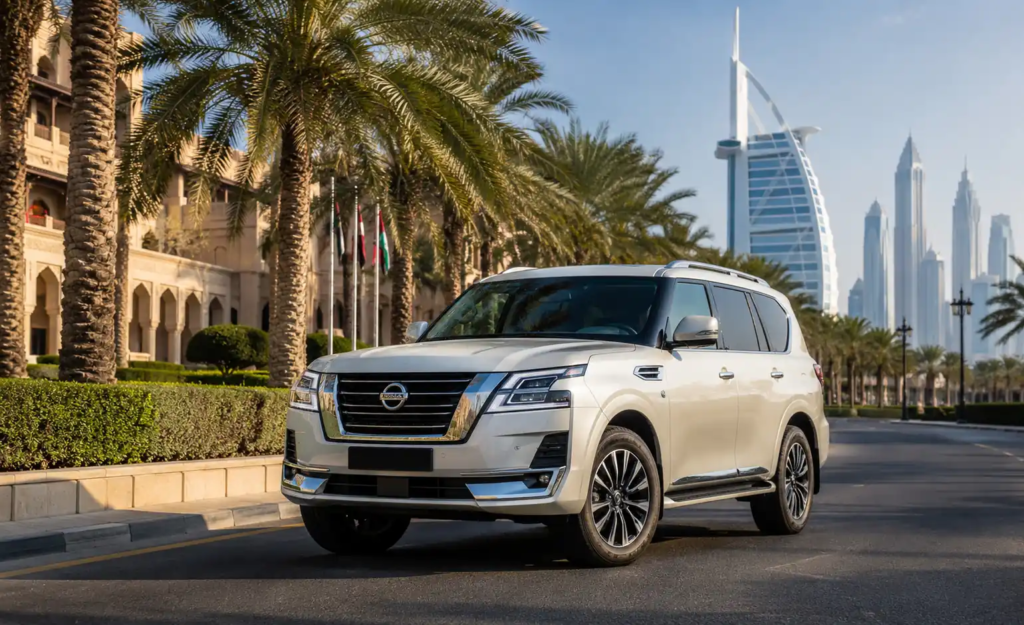
The Patrol’s importance to Nissan in the region became particularly clear through models developed specifically for Middle Eastern customers.
The first Patrol NISMO arrived in 2015 as a performance-oriented version created for the region. Nissan described it as the first race-inspired Patrol built specifically for the Middle East, reflecting local demand for large SUVs with stronger performance and a more distinctive road presence.
The Safari Falcon, Gazelle and Gazelle X editions followed a similar regional strategy. Rather than offering generic global packages, Nissan used names, styling and equipment connected to Gulf desert culture.
This regional influence has appeared in several forms:
- Traditional off-road buyers retained the Safari. Nissan did not assume every Patrol customer wanted the newest luxury platform. Keeping the Y61 alive allowed the company to serve buyers who valued familiarity and ruggedness over the latest cabin technology.
- Performance-focused owners gained NISMO models. These versions added more aggressive styling and road-oriented tuning while preserving the scale and identity of the Patrol. They did not replace dedicated off-road builds, but they widened the flagship’s appeal.
- The Middle East became central to major Patrol launches. Nissan selected Abu Dhabi for the global unveiling of the seventh-generation Patrol in September 2024. That choice reflected the region’s importance to the nameplate rather than treating the GCC as a secondary market.
The seventh-generation Patrol pushed deeper into luxury
Nissan unveiled the seventh-generation Patrol in Abu Dhabi on 4 September 2024.
The new model replaced the familiar V8 with a 3.5-litre twin-turbocharged V6 producing 425 hp and 700 Nm. A naturally aspirated 3.8-litre V6 was also announced for the region, while a nine-speed automatic transmission replaced the previous seven-speed unit.
Depending on specification, the new Patrol introduced adaptive air suspension, six drive modes, twin digital displays, Google built-in services, a Klipsch premium sound system and advanced driver-assistance technology.
These features placed it firmly in the modern luxury-SUV category, but Nissan retained drive settings for sand, rock and mud or rut conditions. That combination was necessary because Patrol buyers still expect off-road ability to be more than a styling claim.
The switch from V8 to twin-turbo V6
Replacing the V8 was one of the most significant changes in the Patrol’s recent history.
The twin-turbo V6 produces greater torque than the previous naturally aspirated engine and reflects wider automotive pressure to improve efficiency while maintaining performance. However, the emotional appeal and long-term familiarity of the V8 remain important to many GCC owners.
The new engine’s durability will be judged through years of regional use. Cooling performance, turbocharger life, maintenance quality and parts support will matter as vehicles accumulate higher mileages in Gulf heat.
The V6 cannot yet possess the ownership record of an engine used across the region for many years. That does not make it unreliable, but it means long-term confidence must be earned rather than assumed.
Patrol NISMO raised the performance ceiling again
Nissan revealed the latest Patrol NISMO in June 2025, producing 495 hp and making it the most powerful production Patrol announced by the company at that point.
The model was developed using Middle Eastern customer insights and tested for regional driving conditions. Nissan confirmed availability across the Middle East from July 2025.
Its existence shows how far the Patrol has travelled from its workhorse origins. It is now expected to serve off-road drivers, families, luxury buyers and performance enthusiasts within the same broad model range.
The Patrol’s status is stronger in the GCC than almost anywhere else
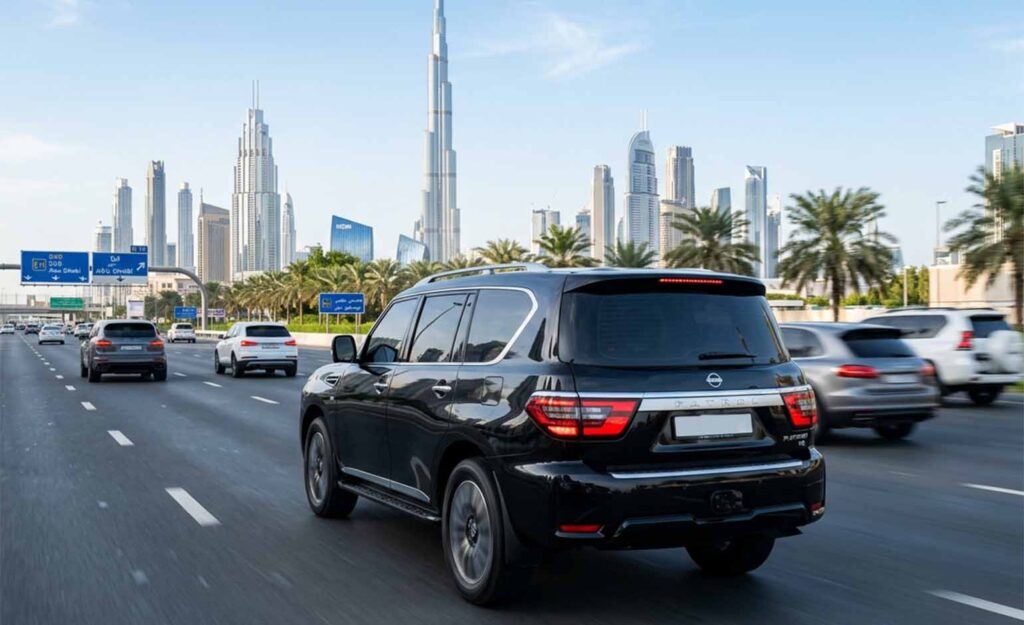
The Patrol is available in other markets, with related versions sold under names such as the Nissan Armada. Its cultural position in the Gulf, however, is different.
Here, the Patrol can be a desert vehicle, a family car, a government fleet SUV, a modified performance machine or a premium chauffeur-driven flagship. Few models can move between those identities without appearing out of place.
Nissan has reinforced this connection through regional events and demonstrations. In 2013, a Patrol towed a 170-tonne Ilyushin-76 cargo aircraft for more than 50 metres at Sharjah International Airport. In 2015, another Patrol set a record for climbing a 100-metre sand dune in 4.9 seconds.
These were promotional exercises, but they worked because they matched an existing public perception of the Patrol as a powerful and capable vehicle.
Its cultural position is supported by three deeper factors:
- Several generations have grown up around the Patrol. Many GCC residents associate it with family trips, desert camps and long-distance journeys. That personal connection gives older models emotional value beyond their market price.
- The Patrol has a recognisable regional identity. A Y61 Super Safari or Y62 can be identified immediately by people who may not follow automotive news closely. Familiarity strengthens both its prestige and its used-car appeal.
- The name crosses different buyer groups. It is owned by enthusiasts, families, companies and public organisations. Each may use it differently, but the badge carries a broadly understood reputation.
Gulf heat and dust expose the realities behind the image
The Patrol’s reputation does not make ownership cheap or maintenance optional.
It remains a large, heavy petrol SUV with substantial tyres, complex four-wheel-drive components and high cooling demands. Urban traffic in Dubai, Abu Dhabi and Riyadh places constant pressure on air-conditioning and cooling systems, while sand and dust affect filters, radiators and moving components.
Owners and used-car buyers should pay particular attention to:
- Cooling-system health in extreme temperatures. Radiators, coolant, hoses, fans and air-conditioning components must be maintained correctly. Rising engine temperatures or weak cabin cooling should be investigated before a minor issue develops into a major repair.
- Tyre age, specification and pressure. The Patrol’s weight places significant loads on its tyres, particularly during high-speed motorway use. Tread depth alone is not enough, as heat and age can harden or crack the rubber.
- Evidence of heavy desert use. Off-road driving is part of the Patrol’s purpose, but repeated hard use can wear suspension, steering, drivetrain and underbody components. A professional inspection should distinguish a properly maintained desert vehicle from one that has been abused.
Fuel consumption also remains a major ownership consideration. The latest V6 may be more technically efficient than the outgoing V8, but it still powers a full-size SUV. Actual fuel use will depend heavily on traffic, speed, load, tyre choice and driving style.
Used Patrol buyers should inspect the vehicle, not buy the reputation
Strong resale demand can encourage buyers to assume that any Patrol is a safe purchase. That is a costly mistake.
Durability describes a model’s potential when maintained correctly. It does not protect a buyer from accident repairs, neglected servicing, flood exposure, overheating or poorly installed modifications.
Before buying a used example, buyers should verify:
- Service records and regional specification. A GCC-specification vehicle with documented maintenance is generally easier to assess than an imported example with an unclear history. The chassis number, service invoices and recall status should be checked where possible.
- The quality of modifications. Suspension lifts, oversized wheels, engine tuning and exhaust changes can affect reliability, insurance and roadworthiness. Modifications should be inspected by someone familiar with the relevant Patrol generation.
- Every major luxury feature. Cameras, powered seats, infotainment, climate controls, driver-assistance systems and suspension functions can be costly to repair. A long list of minor faults may indicate poor maintenance rather than harmless age.
The Patrol can retain strong buyer interest, particularly in desirable trims, but resale value depends on condition, mileage, engine, service history and market demand. No generation guarantees a profitable or trouble-free resale.
The Land Cruiser rivalry helped shape the Patrol
The Toyota Land Cruiser is inseparable from the Patrol’s GCC story.
Both vehicles built their reputations through durability, desert ability and family practicality. Both later moved towards more luxurious cabins and increasingly advanced technology.
Their rivalry gave buyers a meaningful choice between two deeply established Japanese full-size SUVs. It also pushed both manufacturers to improve powertrains, comfort, safety systems and regional product support.
Market perceptions vary by generation. Some buyers associate the Land Cruiser with conservative durability and particularly strong resale, while the Patrol is often viewed as more expressive, spacious or performance-focused. These impressions are not universal, and the condition of an individual used vehicle matters more than general brand loyalty.
What is clear is that the Patrol became one of the few models capable of challenging the Land Cruiser’s cultural importance across the GCC.
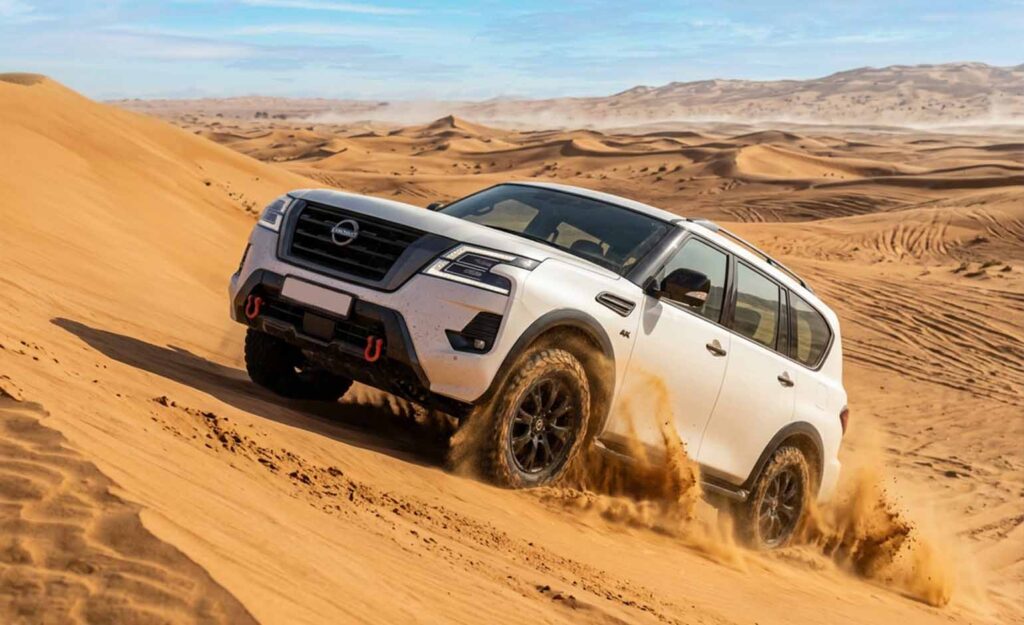
Luxury built on seven decades of desert trust
The Nissan Patrol’s transformation was not a simple move from basic to expensive.
Each generation added something that allowed the vehicle to reach a broader audience. Early Patrols established toughness. The Y60 improved everyday comfort. The Y61 and Super Safari strengthened the desert legend. The Y62 added V8 performance and true flagship refinement. The latest Patrol has introduced turbocharged power, adaptive suspension and a digitally focused interior.
Yet the reason Gulf buyers continue to accept the Patrol as a luxury SUV is that its premium identity rests on genuine regional history.
It is still expected to cross dunes, tolerate demanding summer conditions and cover long GCC highway journeys. At the same time, it must now provide the comfort, technology and road presence expected outside luxury hotels and business districts.
Few vehicles have managed that transition while keeping both sides of their character intact. The Patrol went from workhorse to luxury icon not by leaving the desert behind, but by carrying its desert reputation into a more sophisticated era.