Abu Dhabi Self-Driving Car Licence Plates Arrive as Autonomous Services Expand

Abu Dhabi has introduced its first dedicated licence plates for autonomous vehicles, creating a clear visual distinction between self-driving vehicles undergoing testing and those already approved for commercial operation. The new Abu Dhabi self-driving car licence plates were announced by the Integrated Transport Centre, Abu Dhabi Mobility, on 13 July 2026 under the supervision of the Smart and Autonomous Systems Council.
There are two categories. Autonomous vehicles providing commercial services receive blue plates marked “Auto Drive”, while vehicles operating as part of testing or pilot programmes use blue plates carrying the word “Test”. The system is intended to make autonomous vehicles immediately identifiable to regulators and other relevant authorities while connecting their registration more closely with Abu Dhabi’s technical and operational requirements.
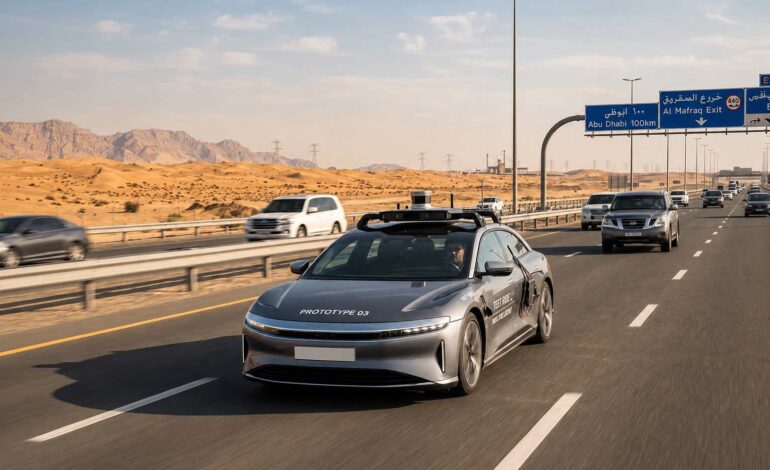
The change may appear relatively small compared with the technology fitted to a driverless taxi, but it comes at a significant stage in Abu Dhabi’s autonomous transport programme. Fully driverless Level 4 commercial vehicles are already operating in the emirate, robotaxi services are expanding, and a dedicated control room now monitors autonomous vehicle operations in real time.
Two blue plates separate autonomous testing from commercial operation
The dedicated number plates establish a straightforward distinction between vehicles that are still being evaluated and those authorised to provide commercial autonomous services.
Abu Dhabi Mobility says both plate types share a blue design, helping authorities recognise autonomous vehicles while they are operating on public roads. The plates are also tied to approved licensing and operational requirements for autonomous vehicle operators.
The system is divided as follows:
- “Auto Drive” identifies commercial autonomous vehicles. These plates are intended for vehicles delivering an approved commercial service using autonomous driving technology. That distinction matters as Abu Dhabi moves beyond closed trials towards robotaxis and other services carrying real customers.
- “Test” identifies vehicles still being evaluated. Autonomous cars participating in testing, pilot programmes or development work can therefore be distinguished from commercially deployed vehicles. The wording gives regulators an immediate visual indication of the vehicle’s operational category.
- Both versions use a recognisable blue design. According to Abu Dhabi Mobility, this is intended to make autonomous vehicles easier to identify on the road and support field monitoring and road safety. The plate itself does not describe the vehicle’s exact autonomous technology or operating limitations.
This distinction is particularly relevant because autonomous vehicles in Abu Dhabi can be at very different stages of deployment. One vehicle may be collecting data during a controlled trial, while another may already have approval to provide a Level 4 passenger service.
Abu Dhabi is already operating fully driverless Level 4 vehicles
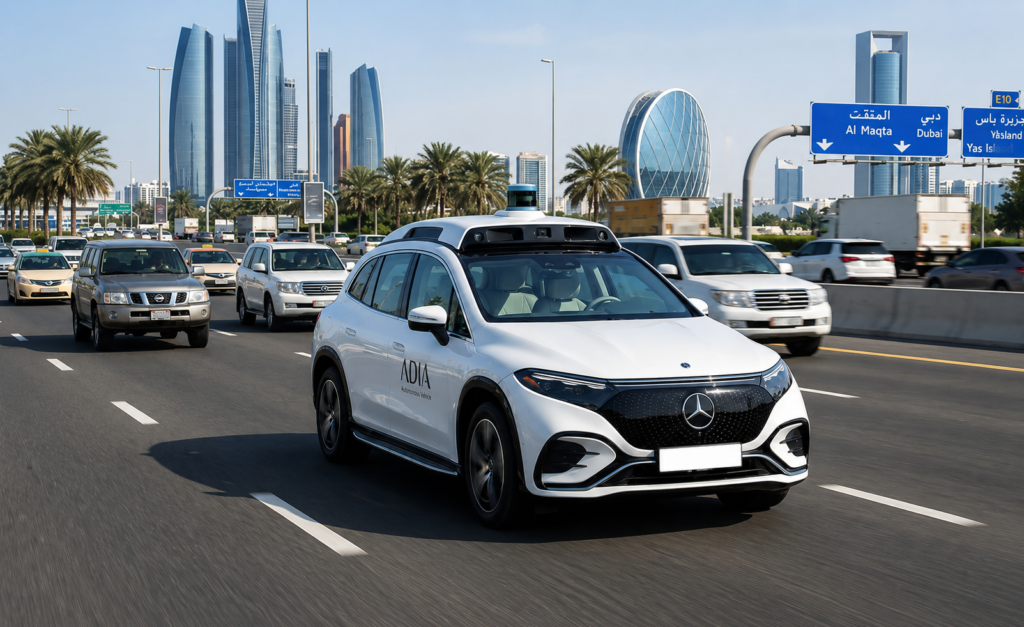
The licence plates are not being introduced in preparation for a distant autonomous future. They arrive after Abu Dhabi moved into commercial driverless operation.
In November 2025, Abu Dhabi Mobility announced the start of commercial operations for fully autonomous Level 4 vehicles, describing Abu Dhabi as the first city in the Middle East and North Africa to reach that stage. The first two operating permits covered WeRide working with Uber and Tawasul, and AutoGo-K2 working with Apollo Go, part of Baidu.
Level 4 automation generally means the vehicle can handle the driving task without a human driver within defined operating conditions or areas. It should not be confused with a privately owned car offering advanced driver assistance while still requiring the person behind the wheel to supervise the vehicle.
WeRide and Uber have built up substantial Abu Dhabi mileage
Before the move into fully driverless commercial operations, WeRide robotaxis had already accumulated more than 800,000 kilometres in Abu Dhabi by October 2025, according to Abu Dhabi Mobility. Individual vehicles were completing up to 20 trips during a 12-hour operating shift.
At the time of the Level 4 commercial announcement, the Uber and WeRide operation covered around half of Abu Dhabi’s core area. WeRide had also been conducting fully driverless Level 4 testing since the second quarter of 2025.
AutoGo and Apollo Go are expanding from Yas Island
AutoGo-K2 also progressed through autonomous testing on Yas Island during 2025, working with Apollo Go. Abu Dhabi Mobility said the programme advanced from its deployment launch in July to certified driverless operation by the end of September 2025, after completing more than 100,000 kilometres of road testing.
Commercial autonomous taxi operations on Yas Island were expanded again in March 2026. Abu Dhabi Mobility said the service was planned to extend later to Al Reem Island, Al Maryah Island and Saadiyat Island, although future expansion remains subject to the authority’s deployment programme.
Those programmes give the new “Auto Drive” and “Test” plates a practical role. Abu Dhabi now needs to regulate several operators, vehicles, routes and stages of autonomy rather than a handful of isolated experiments.
Why Abu Dhabi needs dedicated plates now
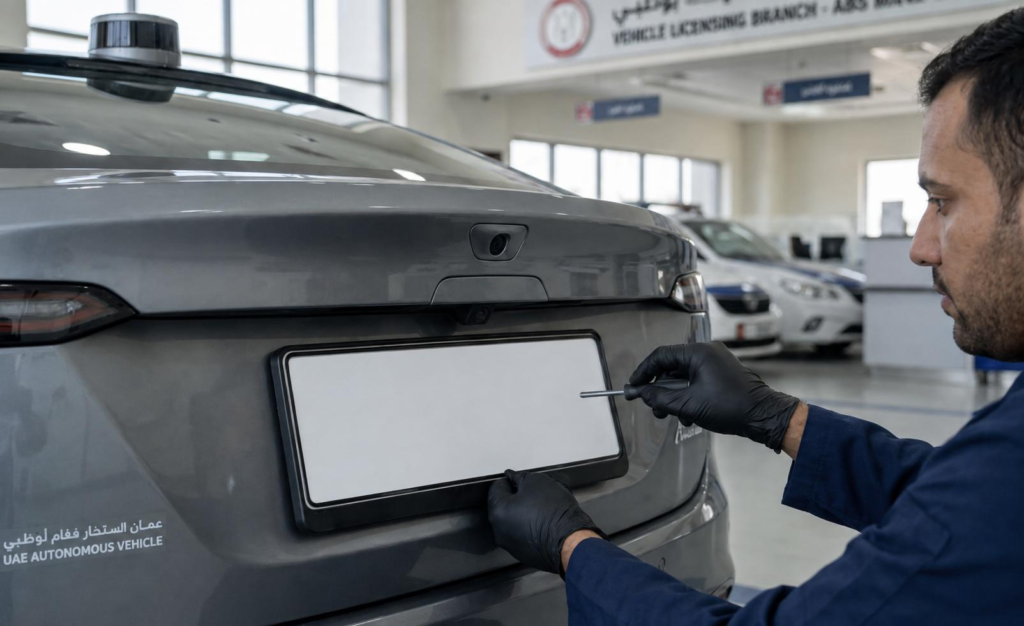
Ordinary registration identifies a vehicle, but a dedicated autonomous vehicle plate adds another layer of information. It tells authorities immediately that the vehicle belongs to a specially regulated transport category.
Abu Dhabi Mobility says the system is intended to strengthen field supervision, support road safety and help ensure operators continue to meet the emirate’s approved technical and operational standards.
There are several practical reasons why that becomes more useful as fleets expand:
- Roadside identification becomes simpler. Police, transport inspectors and other authorities can distinguish an autonomous test vehicle from an ordinary privately driven car without relying only on roof-mounted sensors or vehicle branding. They can also tell whether it belongs to a testing category or a commercial operation.
- Commercial approval is visibly different from testing. A vehicle marked “Test” should not be assumed to have the same operational status as one displaying “Auto Drive”. That distinction helps reinforce the idea that autonomous testing and permission to carry passengers commercially are separate regulatory stages.
- Fleet growth requires clearer oversight. Abu Dhabi Mobility currently states that 69 autonomous vehicles operate in the emirate as part of the commercial fleet managed through its autonomous vehicle systems. As fleet numbers and operating zones increase, clear registration categories become more valuable to regulators.
The number plate should therefore be viewed as one component of a much wider regulatory structure rather than a standalone road safety measure.
A control room is watching Abu Dhabi’s autonomous fleet
Just three days before announcing the dedicated plates, Abu Dhabi Mobility opened a central control room for autonomous vehicle operations on 10 July 2026.
The facility uses a centralised monitoring system together with the Autonomous Vehicle Integrated Testing and Operations Management System, known as AViTOMS. The platform can monitor vehicle locations, speeds and routes, record journeys, support incident analysis, coordinate emergency response procedures and manage permits and approved operating routes.
Abu Dhabi Mobility’s autonomous mobility portal also states that operators including K2 and WeRide are registered through AViTOMS. The authority reports more than 91,000 autonomous vehicle trips, over 900,000 kilometres travelled and more than 40,000 users served, although these totals can continue to change as operations expand.
The new licence plates fit naturally into this system. One provides physical identification on the road, while the digital infrastructure gives regulators a much deeper view of where authorised vehicles are operating and under what conditions.
UAE heat, dust and complex traffic remain part of the testing challenge
Autonomous vehicles developed for Gulf markets need to operate in conditions that can differ considerably from those faced in many European or North American cities.
Dubai’s Roads and Transport Authority has previously identified extreme weather and the diversity of road users as additional challenges when deploying self-driving transport in the UAE.
For Abu Dhabi, this means testing is particularly valuable before operating areas are expanded.
- High temperatures matter for vehicle systems. Autonomous cars rely on sensors, computing hardware, communications equipment and cooling systems operating together for long periods. Gulf deployments therefore provide manufacturers with real-world evidence of how complete vehicle systems behave during demanding summer conditions.
- Dust and reduced visibility add another environmental variable. Cameras, lidar units and other external sensors need to maintain reliable perception even when vehicles accumulate dust or encounter hazy conditions. The dedicated “Test” registration category gives authorities a clear way to identify vehicles that are still gathering data or validating these systems.
- Abu Dhabi mixes urban streets with high-speed road networks. Robotaxi operation around places such as Yas Island, central Abu Dhabi, Masdar City and Khalifa City can expose systems to very different road layouts and traffic conditions. Approval in one defined operating area should not automatically be interpreted as unrestricted autonomous capability throughout the UAE.
These are technology and operating considerations rather than proof that a particular autonomous model cannot cope with Gulf conditions. Actual deployment permissions remain determined by the relevant authorities and the vehicle’s approved operating environment.
The plates are part of a broader UAE regulatory shift
Abu Dhabi is not developing autonomous vehicle rules in isolation.
At federal level, the UAE’s current traffic framework specifically provides for regulation covering the inspection, registration, licensing and renewal of self-driving vehicles, as well as testing of modern vehicle technologies. Federal Decree-Law No. 14 of 2024 on Traffic Regulation came into effect on 29 March 2025.
The UAE had already granted WeRide preliminary national approval for autonomous vehicle testing in 2023, allowing the company to begin testing different types of autonomous vehicles in the country.
Dubai has developed its own framework too. Law No. 9 of 2023 regulates autonomous vehicle operation in the emirate and gives the Roads and Transport Authority responsibility for matters including vehicle categories, technical standards, operating areas, routes and licensing.
Dubai’s long-standing autonomous transport strategy targets 25 per cent of transportation trips being smart and driverless by 2030. Abu Dhabi’s current autonomous mobility strategy sets a separate goal of 25 per cent of all trips being autonomous by 2040.
Together, these programmes show how the UAE is moving from isolated demonstrations towards formal systems covering licensing, technical approval, monitoring, defined operating territories and commercial deployment.
What changes for ordinary drivers in Abu Dhabi?
For most motorists, the immediate change is straightforward: autonomous vehicles should become easier to recognise.
Drivers may increasingly see blue “Auto Drive” or “Test” plates as robotaxi coverage and autonomous pilots expand. However, the presence of a dedicated plate does not alter the basic responsibility of every other road user to follow normal traffic rules.
There are several distinctions worth keeping in mind:
- A blue plate does not mean every vehicle is operating in exactly the same way. Some will be commercially approved while others remain under test. Their permitted routes, operating conditions and deployment stages can differ.
- Do not assume autonomous vehicles operate like conventional human-driven cars in every situation. Their behaviour is determined by software, sensors, approved operating rules and safety systems. Drivers should maintain normal road discipline rather than trying to test how a robotaxi reacts.
- The plates do not signal that private driverless ownership has suddenly become widespread. Abu Dhabi’s current autonomous deployments are centred on approved operators and services. The announcement does not establish a general retail programme allowing residents to buy an autonomous car and simply register it with an “Auto Drive” plate.
That last distinction matters for motorists following developments from brands such as Tesla, Mercedes-Benz, BMW and other manufacturers offering increasingly capable driver-assistance systems. A vehicle equipped with advanced assistance is not automatically part of Abu Dhabi’s regulated commercial Level 4 autonomous fleet.
Autonomous taxis are only one part of the plan
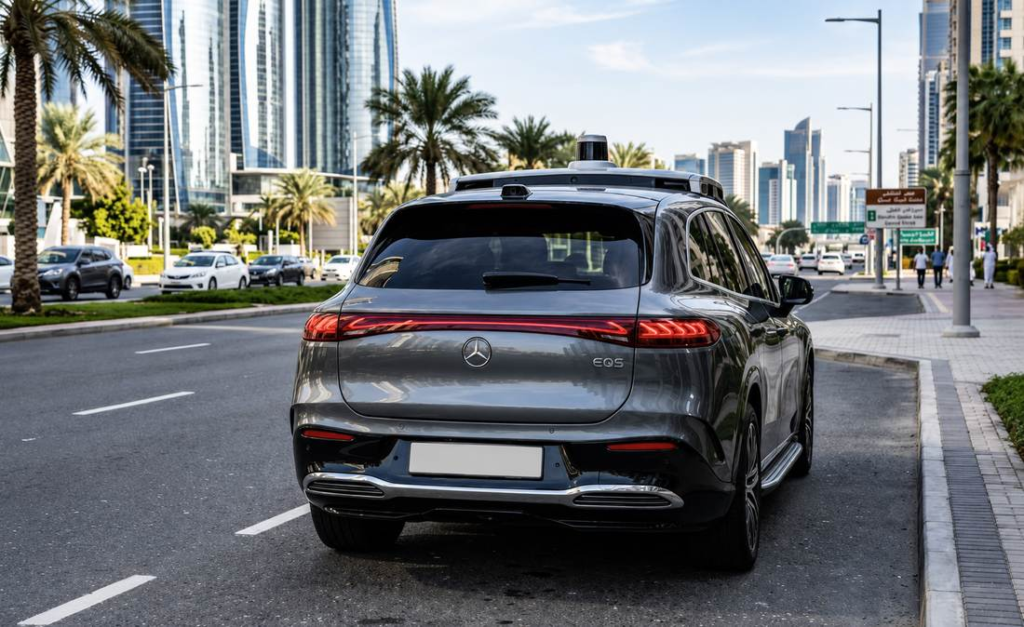
The dedicated licence plate system is broad enough to matter beyond passenger robotaxis.
In September 2025, Abu Dhabi launched a pilot autonomous delivery programme in Masdar City with K2 and EMX, the logistics arm of 7X. AutoGo vehicles were used in the programme, which Abu Dhabi Mobility said included the emirate’s first official licence plate for a self-driving delivery vehicle.
The July 2026 announcement creates a more clearly defined plate system covering trial and commercial autonomous vehicles generally.
That opens the regulatory framework to different applications as technology develops, including passenger transport and logistics. Exactly which additional vehicle types will receive commercial approval, and when, will depend on future announcements rather than the licence plate programme alone.
Could Abu Dhabi’s approach influence the wider GCC?
There is no confirmed GCC-wide autonomous licence plate standard, so Abu Dhabi’s blue plate design should not be treated as a regional system.
What it does provide is a useful example of how one Gulf authority is handling the shift from experimentation to everyday commercial deployment.
For other GCC markets considering larger autonomous fleets, three elements of Abu Dhabi’s approach are particularly relevant: a visible distinction between test and commercial vehicles, defined operating permits, and centralised digital monitoring.
Saudi Arabia, Qatar, Bahrain, Kuwait and Oman have different transport authorities and regulatory structures, so any future licensing rules would need to be introduced locally. Abu Dhabi’s system therefore represents an Emirate-level model rather than a template already adopted across the Gulf.
Blue plates put Abu Dhabi’s driverless programme in plain sight
The most significant point about Abu Dhabi’s autonomous vehicle licence plates is not their colour. It is what they reveal about how far the emirate has moved beyond experimental demonstrations.
There are now separate identifiers for testing and commercial autonomous vehicles, approved Level 4 operators, expanding robotaxi services, a dedicated monitoring centre and a digital platform overseeing active deployments. Abu Dhabi Mobility says its longer-term target is for autonomous journeys to account for 25 per cent of trips by 2040.
For UAE motorists, the blue plates make that transition considerably more visible. A vehicle carrying “Test” remains part of the development process. One carrying “Auto Drive” belongs to an approved commercial autonomous operation.
As more self-driving taxis and specialised vehicles enter Abu Dhabi’s roads, that simple distinction could become an increasingly familiar part of the UAE traffic landscape.