How Ford’s GT40 Finally Beat Ferrari at Le Mans
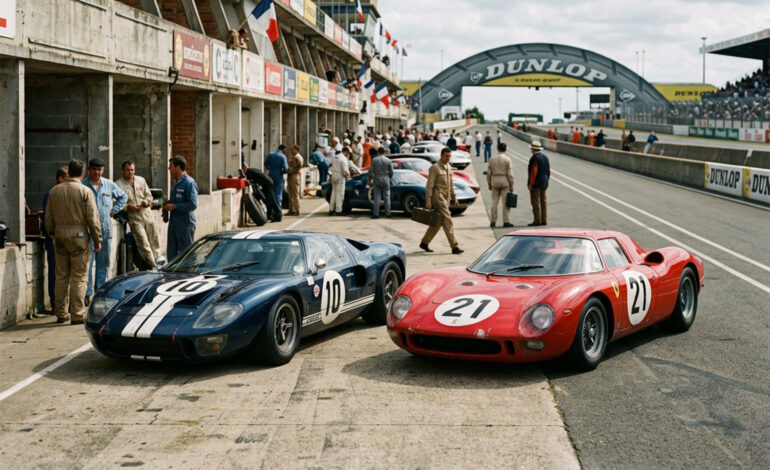
The Ford GT40 was not created simply to promote a new sports car. It was developed to defeat Ferrari at the 24 Hours of Le Mans, the race where the Italian manufacturer had become almost untouchable.
Ford’s attempt to acquire Ferrari collapsed in 1963, prompting Henry Ford II to pursue a far more public response. Ford would build its own endurance racer, confront Ferrari at Le Mans and prove that an American manufacturer could master Europe’s most prestigious sports car race.
That objective required considerably more than fitting a large V8 into a lightweight body. The GT40 programme brought together British race-car design, American industrial resources, experienced independent teams and thousands of kilometres of difficult testing. After painful failures in 1964 and 1965, the project finally produced a 1-2-3 finish at Le Mans in 1966.
The story remains especially relevant in 2026, the 60th anniversary of Ford’s first Le Mans victory. The three GT40 Mk IIs that filled the 1966 podium were recently reunited at the Goodwood Festival of Speed, while historic motorsport events and endurance racing at Dubai Autodrome continue to introduce UAE audiences to the type of racing culture that produced the GT40.
A failed Ferrari deal created Ford’s most ambitious racing project
During the early 1960s, Ferrari was the benchmark in international endurance racing. The Italian manufacturer won Le Mans every year from 1960 to 1965, extending a period of dominance in which only Aston Martin’s 1959 victory interrupted its success between 1958 and 1965.
Ford initially considered buying that expertise rather than building it from the ground up. Negotiations to acquire Ferrari began in 1963 but ended without an agreement. Ford subsequently decided that if it could not purchase the Italian company, it would challenge it directly.
The difficulty was that Ford and Ferrari represented very different automotive cultures. Ford understood mass production, robust engines and large-scale engineering. Ferrari had years of experience designing lightweight prototypes, managing endurance-racing strategy and developing cars specifically for circuits such as Le Mans.
Ford therefore faced three major problems:
- Ferrari already understood how to win long-distance races. Speed was only part of the equation. Ferrari knew how to balance performance, tyre wear, fuel consumption, driver workload and mechanical reliability over 24 hours.
- Le Mans exposed weaknesses that shorter races could hide. Cars ran at high speed for extended periods along the Mulsanne Straight before repeatedly braking for slower corners. Components had to survive changing weather, darkness, traffic and thousands of gear changes.
- Ford did not have an existing Ferrari rival ready for development. The company needed to create a mid-engined racing car, organise a European operation and develop specialist knowledge while already competing against established teams.
The answer was an international project rather than a purely Detroit-designed machine.
The original GT40 combined British design with American power
Although the GT40 became an American motorsport symbol, its origins were strongly connected to Britain.
Ford turned to Eric Broadley, founder of Lola Cars, whose Lola Mk6 GT had demonstrated the potential of a low, mid-engined sports car powered by a Ford V8. The Mk6 provided an important design foundation for Ford’s new Le Mans contender.
The Lola Mk6 provided the starting point
The Lola was compact, aerodynamically shaped and built around a mid-engined layout. Positioning the engine behind the driver helped centralise mass and gave the car proportions that were far more suitable for racing than Ford’s conventional front-engined road models.
Ford established Ford Advanced Vehicles in Slough, England, to develop the programme. The location allowed the company to draw upon Britain’s established network of race engineers, fabricators, component suppliers and test drivers.
The production GT40 was not merely a rebadged Lola. It developed into a separate Ford programme involving engineers and teams on both sides of the Atlantic. However, the Lola Mk6 gave Ford a credible starting point and helped prevent the project from beginning with a blank sheet of paper.
Why was it called the GT40?
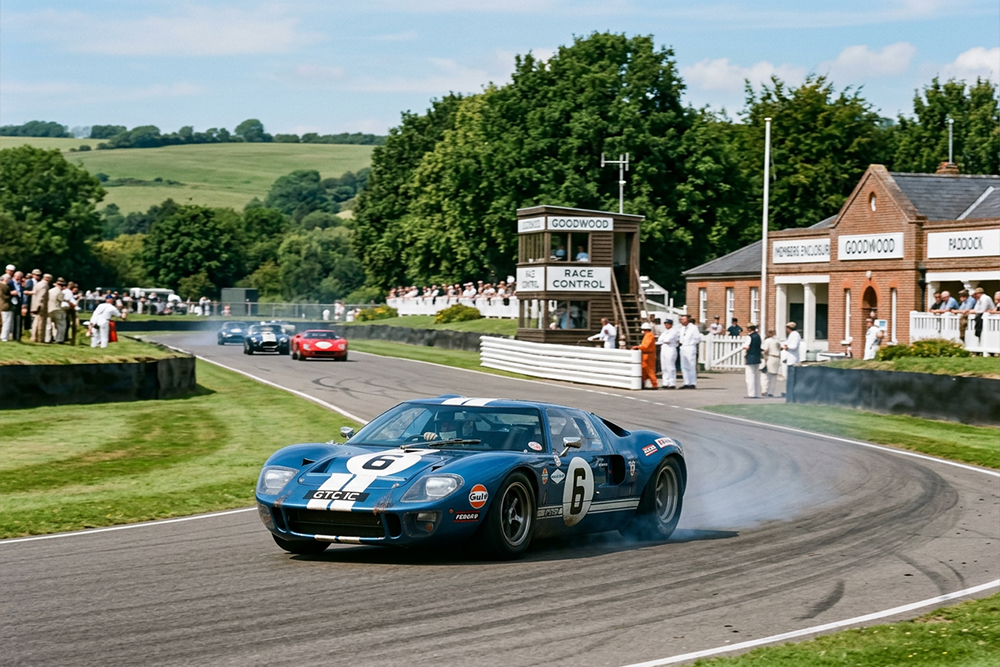
The name came from the car’s remarkably low height. The original racer stood approximately 40 inches tall, creating the wide, low silhouette that continues to define both the GT40 and later Ford GT road cars.
This shape reduced frontal area and helped the car reach high speeds, but it also created packaging difficulties. The cabin was cramped, visibility was restricted and taller drivers could struggle to fit.
Dan Gurney’s height eventually led fabricator Phil Remington to create a raised section in the driver’s door roof. That feature became known as the “Gurney bubble” and remains one of the GT40’s most recognisable details.
The first engine was smaller than many remember
Early GT40s used a Ford 289-cubic-inch V8, equivalent to approximately 4.7 litres. It was related to the compact Ford engines used in other racing projects and high-performance road cars rather than the enormous 7.0-litre unit associated with the 1966 winner.
The combination offered considerable potential, but the first GT40 was still an immature racing car. Ford had created the basic architecture. It had not yet created a reliable Le Mans winner.
The 1964 Le Mans failure exposed how much work remained
Ford entered three GT40s in the 1964 24 Hours of Le Mans. None reached the finish.
The cars were driven by established names, including Phil Hill, Bruce McLaren, Richie Ginther, Masten Gregory, Richard Attwood and Jo Schlesser. Despite their pace, the programme suffered from fire and gearbox problems, demonstrating that outright speed could not compensate for an underdeveloped endurance package.
The first campaign exposed several weaknesses:
- High-speed stability required further development. Ken Miles later documented instability caused by the design of the GT40’s nose after testing the car at Ford’s Romeo proving ground. The issue mattered because even a small aerodynamic imbalance became serious at Le Mans speeds.
- The transmission was not yet dependable enough. Early gearboxes were new and insufficiently proven for 24-hour competition. Bruce McLaren later recalled being warned to protect the transmission before gearbox failures ended Ford entries.
- Individual components had not been developed as one complete system. Cooling, aerodynamics, brakes, engine performance and drivetrain durability all affected each other. Ford needed to stop treating each failure as an isolated fault and begin developing the entire car around endurance racing.
Another unsuccessful Le Mans campaign followed in 1965. The result was embarrassing for a programme supported by Ford’s considerable financial and engineering resources, but the failures generated the test data needed to improve the car.
Carroll Shelby and Ken Miles turned testing into race victories
Ford’s decision to involve Carroll Shelby changed the direction of the GT40 programme.
Shelby understood both American V8 performance and European endurance racing. He had won Le Mans as a driver for Aston Martin in 1959 and later achieved international success with the Shelby Cobra Daytona Coupe. His organisation was therefore capable of interpreting Ford’s engineering resources through the practical demands of racing.
Ken Miles was equally significant. He was not merely a driver receiving instructions from engineers. Miles tested components, evaluated handling changes and communicated mechanical problems with unusual precision.
His ability to drive quickly while analysing the car made him central to the GT40’s development. The surviving 1965 memorandum in which he described aerodynamic instability in the nose illustrates how closely driver feedback and engineering work were connected.
Shelby American helped introduce a more disciplined development process:
- Changes were tested under racing conditions. Miles and the team worked through aerodynamic, suspension and drivetrain problems rather than relying entirely on theoretical calculations. A modification remained only a proposal until it proved itself on the circuit.
- Race preparation became as important as vehicle design. Shelby’s operation focused on pit procedures, component access, driver comfort and the ability to diagnose faults quickly. These details determined whether a fast car could remain competitive through the night.
- Ford’s separate specialists were directed towards one target. Shelby American, Holman-Moody, Ford engineers and British operations did not always agree, but the scale of the combined programme allowed several solutions to be tested simultaneously.
By early 1966, the programme was producing results. Miles won the 24 Hours of Daytona and the 12 Hours of Sebring before arriving at Le Mans, placing him in contention for an unprecedented endurance-racing triple.
The GT40 Mk II used American muscle to attack Le Mans
The original 4.7-litre GT40 remained competitive, but Ford believed it needed more power to establish a decisive advantage over Ferrari.
The GT40 Mk II received Ford’s 427-cubic-inch V8, an engine of approximately 7.0 litres with links to the company’s NASCAR programme. The conversion was not as simple as installing a larger engine. The additional power, weight and torque placed greater demands on the gearbox, brakes, suspension and cooling system.
The 7.0-litre V8 changed Ford’s strategy
Ferrari traditionally pursued performance through sophisticated, relatively high-revving engines and lightweight chassis. Ford took a different route, using a large-capacity V8 that produced strong torque and could sustain very high speeds along Le Mans’ long straights.
This was not crude power replacing engineering. Making a large engine survive 24 hours required careful attention to lubrication, cooling, gearing and component loads.
The Mk II also forced Ford to refine the car around the engine. Gearbox failures had already damaged previous campaigns, while drivers had to manage brakes that repeatedly changed from relatively cool conditions to extreme temperatures at the end of the Mulsanne Straight.
Chris Amon later described slowing from around 220 mph and the risk of brake discs cracking under the thermal load. He also recalled limited visibility, rain, oil on the circuit and the physical effort required to drive without power steering or paddle-shift gearboxes.
Ford brought strength in numbers
Ford arrived at the 1966 Le Mans race with eight 7.0-litre Mk IIs supported by additional smaller-engined GT40 Mk Is. The cars were operated by major teams including Shelby American, Holman-Moody and Alan Mann Racing.
The size of the entry was part of Ford’s strategy. Multiple cars increased the likelihood that at least one would survive, while the teams could gather information from different drivers and setups during the race.
The approach was expensive, but it reflected what Ford did best. Rather than trying to imitate Ferrari’s smaller racing organisation, Ford used its own advantages in finance, logistics, parts supply, engineering manpower and large-scale preparation.
The 1966 race finally ended Ferrari’s winning streak
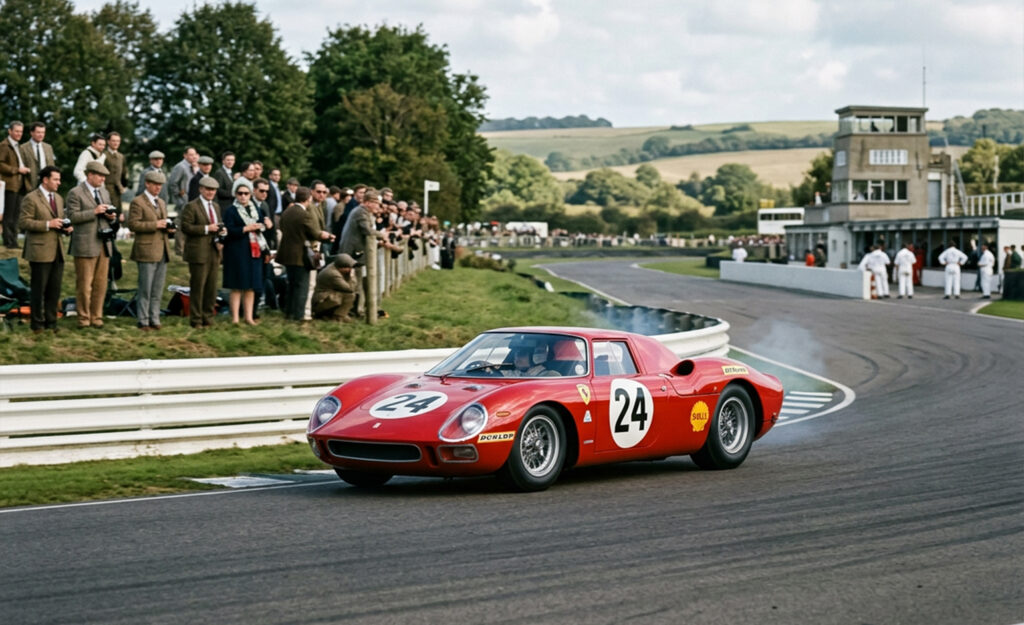
Ford’s preparation worked. The Ferrari challenge weakened as the race progressed, while the leading GT40 Mk IIs continued at the front.
By the closing stages, Ford was no longer concerned about simply reaching the finish. Its management wanted the leading cars to cross the line together, creating an image of complete dominance.
That decision produced one of the most debated finishes in motorsport history.
The leading cars were the number 1 GT40 of Ken Miles and Denny Hulme and the number 2 car of Bruce McLaren and Chris Amon. They approached the line together, with the number 5 Ford of Ronnie Bucknum and Dick Hutcherson completing the podium sweep several laps behind.
The official Automobile Club de l’Ouest record states that the number 2 car finished ahead of number 1. Photographs show the McLaren and Amon GT40 fully across the line first, while the regulations also accounted for the different starting positions of cars completing the same number of laps. The calculated winning margin was just over 20 metres.
McLaren and Amon were therefore declared the winners, with Miles and Hulme second. The result denied Miles the Daytona, Sebring and Le Mans triple, despite his major contribution to developing the winning car.
The finish remains controversial because Ford’s attempt to stage a formation photograph interfered with an active sporting contest. Yet it does not reduce the scale of the engineering achievement. Ford had ended Ferrari’s Le Mans streak and occupied all three podium positions.
Ford did not stop after its first Le Mans victory
A single victory might have been dismissed as the result of superior funding or favourable circumstances. Ford’s subsequent record made that argument difficult to sustain.
The American-built Ford Mark IV won in 1967 with Dan Gurney and A.J. Foyt. Ford then withdrew its direct factory effort, but John Wyer’s organisation continued racing the smaller GT40 Mk I.
GT40 chassis 1075 won Le Mans in both 1968 and 1969. Pedro Rodríguez and Lucien Bianchi took victory in 1968, followed by Jacky Ickx and Jackie Oliver in 1969.
The latter race produced another famous finish, with the ageing GT40 defeating the Porsche 908 after 24 hours of competition. Ford-powered cars had now won Le Mans for four consecutive years, proving that the programme had produced more than a single oversized response to Ferrari.
Why Ford GT40 history still matters in the UAE and GCC
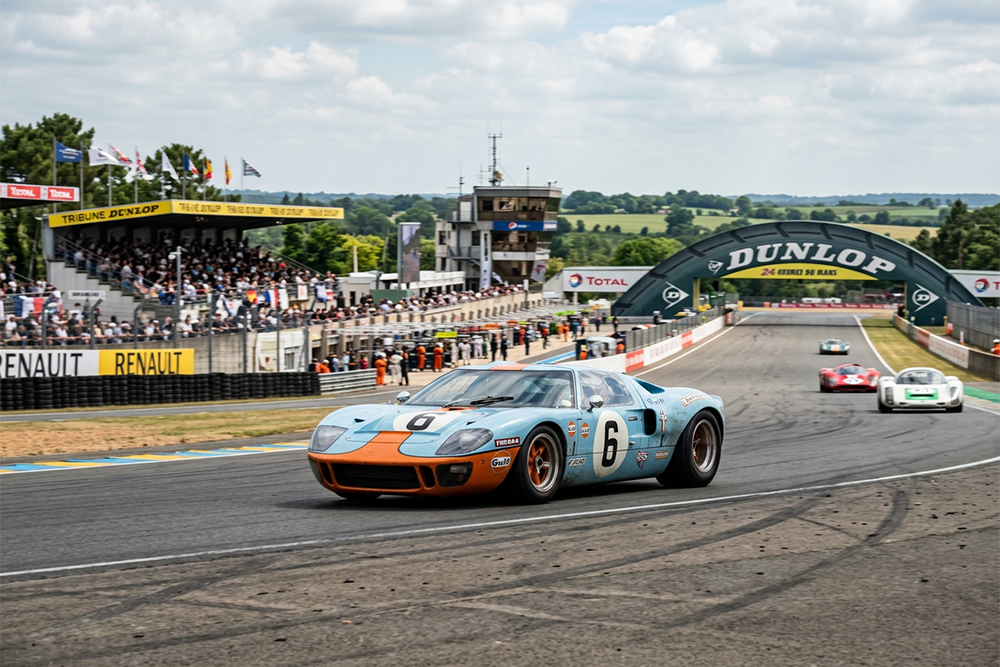
The GT40 story has particular resonance in the Gulf, where American performance cars, European supercars and international motorsport culture regularly share the same space.
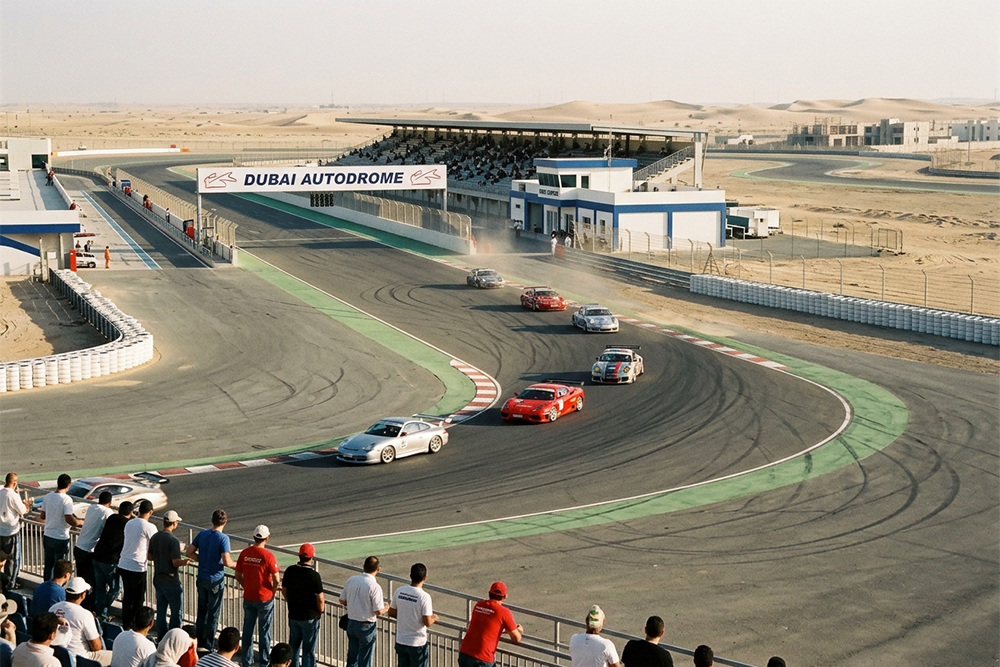
Dubai Autodrome hosts modern endurance competition through the 24H Dubai, with manufacturers including Ford and Ferrari appearing within the event’s large GT and touring-car fields. Historic events at the circuit have also brought important racing machinery and former Le Mans competitors before a regional audience.
For UAE and GCC enthusiasts, the GT40 offers several useful perspectives:
- It connects American V8 culture with European racing engineering. That combination is familiar in a region where Mustangs, Ferraris, Ford GTs and specialist track cars often occupy the same collections. The GT40 does not belong neatly to one national design tradition.
- It explains why provenance matters in the collector market. An original GT40, an officially licensed continuation car, a replica and a later Ford GT may look related but have very different histories and values. Documentation, chassis identity and restoration records require expert verification before any purchase.
- Gulf conditions make preservation a serious responsibility. High temperatures, dust and long periods in storage can affect cooling systems, fuel components, seals, wiring and tyres. Any GT40-style car used in the UAE should receive specialist inspection before road or circuit driving.
The modern Ford GT also carried the original car’s story into the regional market. Examples have appeared at high-profile Gulf auctions, including a 2006 Ford GT catalogued by RM Sotheby’s in Abu Dhabi, showing how the GT40 design lineage has become part of the Middle East collector-car landscape.
The GT40 succeeded because Ford learned rather than copied
Ford did not beat Ferrari by building an American version of a Ferrari.
It began with a British-inspired mid-engined design, added American V8 power and then spent two difficult seasons identifying why the package failed. Shelby American, Ken Miles, Holman-Moody, Alan Mann Racing and Ford’s engineers gradually turned an unstable and unreliable prototype into a durable endurance racer.
The decisive advantage was not simply Ford’s budget. Money allowed the company to build more cars, test more components and recruit leading specialists, but those resources only became useful when Ford accepted what the early failures were revealing.
By 1966, the GT40 Mk II was no longer an emotional response to a collapsed business deal. It was a thoroughly developed race car supported by an operation capable of matching Ferrari’s endurance expertise with a very different combination of power, preparation and industrial scale.
Sixty years later, that is why Ford GT40 history remains so compelling. The car was born from rivalry, but its lasting reputation came from engineering persistence.