UAE Leads Middle East EV Sales Again as More Buyers Make the Switch
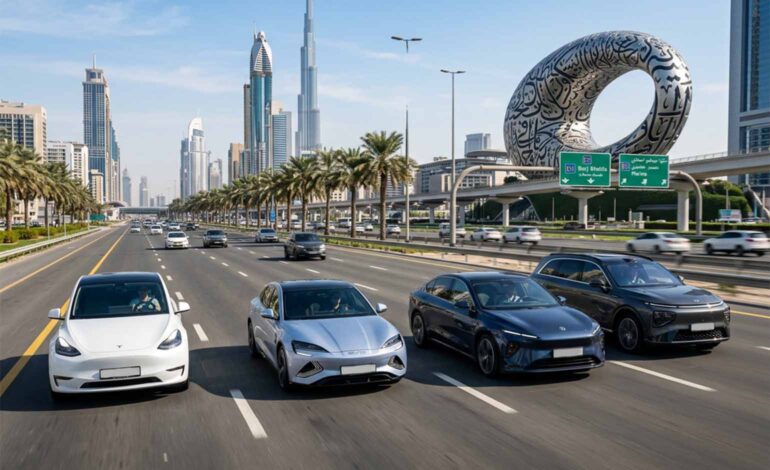
The UAE retained its position as the Middle East’s largest electric vehicle market in 2025, accounting for nearly half of the region’s EV sales, according to the International Energy Agency’s Global EV Outlook 2026.
The result marks the second consecutive year that the UAE has led regional electric car sales. For buyers in Dubai, Abu Dhabi and the Northern Emirates, the figures point to wider model choice and improving charging coverage, but they also make careful checks on warranties, home charging and aftersales support increasingly important.
UAE leads Middle East EV sales for a second year
The International Energy Agency published its Global EV Outlook 2026 on 20 May 2026. The report found that global electric car sales exceeded 20 million units in 2025, representing one in four new cars sold worldwide.
Within the Middle East, the UAE accounted for close to 50 per cent of electric vehicle sales during the year. This placed the country ahead of other regional markets and reinforced its role as an early adoption centre for electric mobility.
The main confirmed points include:
- The UAE remained the regional EV sales leader. Nearly one in every two electric cars sold across the Middle East in 2025 was purchased in the UAE. The IEA data does not mean that half of all new cars sold inside the UAE were electric.
- The ranking covers sales completed in 2025. It was published through the IEA’s 2026 report and should not be interpreted as a final sales result for the whole of 2026. Full-year UAE sales figures for 2026 remain unconfirmed.
- The wider global EV market also expanded. Worldwide electric car sales grew by approximately 20 per cent in 2025 and passed 20 million units. The IEA expects global demand to rise further during 2026.
Charging infrastructure is expanding with EV demand
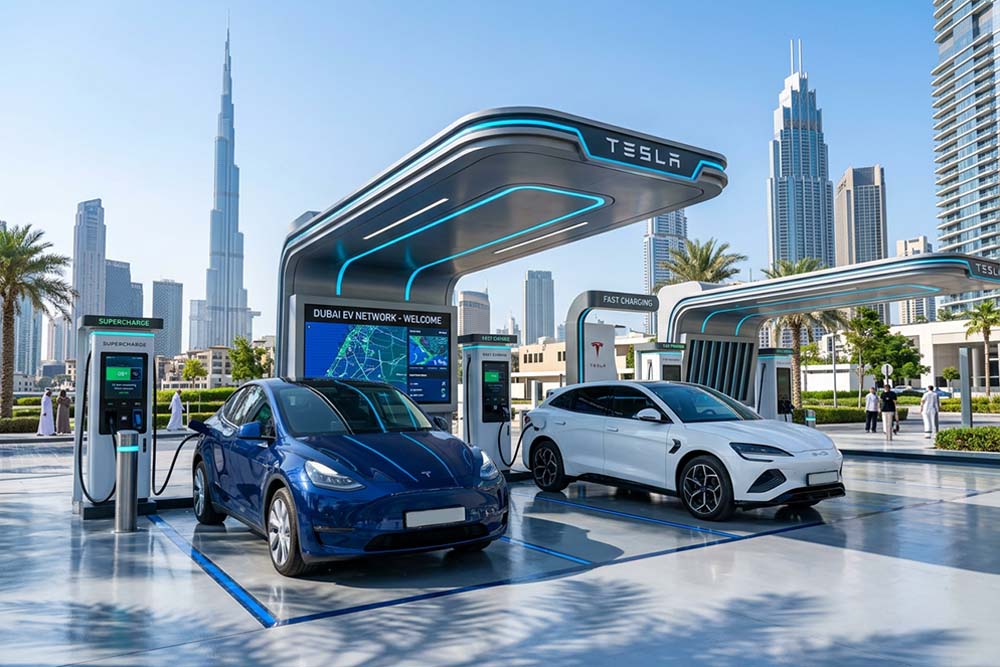
The sales result comes as charging networks continue to grow across the Emirates. Dubai Electricity and Water Authority reported that Dubai had reached 2,223 EV charging points by the end of the first quarter of 2026, including DEWA Green Chargers and facilities operated by licensed private companies.
ADNOC Distribution also expanded its E2GO network during 2025, adding 182 fast and superfast charging points and taking its UAE total to 402. In January 2026, the company opened a major superfast charging hub and announced plans to electrify the UAE highway network by the end of 2027.
New owners should still plan around where and how they will charge:
- Home charging remains the most convenient option for many drivers. Apartment residents should check whether their building permits private charger installation and how electricity use will be billed. Approval processes can differ between properties and emirates.
- Public charging access varies by location. Coverage is strongest in major urban areas, shopping destinations and selected highway corridors. Drivers regularly travelling between emirates should identify compatible chargers before longer journeys.
- Charging speed depends on more than the station rating. The vehicle’s maximum charging capacity, battery temperature and current charge level can all affect the time required. A car cannot necessarily accept the full output advertised by a high-powered charger.
The ownership checks first-time EV buyers should make
Stronger sales and a wider selection of vehicles do not remove the need for careful research. The UAE market now includes EVs from established manufacturers, newer Chinese brands and parallel importers, with significant differences in warranty coverage, software support and parts availability.
Battery warranties need closer inspection
Buyers should confirm the duration, kilometre limit and minimum battery-health threshold stated in the written warranty. They should also check whether the warranty is valid through an authorised UAE distributor or depends on an overseas seller.
A long headline warranty may not cover every type of battery degradation. Conditions relating to servicing, charging practices and unauthorised repairs should be reviewed before purchase.
Gulf specifications and thermal management matter
Extreme summer temperatures can affect energy consumption, charging performance and driving range. A vehicle’s cooling system and battery thermal management therefore matter as much as its advertised laboratory range.
Owners should expect real-world range to vary when air conditioning is used heavily, the car is driven at motorway speeds or the battery is exposed to prolonged heat.
Important purchase checks include:
- Confirm whether the vehicle is an official UAE model or a parallel import. Imported cars may have different charging connectors, navigation software or connected services. Local warranty and recall support may also be limited.
- Check the authorised repair network before paying a deposit. Ask where battery diagnostics, accident repairs and software updates will be completed. A showroom presence alone does not guarantee comprehensive technical support.
- Request an insurance quotation for the exact model. Premiums and repair conditions can differ because battery packs, sensors and specialised body components may increase accident-repair costs. Buyers should also check whether agency repair is included.
What remains unconfirmed about the UAE’s 2026 EV market
The IEA report confirms the UAE’s regional position based on 2025 sales, but it does not provide a final 2026 market result. It also does not confirm which individual brands or models will lead UAE registrations this year.
There is no single publicly confirmed national forecast detailing exact 2026 EV sales by model, emirate or buyer type. Availability, prices and delivery schedules can also change between manufacturers and authorised distributors.
The UAE’s National Electric Vehicles Policy supports the development of a countrywide charging network, common standards and a centralised charging-station database. However, implementation continues across different authorities and operators, meaning the ownership experience may still vary by emirate and location.
The UAE’s EV lead now shifts attention to ownership quality
Leading Middle East EV sales for a second consecutive year shows that electric cars are becoming a more established part of the UAE market. Expanding charger networks and a broader range of vehicles should make adoption easier, especially for urban drivers with reliable home or workplace charging.
The next test will be whether service networks, battery support, insurance products and used-EV valuations develop as quickly as new-car sales. For first-time owners, the safest approach is to look beyond range and showroom technology and verify the complete ownership package before signing an order.