Why The Mercedes-Benz SLR McLaren Still Matters In GCC Car Culture
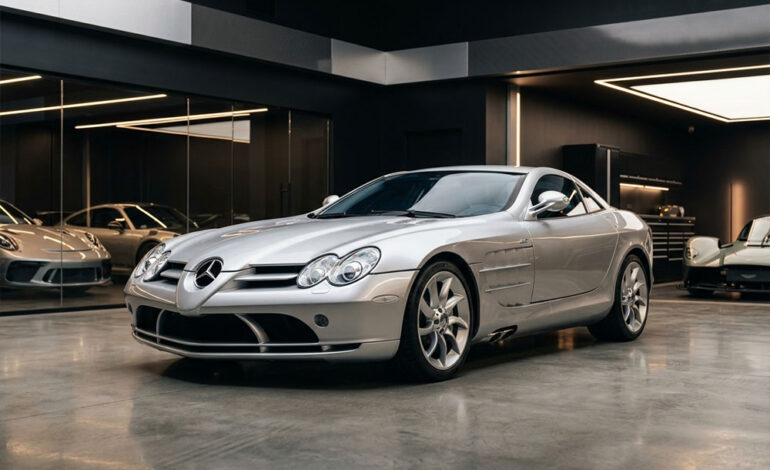
The Mercedes-Benz SLR McLaren still matters in GCC car culture because it sits at a rare meeting point: Mercedes-Benz prestige, McLaren engineering, AMG V8 drama and early-2000s supercar theatre. In a region where collectors value presence, heritage, performance and rarity, the SLR remains more than an old flagship. It is one of the cars that helped define the modern Gulf supercar era before today’s hypercar-heavy scene took over.
Built through the Mercedes-Benz and McLaren partnership, the SLR arrived as a front-mid-engined carbon-fibre grand tourer with a hand-built 5.4-litre supercharged V8 producing 626 PS. McLaren describes it as its second road car after the F1, with carbon-fibre construction, active aerodynamics and a direct link to the 300 SLR name from Mercedes-Benz’s 1955 sports car racing history.
For UAE and GCC enthusiasts, that mix still carries weight. The SLR is not just fast by old standards. It belongs to a period when Dubai, Abu Dhabi, Doha and Riyadh were becoming more visible on the global supercar map, and when rare Mercedes-AMG, Ferrari, Lamborghini, Porsche and McLaren models started becoming part of the region’s automotive identity.
A Mercedes-McLaren Collaboration That Still Feels Unrepeatable
The SLR McLaren was never a normal Mercedes-Benz sports car. It was designed and developed through the Mercedes-Benz and McLaren relationship at a time when both brands were closely connected through Formula 1 and road car engineering. Production began in the early 2000s, and McLaren says the SLR was one of the first projects at the McLaren Technology Centre in 2003.
That matters because the SLR was not simply a Mercedes with extra power. It combined AMG’s supercharged V8 character with McLaren’s carbon-fibre experience, active aero knowledge and low-slung supercar construction. The result was a car that never fitted neatly into one category.
It was too dramatic to be a normal grand tourer. It was too luxurious and automatic to be a stripped-out supercar. It was too loud, rare and expensive to be treated like an SL with more carbon fibre. That unusual identity is exactly why it still attracts attention in the Gulf.
For GCC collectors, the SLR’s appeal comes from several layers:
- It has two brand stories in one car. Mercedes-Benz gives it luxury, heritage and long-term collector credibility, while McLaren gives it engineering intrigue and supercar legitimacy. That dual identity makes it different from later single-brand models such as the Mercedes-AMG GT or McLaren 12C.
- It belongs to a short and specific era. The SLR reflects the 2000s moment when analogue drama, big engines and early carbon construction were still being mixed with modern electronics. That gives it a different personality from today’s hybrid hypercars and heavily screen-led performance cars.
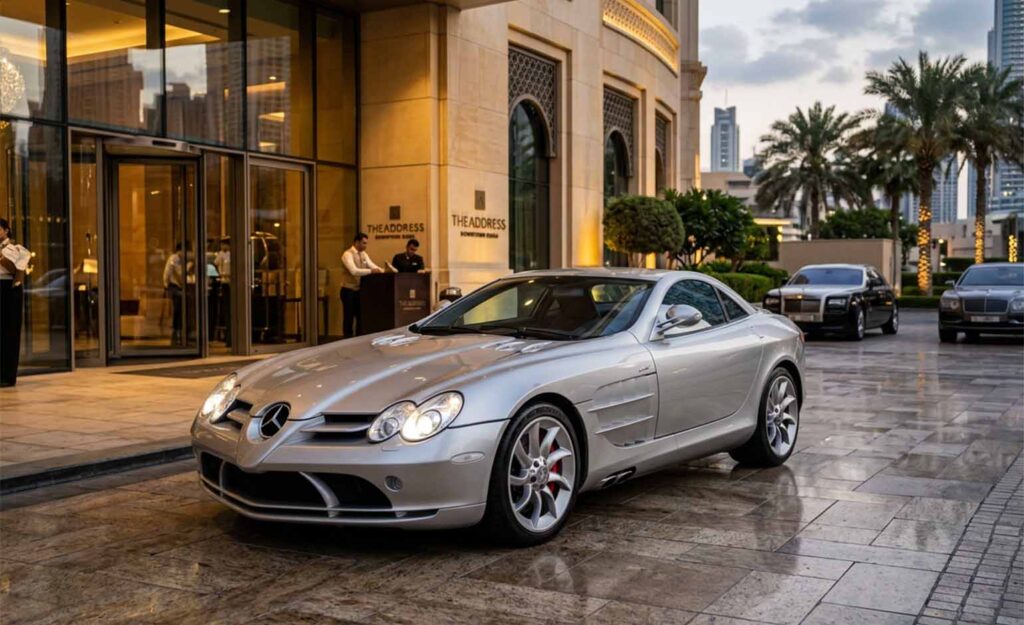
- It has a shape people remember. The long bonnet, side-exit exhausts, scissor-style doors and rear air brake make it instantly recognisable. In GCC car culture, visual presence matters, and the SLR still has it without needing extreme aftermarket changes.
Why The Mercedes-Benz SLR McLaren Fits Gulf Supercar Taste
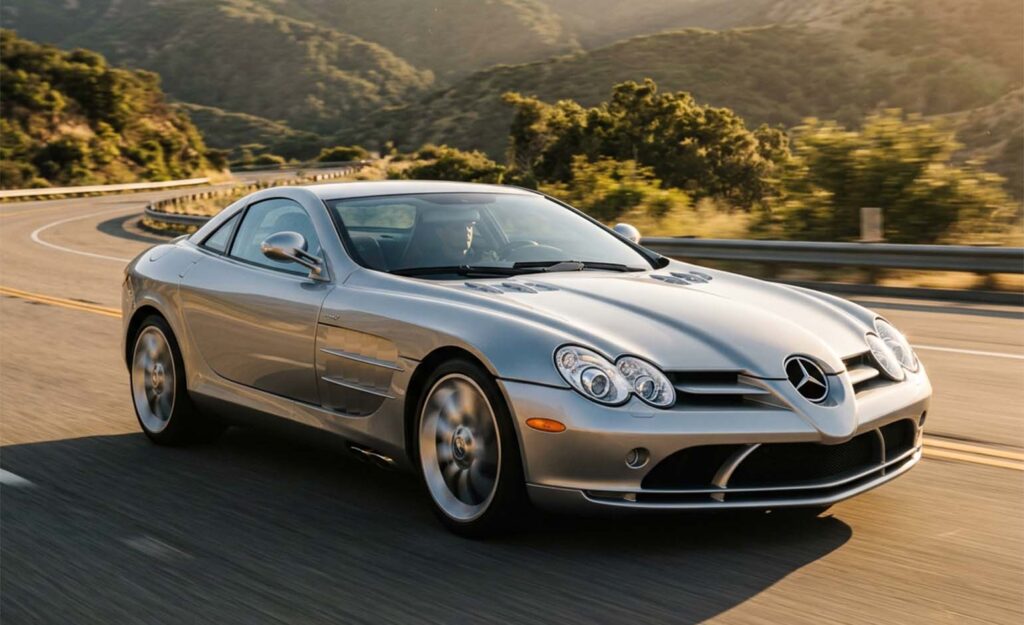
The Gulf has always had room for cars that combine speed with theatre. A supercar in Dubai or Doha is not judged only by lap times. It also needs status, sound, rarity and a sense of occasion.
The SLR delivers that in a way many newer cars do not. Its supercharged V8 is part of the appeal, but so is the way the car looks and feels. The front-mid-engine layout gives it a long, almost aircraft-like profile, while the side pipes add a mechanical edge that suits the GCC’s love of big, expressive performance cars.
Power With A Grand Touring Character
The SLR’s 5.4-litre supercharged V8 produced 626 PS, which remains serious even by modern performance standards. Its character is different from newer turbocharged supercars because it is less about silent efficiency and more about torque, noise and effort.
That grand touring side also matters in the Gulf. Many cars here are used across wide roads, long highways and city boulevards rather than tight European lanes. The SLR’s personality suits that environment better than some sharper, less comfortable mid-engined rivals.
Design That Still Works In Dubai And Abu Dhabi
The SLR has aged well because it was never a subtle car, but it was not purely aggressive either. It mixed Mercedes-Benz elegance with McLaren-era drama, making it feel special without relying only on wings, vents and track-focused styling.
That balance is important in UAE car culture. Dubai and Abu Dhabi already see a huge number of modern supercars, so an older rare car needs a strong identity to stand out. The SLR has one.
A Car From The Poster Era
For many enthusiasts now in their 30s and 40s, the SLR belongs to the same mental garage as the Porsche Carrera GT, Ferrari Enzo, Lamborghini Murciélago and early Bugatti Veyron. These are cars from the magazine, poster and early internet era.
That nostalgia is now becoming a genuine collector force. In the GCC, where rare 2000s supercars are increasingly treated as modern classics, the SLR benefits from being both recognisable and relatively scarce.
The GCC Collector Market Has Not Forgotten The SLR
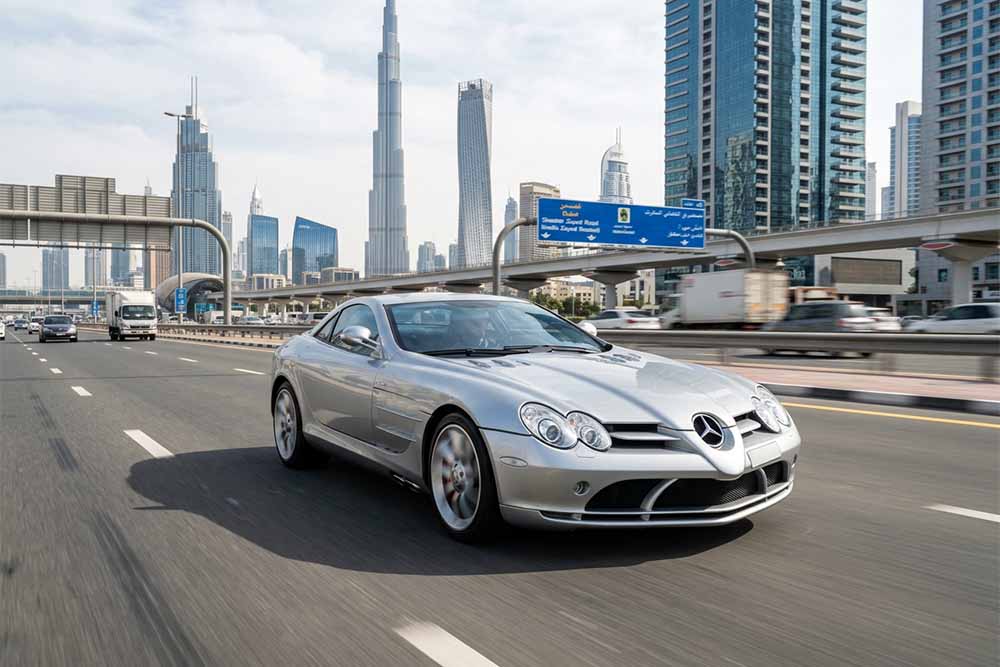
The SLR’s relevance is visible in the UAE used and collector market. Listings on UAE platforms regularly show SLR examples advertised at seven-figure dirham prices, with coupe, roadster and special edition cars appearing in Dubai and Abu Dhabi dealer inventory. Current listings on dubizzle show examples advertised from around AED 1.29 million to above AED 2 million, depending on year, mileage, specification and condition.
DubiCars also lists used Mercedes-Benz SLR examples in Dubai with asking prices starting from around AED 1.29 million, showing that the model remains actively traded rather than forgotten in private garages.
These listings are not official value guides, and asking prices do not always reflect final transaction prices. Still, they show clear regional interest in the SLR as a collector-grade car.
For buyers looking at an SLR in the UAE or wider GCC, the key checks are more serious than on a normal used Mercedes:
- Service history matters more than mileage alone. A very low-mileage car can still need major work if it has been stored poorly or maintained inconsistently. Buyers should look for detailed records, specialist inspection reports and evidence that age-sensitive parts have not been ignored.
- Specification and provenance affect desirability. GCC-spec cars, rare editions, original paint, low mileage and documented ownership can all influence collector interest. Imported cars can still be attractive, but buyers should verify history carefully.
- Condition should be judged by specialists. The SLR uses carbon-fibre construction, complex braking technology and model-specific parts. A general inspection may not be enough for a car at this level.
The Stirling Moss Link Adds Serious Gulf Collector Pull
The most extreme SLR variant, the Mercedes-Benz SLR McLaren Stirling Moss, has become especially important in collector circles. Mercedes-Benz notes that the SLR McLaren Stirling Moss was launched in 2009 as the final and most uncompromising version of the SLR series, inspired by the 300 SLR and Stirling Moss’s 1955 Mille Miglia victory. Only 75 examples were produced.
That link matters in the Gulf because regional collector culture increasingly values heritage, not just horsepower. The SLR Stirling Moss is not simply a rare speedster. It connects the modern SLR story to one of Mercedes-Benz’s most important racing names.
The UAE has also recently hosted significant Mercedes-Benz heritage activity. The 1000 Miglia Experience UAE has brought classic motorsport culture into the region, and the 2026 event website highlights a Mercedes-Benz 300 SLR display in the Gulf alongside UAE ruling family cars, Dubai Police supercars and other collector showcases.
That matters because it places the SLR family in a wider local conversation. Gulf collectors are not only buying modern hypercars. They are increasingly engaging with heritage, provenance and the story behind important models.
Dubai Auction Attention Proved Its Staying Power
One of the clearest signs of the SLR’s GCC relevance came through RM Sotheby’s Dubai activity. A 2009 Mercedes-Benz SLR McLaren Stirling Moss sold in Dubai for $3,211,250, with RM Sotheby’s noting that the car was one of only 75 examples, had covered 9,233 kilometres and had later been exported to the Middle East.
That result was not just about one car. It showed that Dubai can host serious collector-grade Mercedes-Benz metal and that the SLR name has enough weight to headline attention in a market filled with newer hypercars.
For the Gulf collector scene, this matters in three ways:
- Dubai is becoming more credible as a collector-car stage. Rare cars no longer need to be discussed only through European or American auction houses. The UAE is increasingly part of the conversation.
- The SLR’s rarest versions are now treated as blue-chip modern classics. The Stirling Moss sits at the top of the range, but attention around it also lifts awareness of the wider SLR family. Standard coupes and roadsters benefit from that halo.
- Regional history adds value. A car with Middle East ownership, careful storage and documented maintenance can become more interesting to local buyers. Provenance is becoming as important as mileage.
Why It Still Matters Beside Modern Hypercars
On paper, many modern supercars and hypercars are faster than the SLR. A new plug-in hybrid Lamborghini, Ferrari or McLaren will offer sharper acceleration, better electronics and more advanced chassis systems. That does not make the SLR irrelevant.
Its value is not only in numbers. The SLR matters because it represents a type of performance car that is not being made in the same way anymore. Big supercharged engines, dramatic long-bonnet proportions, analogue sound and cross-brand engineering partnerships are now far less common.
For GCC enthusiasts, the SLR sits in a useful position between old and new:
- It is modern enough to use carefully. Unlike much older classics, the SLR has modern safety systems, a strong automatic gearbox and grand touring comfort. That makes it more usable for occasional UAE drives than many fragile historic cars.
- It is old enough to feel special. It has passed out of normal used-supercar territory and entered modern classic status. That shift changes how owners, collectors and dealers treat it.
- It tells a story newer cars cannot copy. A modern AMG or McLaren may be faster, but it does not carry the same Mercedes-McLaren partnership story. That backstory is central to the SLR’s cultural staying power.
The Ownership Costs Buyers Should Not Ignore
The SLR may be a Mercedes-Benz, but it should not be approached like a normal used AMG. Parts, specialist labour, bodywork and inspection standards all sit closer to collector-supercar territory.
Mercedes-Benz Classic continues to support the preservation of classic vehicles with genuine spare parts, while Mercedes-Benz USA also lists SLR McLaren parts through its official parts channels. That does not mean every part is cheap or instantly available in the GCC, but it does show that the model is still supported through official classic and parts ecosystems.
The SLR.CLUB also describes itself as an exclusive community for SLR owners and notes support around technical knowledge, events and preservation of the SLR archive. Its Mercedes-Benz club page also refers to help with SLR-related issues such as spare parts availability, service and workshops.
Before buying one in the UAE or GCC, owners should think carefully about:
- Heat and storage conditions. Gulf heat can be tough on tyres, rubber seals, batteries, fluids and interior materials. A climate-controlled garage is not a luxury for an SLR, it is part of responsible ownership.
- Specialist maintenance access. Buyers should confirm who will service the car before they buy it. The right workshop should understand the SLR’s carbon structure, braking system, cooling needs and model-specific parts.
- Insurance and valuation. A normal insurance approach may not suit a collector-grade SLR. Owners should look at agreed-value cover where available and make sure modifications, mileage limits and storage conditions are clearly understood.
The Bottom Line For Gulf Drivers
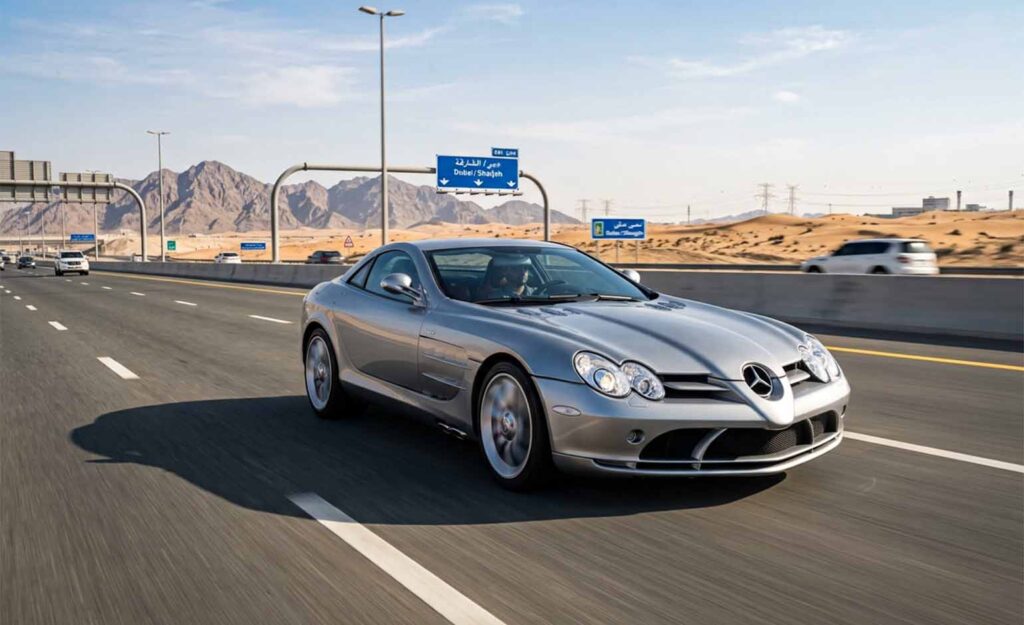
The Mercedes-Benz SLR McLaren still matters in GCC car culture because it has the qualities the region continues to value: rarity, presence, power, heritage and a story worth telling. It is not just another old supercar sitting between eras. It is one of the cars that helped shape the modern Gulf appetite for high-performance collector machines.
For UAE and GCC buyers, the SLR is best understood as a modern classic rather than a cheaper alternative to a new supercar. It needs specialist care, proper storage, careful inspection and a clear understanding of long-term costs.
For enthusiasts, its appeal is simpler. The SLR still looks dramatic, still sounds special and still represents a moment when Mercedes-Benz and McLaren built something neither brand is likely to repeat in the same way again.