Abu Dhabi Car Washing Fine: Why The Dh4,000 Claim Needs Context
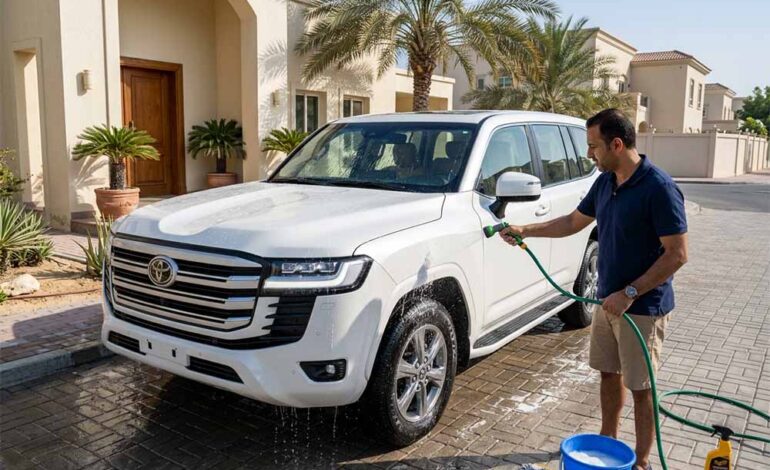
Washing your car outside your home may seem harmless, particularly in Abu Dhabi where dust and sand can quickly cover a freshly cleaned vehicle. But motorists need to be careful about where the water ends up.
Abu Dhabi City Municipality launched a new awareness campaign on 15 August 2026 targeting the unauthorised washing of vehicles in residential areas. The municipality is warning residents against washing cars in locations that are not designated for the activity, particularly where wastewater collects on public roads, pavements, pathways and parking areas.
The Abu Dhabi car washing fine has attracted particular attention after reports referred to penalties of up to Dh4,000. However, the official Department of Municipalities and Transport fine schedule requires some important clarification. The listed offence for water accumulating in a public area as a result of washing vehicles carries fines of Dh500 for a first offence, Dh1,000 for a second and Dh2,000 for a third.
The Dh4,000 figure has been associated with separate public-space violations and reporting around repeat offences involving neglected or dirty vehicles. At the time of writing, the official DMT schedule available publicly does not list Dh4,000 as the third-offence penalty for the specific violation of water accumulating because a vehicle has been washed.
That distinction matters for Abu Dhabi motorists trying to understand what is actually prohibited, what could result in a fine and whether washing a vehicle at home automatically breaks the rules.
Abu Dhabi Municipality Targets Unauthorised Car Washing
Abu Dhabi City Municipality’s latest campaign forms part of its wider “Our Home, Our Responsibility” initiative, which focuses on maintaining the appearance and cleanliness of residential neighbourhoods.
The campaign is not simply telling motorists to keep their cars clean in a different way. Municipal officials are specifically drawing attention to washing vehicles in unauthorised locations and the consequences of allowing water to collect in public areas.
Inspectors have been carrying out field visits in residential communities, speaking directly with residents and explaining the effects of informal vehicle washing. Awareness workshops have also been organised across different areas as part of the campaign.
The main points raised through the campaign include:
- Water collecting on roads and walkways is one of the municipality’s main concerns. When cars are washed in unsuitable areas, the resulting water can spread across streets, pedestrian paths and shared spaces rather than being properly contained or drained. Abu Dhabi City Municipality says this can affect the appearance and cleanliness of residential neighbourhoods.
- Standing water can create wider problems for residents. Municipal messaging has warned that accumulated water may contribute to conditions in which insects can multiply, creating a potential public health concern. Water on the road can also be splashed onto neighbouring or passing vehicles, effectively making other cars dirty in the process.
- Residents are being directed towards authorised car-washing services and locations. The municipality’s message is that motorists should avoid improvised washing on streets and similar public spaces and instead use facilities or services intended for vehicle cleaning. That approach also provides a more controlled way of handling wastewater.
The issue is particularly relevant in residential areas where a driver may think of the space immediately outside a villa or apartment building as part of their home environment. Legally and practically, however, the adjacent road, pavement or communal parking space may still be a public area.
The Abu Dhabi Car Washing Fine Starts At Dh500
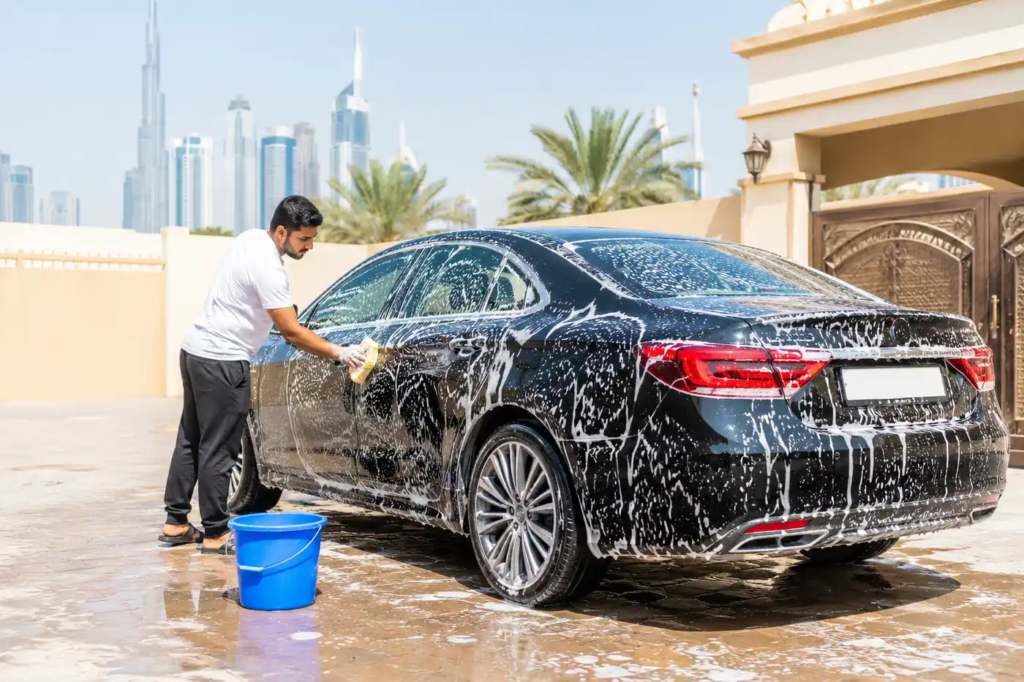
The clearest source for understanding the penalties is the Department of Municipalities and Transport’s official schedule of violations and fines connected with Law No. 2 of 2012 concerning the preservation of public appearance, health and tranquillity in the Emirate of Abu Dhabi.
Within the section covering the preservation of public areas, violation number 33 specifically refers to water accumulating on the ground in public areas as a result of washing vehicles.
First Offence: Dh500
A first offence under this specific provision carries a Dh500 fine.
The wording is important. The offence in the published fine schedule does not simply state that every act of personally washing a vehicle is illegal. It focuses specifically on the accumulation of water in a public area resulting from washing a vehicle.
That means the location and the effect of the washing activity are central to understanding the rule.
Second Offence: Dh1,000
A second offence increases the penalty to Dh1,000.
For motorists who regularly wash their cars outside villas or in shared residential parking spaces, repeat violations can therefore become significantly more expensive. Residents should not assume that being immediately outside their own property means the surrounding road or parking area is private.
Third Offence: Dh2,000
The official DMT schedule lists a Dh2,000 fine for a third offence involving water accumulation in public areas caused by vehicle washing.
The confirmed penalty progression shown in the official document is therefore:
- Dh500 for the first violation. This applies to the specific offence of water accumulating in a public place because a vehicle has been washed. A seemingly inexpensive home car wash could therefore become considerably more costly if it affects a public area.
- Dh1,000 for the second violation. Repeat offences attract a higher penalty under the published schedule. Drivers who routinely wash their cars in the same street or shared parking location should therefore pay particular attention to where the wastewater flows.
- Dh2,000 for the third violation. This is the highest figure listed in the current DMT document for violation number 33. No Dh4,000 third-offence figure is shown for this specific vehicle-washing provision in the official schedule reviewed for this article.
So Where Does The Dh4,000 Figure Come From?
The Dh4,000 figure began circulating prominently after regional reports covered Abu Dhabi’s latest campaign.
Khaleej Times reported on 19 August 2026 that motorists washing vehicles in unauthorised public places could face fines and highlighted a figure of up to Dh4,000. However, the same report also discussed a separate issue involving dirty vehicles left unattended in public spaces and repeat offences.
This is where motorists need to separate several different municipal offences.
The DMT fine schedule contains numerous public-space violations with a Dh1,000 first penalty, Dh2,000 second penalty and Dh4,000 third penalty. For example, leaking liquid substances or similar materials is separately listed at Dh1,000, Dh2,000 and Dh4,000. The specific vehicle-washing water accumulation offence immediately above it is listed at Dh500, Dh1,000 and Dh2,000.
That makes it unsafe to apply every Dh4,000 public-space penalty directly to ordinary car washing without identifying the exact violation being issued.
For drivers, the distinctions worth remembering are:
- Car-washing runoff has its own listed municipal violation. DMT’s published schedule specifically identifies water accumulating in public spaces because vehicles are being washed, with fines of Dh500, Dh1,000 and Dh2,000. That is the most directly relevant official penalty schedule for the current car-washing discussion.
- Other liquid-related offences can carry higher fines. The same DMT document contains a separate violation for the leakage of liquid substances or similar materials, with penalties reaching Dh4,000 on a third offence. Drivers should therefore not assume that every situation involving liquid on a public road will necessarily be treated under the car-washing provision alone.
- Neglected and dirty vehicles are another enforcement issue. Abu Dhabi authorities have previously run campaigns targeting vehicles left neglected in streets and other public areas, with municipal enforcement able to progress beyond warnings in relevant circumstances. That should not be confused with the offence covering water pooling during a car wash.
Can You Still Wash Your Car At Home In Abu Dhabi?
This is the question that matters most to residents, and the answer requires more nuance than simply saying that washing a car at home is banned.
The municipality’s August campaign specifically addresses unauthorised locations and the problems created when vehicle washing results in water accumulating on roads, pathways and other public areas. The DMT fine schedule likewise describes an offence involving water accumulating in a public area because a vehicle has been washed.
The published wording reviewed for this article does not establish a blanket prohibition on a vehicle owner cleaning a car entirely within private property regardless of circumstances.
The problem begins when an apparently private home car wash extends into public space.
A Villa Driveway Is Not The Same As The Street Outside
Someone living in a villa might wash a car within the property’s boundary without thinking much about where the water goes. If that water then runs through the entrance and pools on the public road or pedestrian area, the situation could fall within the type of conduct covered by the municipality’s rules.
Similarly, parking bays directly outside a villa are not necessarily part of the private property just because one household normally uses them.
Apartment Parking Creates A Different Issue
Residents of apartment buildings and residential towers should be particularly cautious about washing vehicles in shared parking spaces.
Communal car parks, access roads, pavements and surrounding spaces may be governed by building management rules in addition to municipal regulations. Washing a vehicle in a shared parking space can also send dirty water towards neighbouring vehicles, pedestrian routes or drainage areas.
Mobile Car Washes Need To Be Authorised
Abu Dhabi has numerous mobile car-cleaning services, but the existence of a mobile service does not mean any individual can commercially wash vehicles anywhere they choose.
Recent reporting on the municipal campaign says residents are being encouraged to use licensed and designated car-washing facilities and services rather than unauthorised workers operating in public areas.
For an owner, choosing a properly licensed service and ensuring that the cleaning takes place in an appropriate location is the safer approach.
Why Abu Dhabi Is Focusing On Residential Car Washing
Car washing can appear minor compared with speeding, dangerous driving or mechanical safety offences, but this campaign falls under municipal rules rather than traffic enforcement.
The focus is the effect that repeated everyday behaviour can have on shared urban spaces.
Abu Dhabi City Municipality has identified several issues connected to uncontrolled vehicle washing, particularly in residential neighbourhoods. Water can remain across roads and pedestrian routes, passing vehicles can splash dirty water onto nearby cars and standing water can affect the appearance and general condition of the area.
Regional reporting on the campaign has also highlighted concerns around water wastage, drainage systems, deterioration of road surfaces and the potential for pools of stagnant water to encourage mosquitoes and other insects.
The wider policy direction is consistent with Abu Dhabi’s continuing emphasis on maintaining public spaces. In December 2025, DMT launched an updated edition of its “Keep Abu Dhabi Picture Perfect” campaign, encouraging residents to take responsibility for shared spaces across the emirate.
For motorists, that means vehicle ownership extends beyond road behaviour. Where a vehicle is parked, how it is maintained and what happens to the surrounding public area can also attract municipal attention.
What Abu Dhabi Drivers Should Do Before Washing Their Cars
The easiest way to avoid problems is to consider the location before the hose or pressure washer comes out.
There are three practical points for owners:
- Check whether the washing area is genuinely private. A space being directly outside your villa or apartment does not automatically make it part of your private property. If the washing takes place on a street, pavement, public parking space or shared residential area, municipal rules can become relevant.
- Make sure wastewater does not collect in public areas. The official DMT violation is specifically concerned with water accumulating on public ground because a vehicle has been washed. Owners should therefore avoid any cleaning method that sends substantial amounts of water onto roads or pedestrian areas.
- Use an authorised car wash when there is any uncertainty. Professional facilities are designed for vehicle cleaning and provide a straightforward alternative to washing a car beside a public road. The municipality has explicitly encouraged residents to use licensed services and designated locations during the latest campaign.
This is particularly relevant during the UAE summer, when dust can quickly accumulate on vehicles and owners may be tempted to rinse cars frequently at home.
A quick rinse that sends water across the pavement or into a residential street could create a very different outcome from simply wiping dust off a vehicle without producing runoff.
Do Not Confuse A Dirty Car With Illegal Car Washing
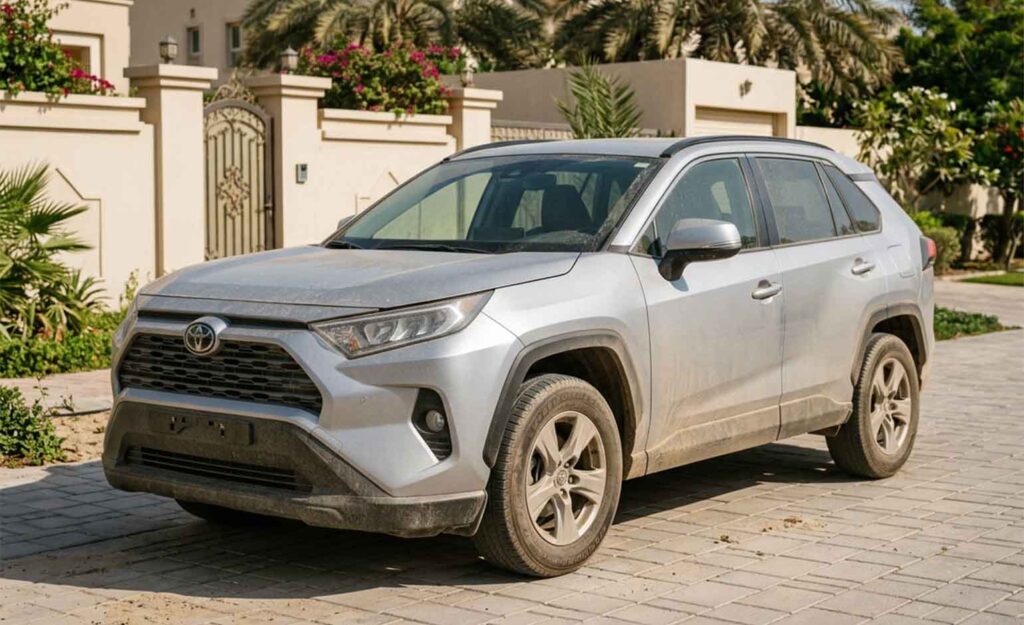
There is another complication for owners. Abu Dhabi also has rules dealing with vehicles that are left neglected or excessively dirty in public places.
The municipality has previously carried out campaigns identifying abandoned or neglected cars, placing warnings on vehicles and taking further enforcement action when owners fail to correct the situation. In a 2023 campaign, Abu Dhabi City Municipality said neglected vehicles in streets, squares and public areas could receive warnings, followed by violations and removal to an impound yard if the situation was not corrected.
This creates an unusual balance for owners. Leaving a vehicle neglected for an extended period can attract municipal attention, but cleaning it in a way that floods a public parking area can create a different violation.
The solution is not to avoid cleaning the vehicle. It is to clean it in an appropriate place.
What Is Still Not Confirmed About The Dh4,000 Warning
Not every detail circulating around the latest campaign has the same level of official confirmation.
Based on the current DMT fine schedule and the municipality’s campaign information reviewed for this article:
- A Dh4,000 maximum has not been confirmed in the official schedule for violation number 33. The published DMT table lists Dh500, Dh1,000 and Dh2,000 for water accumulating in public areas as a result of washing vehicles. Until an updated official schedule states otherwise, Dh2,000 is the highest published third-offence amount for that particular provision.
- There is no blanket statement in the material reviewed saying every private home car wash automatically attracts a fine. The municipal campaign refers to unauthorised places, while the official fine schedule specifically mentions water accumulation in public areas. Drivers should therefore focus on both the location of the wash and where the wastewater ends up.
- The exact violation issued can depend on the circumstances. Abu Dhabi’s municipal schedule contains separate offences covering water accumulation, liquid leakage, misuse of public areas and other behaviours. It would therefore be misleading to claim that every car-washing incident will automatically receive the same fine.
Keeping Your Car Clean Without Risking A Municipal Fine
Abu Dhabi’s latest campaign does not mean motorists should stop cleaning their vehicles. It means owners need to think more carefully about where that cleaning takes place.
The important distinction is between cleaning a vehicle appropriately and carrying out a wash that affects a public street, pathway, car park or other shared space.
For most drivers, the simplest option is to use a licensed car wash or authorised mobile cleaning service in a suitable location. Those who clean vehicles on private property should make sure water and cleaning residue remain properly controlled rather than flowing onto public areas.
And while Dh4,000 has appeared prominently in coverage surrounding Abu Dhabi’s crackdown, motorists should understand the underlying fine schedule rather than relying on the headline figure alone.
The official DMT document currently lists the Abu Dhabi car washing fine for water accumulating in public areas at Dh500 for a first offence, Dh1,000 for a second and Dh2,000 for a third. Separate municipal offences can carry Dh4,000 or higher penalties, which is why identifying the actual violation matters.
For Abu Dhabi residents, the practical rule is straightforward: keep the car clean, but make sure the street does not become part of the wash.