UAE Traffic Signs Explained: A Complete Guide For New Drivers
For new drivers in the UAE, learning the road signs is about much more than passing a theory test. On busy Dubai motorways, Abu Dhabi intersections and multi-lane roads across the Emirates, recognising a sign early can be the difference between making the correct move and suddenly cutting across traffic.
UAE traffic signs broadly tell drivers three things: what they must or must not do, what hazard is ahead, and where they need to go. Regulatory signs cover rules such as speed limits, prohibited turns and parking restrictions, while warning signs highlight hazards and guide signs help with routes and destinations.
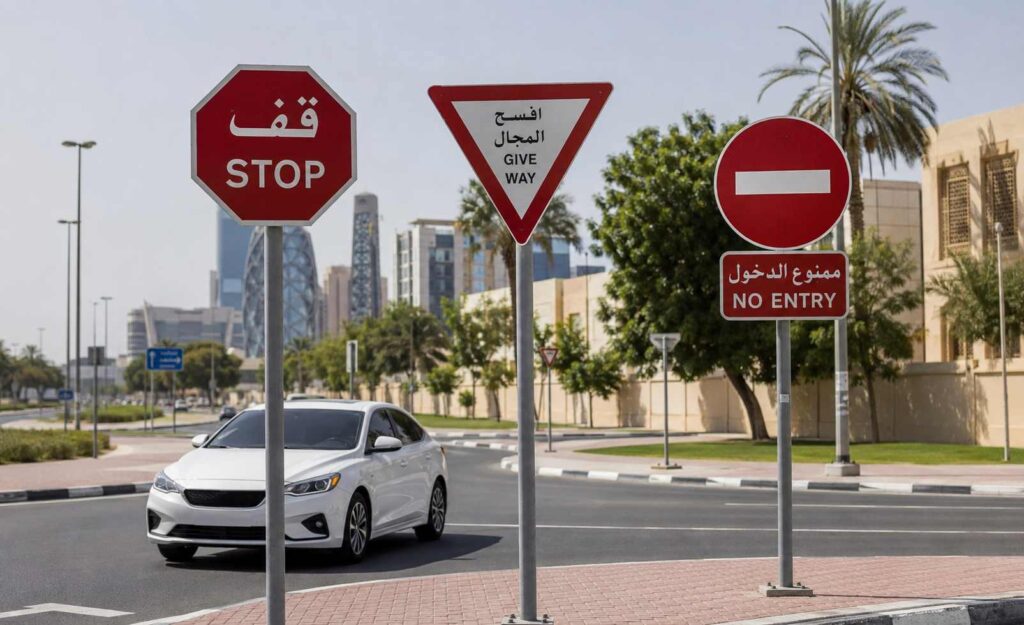
Road and traffic signs in the UAE generally use both Arabic and English, which makes navigation easier for expatriates and visitors. Vehicles also drive on the right-hand side of the road.
Here is how the main UAE traffic signs work and which ones new drivers should learn first.
The Three Main Types Of UAE Traffic Signs
Trying to memorise hundreds of individual signs is difficult. It becomes much easier once you understand what each category is trying to tell you.
RTA guidance divides road signs into three broad purposes:
- Regulatory signs: These tell you what you must or must not do, such as stopping, keeping right or obeying a speed limit.
- Warning signs: These alert you to hazards ahead, including junctions, pedestrians, merging lanes and changing road conditions.
- Guide signs: These provide directions, route numbers, destinations and other information needed to navigate the road network.
Regulatory signs deserve particular attention because ignoring them can amount to a traffic offence. The current UAE road-safety framework is governed by Federal Decree-Law No. 14 of 2024 on Traffic Regulation, which came into effect on 29 March 2025.
Regulatory Signs: The Rules You Must Follow
Regulatory signs control how drivers use the road. RTA further divides these into control, mandatory, prohibitory, parking and freeway signs.
For a new driver, these are some of the most important signs to recognise instantly.
Control signs decide who moves and who waits
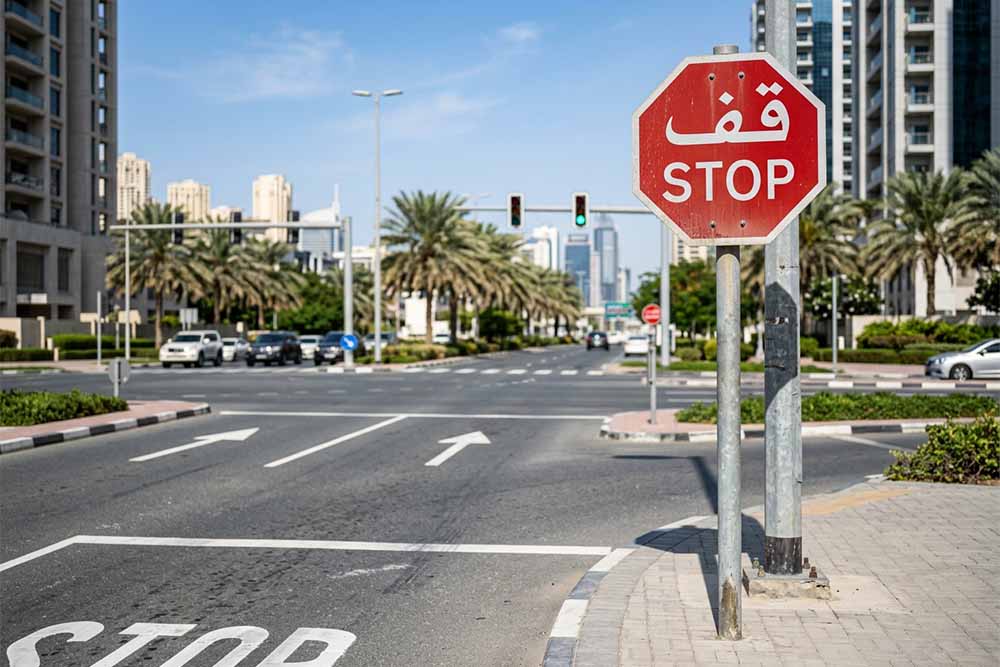
Control signs manage priority and direction at junctions and other conflict points.
Common examples include:
- STOP: Bring the vehicle to a complete stop before proceeding when it is safe.
- Give Way: Yield to traffic or pedestrians that have priority before entering.
- No Entry: Do not drive into the road from that direction.
- Direction arrows: Follow the direction shown rather than choosing another movement.
A common mistake among inexperienced drivers is treating Give Way like STOP. They are not the same. A STOP sign requires the vehicle to stop, while Give Way requires you to yield and proceed only when the road is clear.
Mandatory signs tell you what to do
Mandatory signs give positive instructions rather than warnings.
They are commonly shown as white symbols on a blue circular background. Examples in current RTA guidance include Ahead Only, Turn Right Only, Keep Right, Keep Left and Roundabout direction signs.
Other mandatory signs can apply to specific vehicles or areas:
- Minimum speed: Do not travel below the displayed minimum where the restriction applies.
- Buses or taxis only: The lane or road is reserved for the vehicles indicated.
- Cycle or pedestrian routes: Follow the sign showing who is permitted to use that path.
- Switch headlights on: Use your headlights from the point where the instruction applies.
These signs matter particularly around roadworks, tunnels, dedicated transport lanes and more complex sections of Dubai’s road network.
Prohibitory signs show what is not allowed
Prohibitory signs are among the easiest to misunderstand because many use similar red circles or diagonal lines.
The symbol inside the sign tells you exactly what is restricted.
Common examples include:
- No left or right turn: The indicated turn is prohibited.
- No U-turn: Continue ahead or find another permitted turning point.
- Maximum speed: Do not exceed the number shown in kilometres per hour.
- No overtaking: Overtaking is prohibited while the restriction applies.
- Height, weight or length limit: Vehicles above the stated limit must not proceed.
- No pedestrians, cyclists or motorcycles: The road is closed to the type of road user shown.
For everyday car drivers, speed-limit and turning restrictions are the signs most likely to affect daily journeys.
Speed Limit Signs Need More Attention Than The Number Alone
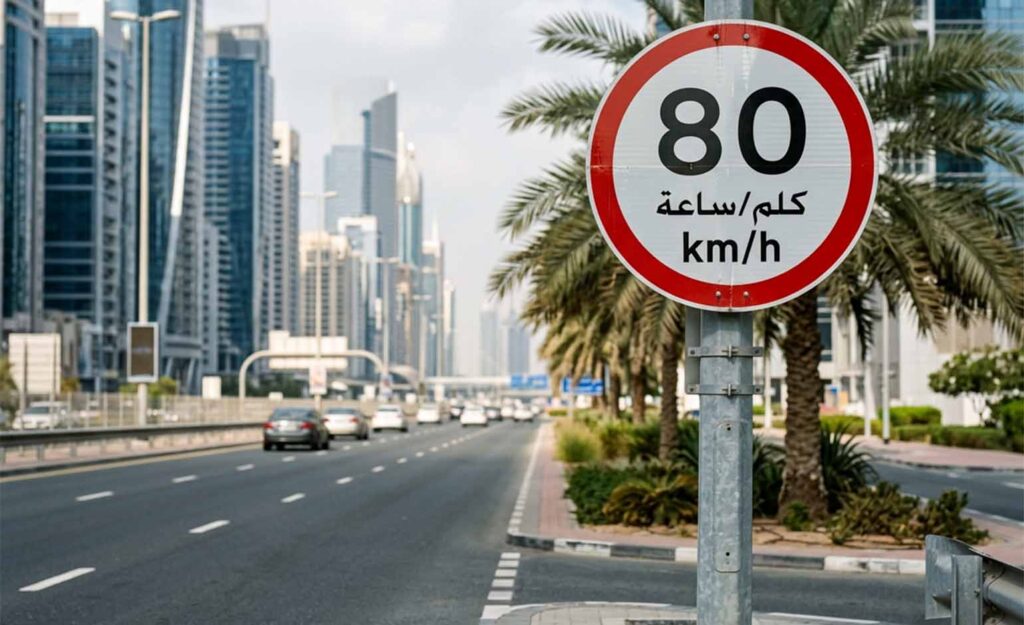
Speed limits in the UAE are displayed in kilometres per hour. A circular sign showing a number inside a red border indicates the maximum permitted speed under the applicable road rules.
New drivers should avoid treating the displayed number as a target. Traffic, visibility, rain, dust or congestion may require a lower safe speed even when the legal maximum is higher.
The opposite sign can also appear. RTA’s handbook includes minimum-speed signs on certain freeway sections, where drivers must maintain at least the indicated speed unless traffic or safety conditions prevent them from doing so.
Drivers should also watch for speed-limit changes when:
- Leaving a major motorway for a local road.
- Entering residential or school areas.
- Approaching roadworks or temporary diversions.
- Moving between different sections of a high-speed road.
A driver who concentrates only on navigation can easily miss a new speed limit after an exit or junction.
Warning Signs Give You Time To React
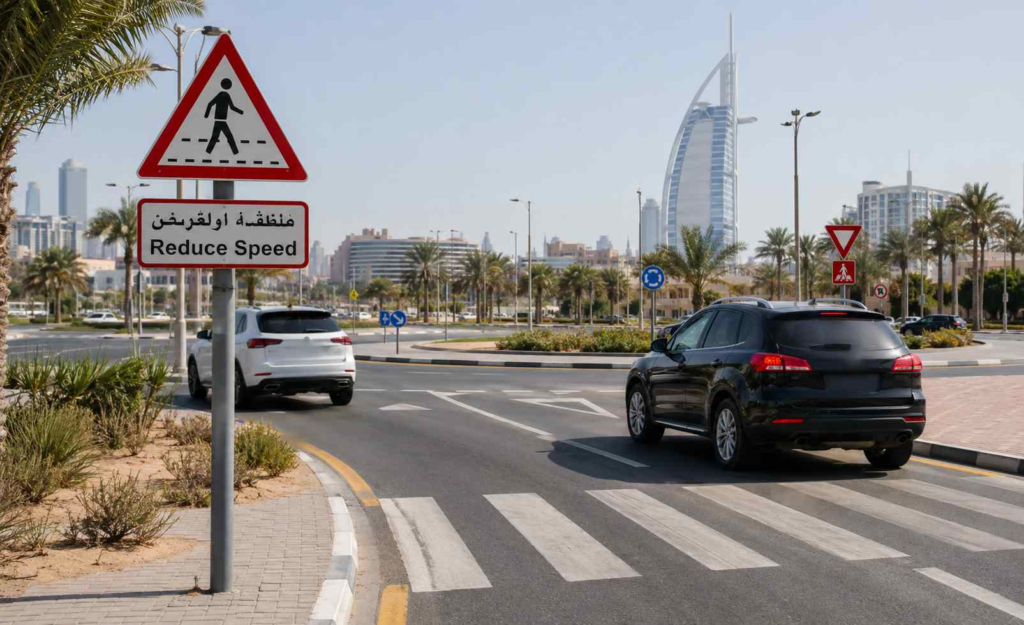
Warning signs are not usually telling you to perform one specific manoeuvre. Instead, they warn that something ahead requires additional attention.
RTA divides warning signs into advance warning signs, hazard markers and diagrammatic warnings.
Typical advance warnings include:
- Traffic signals ahead: Be ready for slowing or stopped vehicles.
- Roundabout ahead: Reduce speed and prepare to give way where required.
- Pedestrian crossing ahead: Watch closely for people entering the road.
- Junction or T-intersection ahead: Expect crossing or merging traffic.
- Two-way traffic: Vehicles may approach from the opposite direction.
- Height restriction ahead: Larger vehicles must check available clearance.
New drivers should react to the hazard, not simply acknowledge the sign. Seeing a pedestrian warning, for example, should mean checking both sides of the road and preparing to slow.
Lane Merges And Closures Matter On UAE Motorways
Dubai and Abu Dhabi both have wide multi-lane roads, so signs explaining lane changes deserve special attention.
Diagrammatic warning signs are designed for situations where a simple triangular sign may not clearly explain the road layout. RTA says these are commonly used on higher-speed roads.
They can warn you about:
- A lane closing ahead.
- An additional lane joining.
- Several lanes reducing into fewer lanes.
- Traffic merging from another road.
- Restrictions affecting a particular lane.
These signs should trigger early preparation. Check mirrors, identify a suitable gap and change lanes smoothly rather than reaching the end of the lane and making a sudden move.
This is particularly important on roads where exits can appear close together and traffic speeds vary considerably between lanes.
Hazard Markers And Chevrons Tell You Where The Road Goes
Drivers will frequently see large black-and-white or directional chevron markings around sharper bends, medians, junctions and physical obstructions.
Their job is simple: make the road layout or hazard easier to see.
A sequence of chevrons around a curve should tell you to look through the bend and adjust your speed before reaching it. A marker around a central island or barrier helps you understand which side to pass.
Ignoring these because they do not contain text is a mistake. Their position is often as important as the symbol itself.
Parking Signs Can Be More Restrictive Than They First Appear
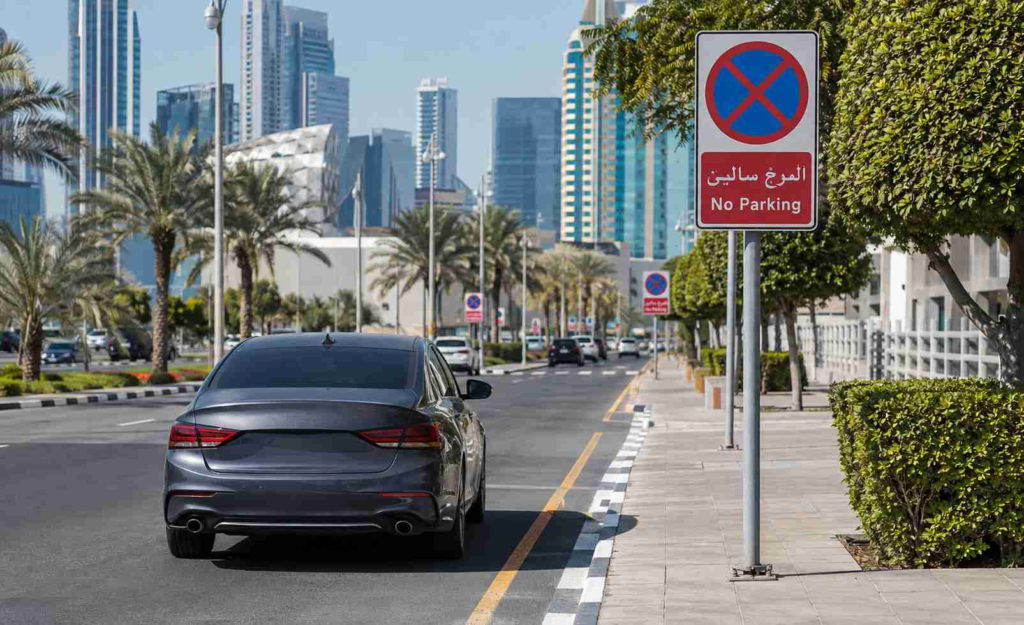
Parking rules vary by location, and signs should always be checked before leaving a vehicle.
RTA’s parking-control signs regulate whether drivers can park, stop or use a space only during specific hours. Some spaces are reserved for particular users.
Pay particular attention to:
- No Parking: Do not leave the vehicle parked in the restricted area.
- No Stopping: Do not stop or park where the restriction applies.
- People of Determination parking: Use only with the required authorisation.
- Taxi or bus areas: These spaces are reserved for the indicated transport service.
- Loading areas: Restrictions may apply according to vehicle type and displayed times.
One common misunderstanding is assuming that remaining inside the car makes prohibited parking acceptable. RTA guidance specifically distinguishes areas where parking or stopping itself is restricted.
Always check arrows and supplementary panels because they can show where the restriction begins, ends or applies only at certain times.
Guide Signs Make UAE Roads Easier To Navigate
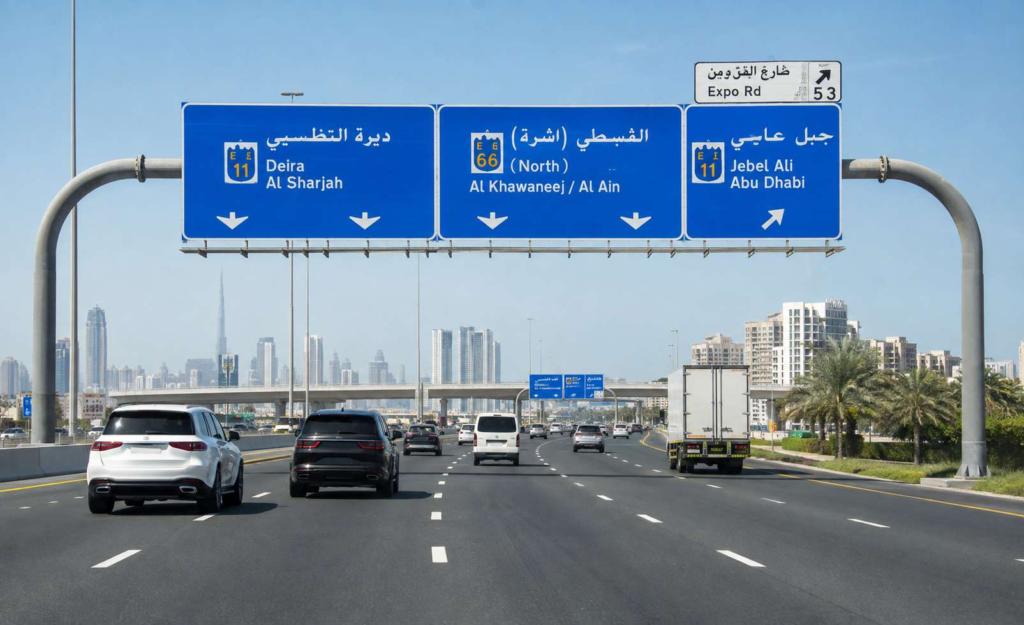
Guide signs provide route numbers, street names, destinations and exit information.
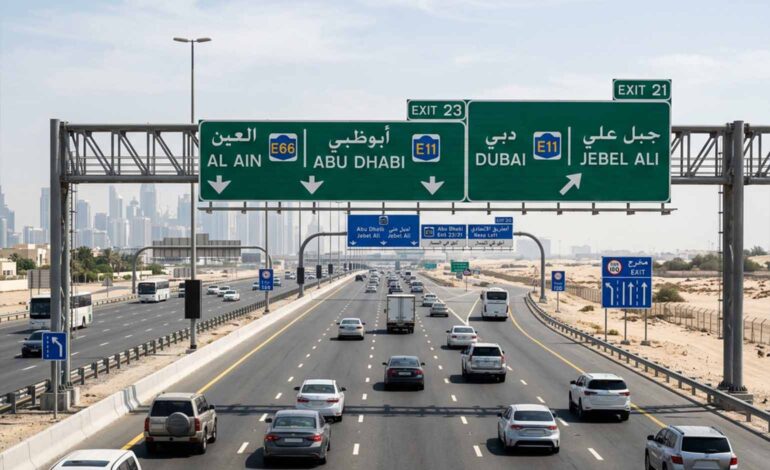
They are especially important in Dubai because missing an exit on Sheikh Zayed Road, Sheikh Mohammed bin Zayed Road or another major corridor can result in a considerable detour.
RTA’s Dubai handbook explains its directional colour system as follows:
- Blue: Used for national routes carrying the Emirates route emblem.
- Green: Used on local Dubai routes carrying the Dubai route emblem.
- White: Used for local destinations, roads or points.
- Brown: Provides additional destination information, often with symbols.
The familiar E route number is particularly useful for journeys between emirates. For example, E11 forms a major north-south corridor through the UAE and carries different local road names as it passes through individual emirates.
Local directional-sign design can vary depending on the emirate and road authority, so drivers should prioritise the destination name, route number, lane arrows and exit position rather than relying on colour alone.
Read The Sign Before Your Navigation App Tells You To Move
Navigation apps are useful, but they should support road signs rather than replace them.
A phone might tell you to take an exit, but the overhead signs show which physical lane feeds that exit. On large UAE interchanges, failing to read the sign early can result in a last-second lane change across several lanes.
A better approach is:
- Check the destination and route number as soon as the overhead sign becomes visible.
- Move towards the required lane gradually rather than waiting for the final exit marker.
- Stay on your current route if you miss the exit rather than making an unsafe correction.
This habit becomes particularly valuable on unfamiliar Dubai roads, where several destinations can appear on the same overhead sign.
Electronic Signs Can Change What Drivers Need To Know
Drivers should also pay attention to electronic Dynamic Message Signs on major Dubai roads.
These displays can provide live information about congestion, accidents, road conditions and other hazards. RTA said in December 2025 that Dubai had 112 electronic signs integrated with its iTraffic system.
Unlike a permanent sign, the message can change according to current conditions.
If an electronic sign warns of a collision, lane closure, congestion or adverse weather, use that information early rather than waiting until you reach the affected area.
School, Pedestrian And Cycling Areas Need Extra Care
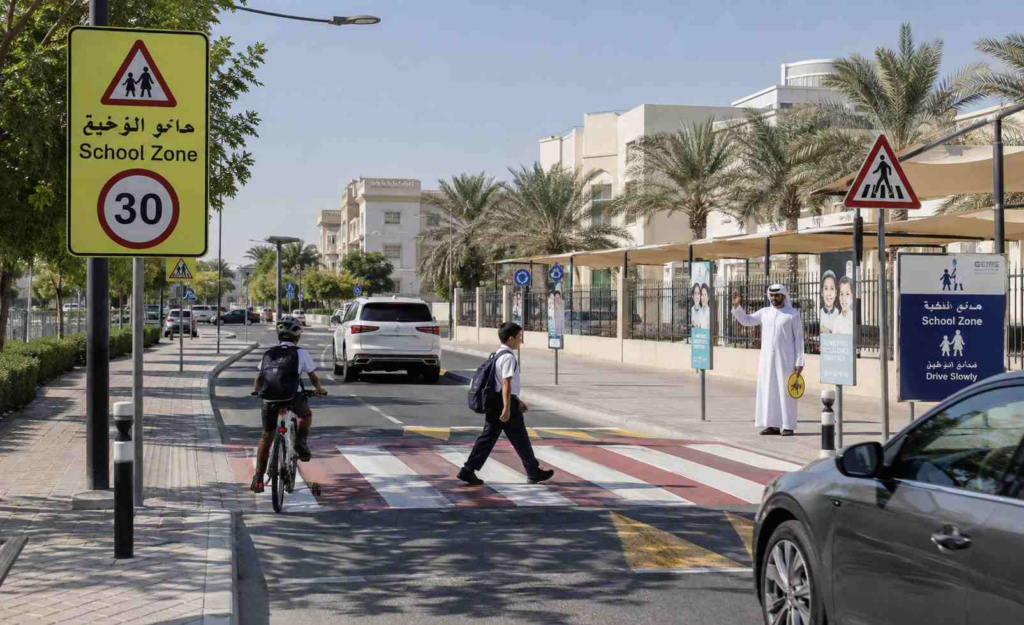
Urban roads in the UAE increasingly include dedicated spaces for pedestrians, bicycles and e-scooters.
Around schools, drivers should watch for lower-speed environments, crossings, warning signs, bus activity and children moving between parked vehicles.
RTA continues to use traffic-calming measures and signage around Dubai school zones and advises motorists to reduce speed, use designated drop-off areas and comply with traffic signs and signals.
Cycling and e-scooter areas can also have dedicated signs showing shared or separated paths, prohibited sections and crossing points. RTA additionally uses red road markings in some soft-mobility areas to alert motorists to reduce speed.
These areas deserve more caution because vulnerable road users can change direction much faster than surrounding cars.
UAE Weather Can Make Signs Even More Important
A road sign that is easy to read on a clear morning may become much harder to spot during fog, heavy rain or a dust storm.
This is where anticipation matters.
RTA advises drivers to reduce speed, increase following distance and continue following signs and warnings during poor weather. Electronic warnings near tunnels or locations affected by water can also provide information about conditions ahead.
In poor visibility:
- Look further ahead so you have more time to identify signs.
- Avoid sudden lane changes if you notice an exit late.
- Follow temporary or electronic warnings around flooding and road closures.
- Reduce speed when conditions make the posted maximum unsafe.
The UAE’s dry climate can encourage drivers to become used to excellent visibility. Fog, dust or sudden rainfall can quickly change that.
Traffic Signs And Road Markings Work Together
Road signs are only part of the information drivers receive.
Lane arrows, solid lines, broken lines, pedestrian crossings, stop lines and other road markings tell you how to position the vehicle and what manoeuvres are permitted.
For example, an overhead sign may show the correct exit while lane arrows below confirm which lanes continue straight. A STOP sign works together with the stop line showing where the vehicle should halt.
New drivers should therefore avoid reading signs in isolation. The safest approach is to combine the sign, lane marking, traffic signal and surrounding traffic conditions before making a decision.
Common UAE Traffic Sign Mistakes New Drivers Should Avoid
Most mistakes are not caused by completely failing to recognise a sign. They happen because the driver notices it too late or interprets it incorrectly.
Watch for these common problems:
- Looking only at GPS: Navigation does not override physical traffic signs or temporary restrictions.
- Changing lanes at the last second: Read overhead signs early and position the vehicle gradually.
- Confusing minimum and maximum speeds: Check the sign design as well as the number displayed.
- Ignoring supplementary panels: Times, vehicle types and directional arrows can change how a restriction applies.
- Assuming an empty road means a prohibited turn is acceptable: Regulatory restrictions still apply.
- Missing temporary signs: Roadworks and diversions can change normal lane arrangements without much notice.
A disciplined driver scans continuously rather than waiting until a sign is directly beside the car.
Learning The Signs Before The UAE Roads Get Busy
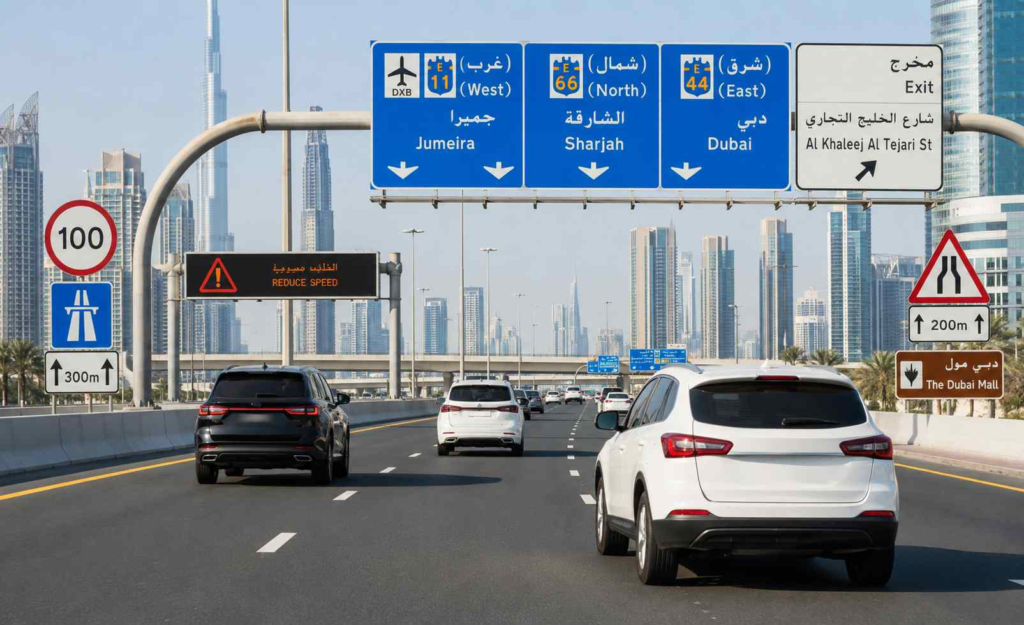
Understanding UAE traffic signs becomes much easier once you stop treating every symbol as something separate to memorise.
Start with the basic logic. Regulatory signs tell you what is required or prohibited. Warning signs prepare you for hazards. Guide signs help you reach the correct road, lane or destination.
Then learn the signs you will see most often: STOP, Give Way, No Entry, speed limits, prohibited turns, mandatory arrows, pedestrian warnings, lane merges and parking restrictions.
For drivers preparing for a Dubai licence, RTA says its official driving handbook covers road rules, offences, black points, road signs and markings. The authority also states that the handbook is reviewed every six months and updated when required, making the current official version a better study source than old sign charts circulating online.
Once those signs become instinctive, navigating busy UAE roads becomes much less stressful and much more predictable.