New Audi Q7 2026 Preview: Is It Still a Luxury Family SUV to Watch in the UAE?
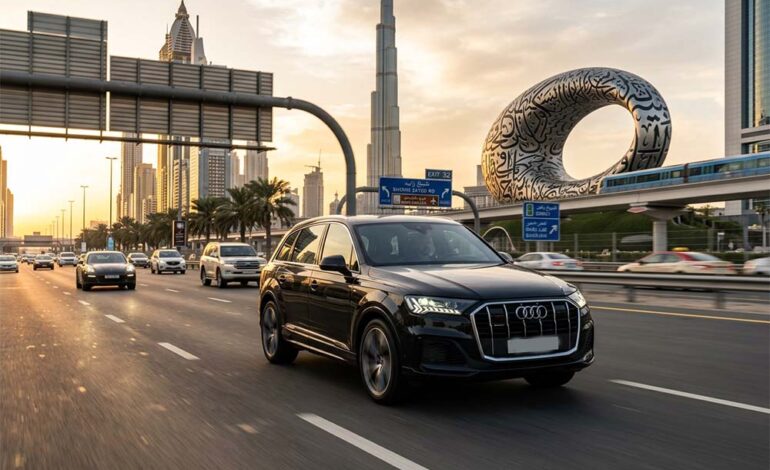
The new Audi Q7 2026 remains a luxury family SUV worth watching in the UAE, particularly for buyers who want seven-seat flexibility without moving into a body-on-frame model such as the Nissan Patrol or Toyota Land Cruiser.
Audi officially revealed the third-generation Q7 on 9 June 2026. The replacement brings a redesigned exterior, a more digital cabin, five, six or seven-seat layouts, updated quattro all-wheel drive and new mild-hybrid technology. German orders opened in June 2026, with European deliveries scheduled to begin in September. (audi.com)
However, UAE buyers need to separate the newly revealed third-generation model from the Q7 currently promoted by Audi Dubai and Audi Abu Dhabi. At the time of writing, the local websites still show the outgoing-generation vehicle, despite using 2026 model-year wording. Audi has not yet confirmed the new-generation Q7’s UAE launch date, petrol engine range, local price or final regional specification. (Audi Dubai)
That uncertainty does not weaken the Q7’s appeal, but it means anyone considering a purchase should confirm exactly which generation is being offered before paying a deposit.
The 2026 Audi Q7 is a completely new generation
The latest Q7 is not another minor update to the long-running second-generation SUV. It is the third full generation of Audi’s largest conventional family SUV, arriving more than 20 years after the original Q7 was introduced in 2005.
Audi has retained the basic formula that made the model relevant to affluent families: a large cabin, permanent quattro all-wheel drive, strong motorway ability and the option of three seating rows. The difference is that the new version moves closer to Audi’s latest generation of digital interiors and lighting technology.
Confirmed global highlights include:
- The new Q7 can be configured with five, six or seven seats. The six-seat version replaces the conventional middle bench with two individual second-row chairs, while the seven-seat model retains a three-person bench. This gives buyers more flexibility than many luxury SUVs that offer only five or seven seats. (audi.com)
- Permanent quattro all-wheel drive is standard on the European launch versions. Audi has also introduced an updated limited-slip centre differential designed to improve traction, stability and steering response. The final drivetrain offered in the UAE has not yet been announced.
- The cabin receives Audi’s curved panoramic display. It combines the digital instrument panel and main MMI touchscreen, while a separate front-passenger display is fitted as standard in the announced European specification. Equipment can vary by market, so UAE availability should not be assumed. (audi.com)
The new model is again being manufactured in Bratislava, Slovakia, where the previous two generations were also produced.
Audi has made the Q7 more practical for families
Large luxury SUVs are often marketed around performance and design, but everyday usability is more likely to decide whether a vehicle works for a UAE family.
Audi appears to have paid close attention to that requirement. The new Q7 has a more upright rear section and an almost horizontal roofline, changes intended to improve interior space and rear headroom.
Five, six or seven seats change the ownership experience
The five-seat Q7 offers the greatest luggage capacity and may suit couples or smaller families that rarely need a third row. Audi quotes up to 806 litres behind the second row and as much as 2,075 litres with the rear seats folded in the European specification. (audi.com)
The six-seat configuration could appeal to families that prioritise second-row comfort. Two individual seats provide easier separation between passengers and create a more premium, business-class layout, although they reduce the ability to carry three people across the middle row.
The seven-seat version remains the most flexible choice for larger households. Audi says three child seats can be installed across the second-row bench, while a comfort-entry function allows access to the third row without requiring the middle-row seatbacks to fold completely flat. (audi.com)
The third row still needs a real family test
Seven seats on a specification sheet do not guarantee that seven adults will travel comfortably. Like most luxury crossovers, the Q7’s rearmost seats are likely to be best suited to children, teenagers or occasional adult use rather than regular long-distance travel.
UAE buyers should test the cabin with the people and equipment they actually carry. A showroom visit should include child seats, a pushchair and representative luggage rather than relying only on published capacity figures.
Family buyers should check these points before ordering
The Q7’s flexible cabin is promising, but the right layout depends on how the vehicle will be used.
- Check luggage room with all three rows raised. Published maximum capacities usually describe the vehicle with one or more rows folded. Families planning airport runs or GCC road trips should confirm whether suitcases still fit when every seat is occupied.
- Test access to the rearmost seats. Children may manage the opening easily, while older relatives could find the step-in height and narrow passage more difficult. The size of the opening matters as much as the amount of legroom once seated.
- Confirm rear air-conditioning coverage. Strong cooling across all seating rows is essential in UAE summer conditions. Buyers should ask whether the regional specification includes four-zone climate control, additional rear vents and separate controls for passengers in the back.
The new interior is more advanced, but screens dominate
The 2026 Q7 adopts the digital cabin design seen in Audi’s newer models.
The central feature is the Audi MMI panoramic display, which uses curved OLED technology and combines the driver information screen with the main infotainment display. A front-passenger screen includes a privacy function designed to prevent its content from distracting the driver. An optional head-up display is also available in the announced European range. (audi.com)
The centre console can wirelessly charge two compatible phones using the Qi2.2 standard, while larger cup holders and additional storage aim to improve everyday usability.
Audi has also developed a new panoramic glass roof with switchable transparency and integrated lighting effects. The roof was not due to be available at the start of European presales, and its UAE availability remains unconfirmed. (audi.com)
The technology should make the Q7 feel current, although buyers should judge usability rather than screen size alone:
- Climate controls must remain easy to reach while driving. Touchscreen systems can look clean but require more attention than physical switches. A test drive should include changing temperature, fan speed and seat ventilation without stopping the car.
- Wireless phone integration needs to work consistently. Buyers should connect their own device and test calls, navigation and audio. Software reliability matters more in daily ownership than animated menus or display resolution.
- The passenger display may be useful, but not essential. It can allow a passenger to manage media or navigation, yet some buyers may see it as another expensive component that could eventually require repair. The value depends on how often the front passenger actually uses it.
The launch engine is unlikely to be the UAE favourite
Audi has confirmed two versions of a 3.0-litre V6 diesel engine for the European launch.
The stronger version produces 299PS and 630Nm, while the lower-output model develops 245PS and 500Nm. Both use Audi’s MHEV plus mild-hybrid system, which can temporarily contribute up to 18kW, equivalent to 24PS, through a powertrain generator. An electrically powered compressor is also used to improve low-speed response. (audi.com)
Both announced engines are paired with an eight-speed Tiptronic automatic gearbox and permanent quattro all-wheel drive.
Diesel engines remain relevant in Europe, particularly for towing and long-distance use, but a diesel-only Q7 range would be unusual for the UAE. Petrol power has traditionally been more important in this market, and the current local Q7 configurator identifies a 45 TFSI petrol version. (Audi Abu Dhabi)
Audi has not yet confirmed which petrol, plug-in hybrid or performance engines will join the third-generation range globally or in the Gulf. UAE buyers should therefore avoid assuming that European launch specifications will match local showroom vehicles.
How the new Q7 could suit UAE driving
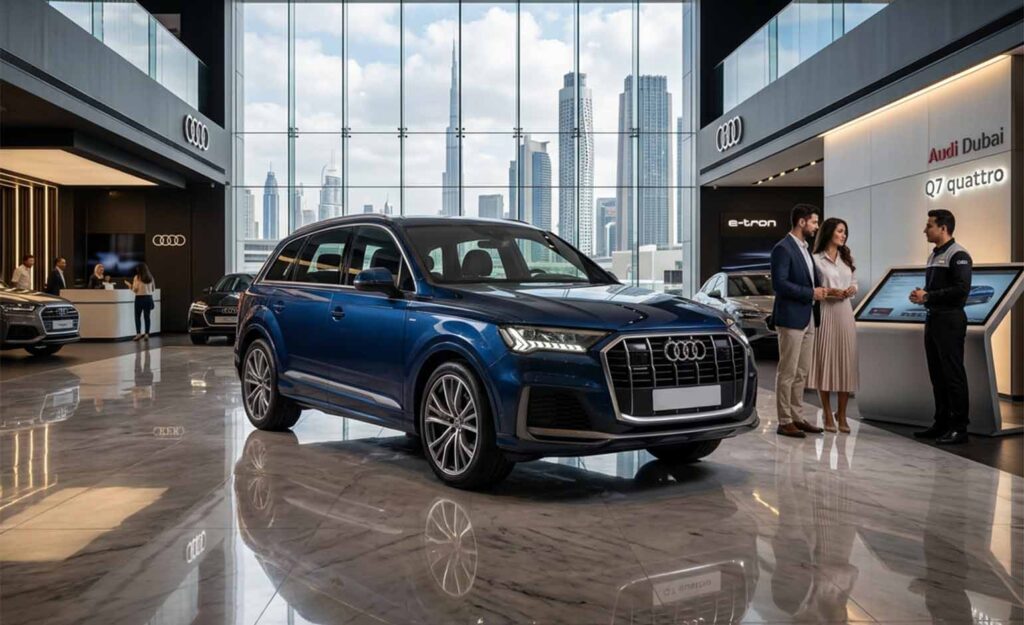
The Q7 has traditionally occupied an important middle ground. It is more road-focused and car-like than a Nissan Patrol or Toyota Land Cruiser, but more spacious and family-oriented than many five-seat premium crossovers.
That balance remains relevant in the UAE, where one vehicle may need to handle school runs, business travel, airport collections and long journeys between emirates.
Quattro should suit fast GCC motorway travel
Permanent all-wheel drive is valuable for traction and stability, even if the vehicle rarely leaves paved roads. On wide, fast routes between Dubai and Abu Dhabi, the Q7’s strength is likely to be its planted motorway behaviour rather than aggressive off-road ability.
Audi also offers adaptive air suspension and a sport version with controlled damping. These systems can potentially improve comfort over expansion joints while keeping the large body more controlled during lane changes. (audi.com)
The standard vehicle uses steel springs, so buyers should verify which suspension is fitted to the exact UAE trim they are considering.
Dubai parking could expose its size
The Q7 is a large SUV, and its dimensions can make older car parks, school entrances and narrow residential spaces more demanding.
Audi has introduced several parking aids for the new generation. These include surround-view cameras, a trained parking function that can remember specific manoeuvres, and reverse assistance for backing out of confined routes. (audi.com)
Optional powered doors can also detect nearby obstacles and stop before contact, although this feature’s UAE availability has not been confirmed.
It is not a substitute for a serious desert SUV
Quattro all-wheel drive improves grip and the Q7 has more rough-road ability than a conventional saloon, but it is not designed to replace a Patrol, Land Cruiser or dedicated off-road vehicle in demanding dunes.
Large alloy wheels, low-profile tyres and bodywork designed for luxury-road use can become liabilities in soft sand or rocky terrain. The Q7 is better suited to maintained tracks, campsites and occasional light off-road use.
Digital lighting is now part of the Q7’s safety package
Audi has made lighting technology one of the defining features of the new model.
Optional digital Matrix LED headlights use micro-LED technology to project high-resolution light patterns. The system can display lane guidance and driver-assistance information directly onto the road ahead, giving the warning a clearer connection to the vehicle’s surroundings. (audi.com)
At the rear, optional third-generation digital OLED lights offer multiple signatures and communication functions. The Q7 can also project turn-signal graphics onto the ground, potentially making the vehicle’s intended movement clearer to cyclists and other road users.
These features are technically impressive, but Gulf buyers should consider their ownership implications:
- Advanced light units can be expensive to replace. A minor front or rear accident may involve cameras, sensors and sophisticated lighting modules rather than a simple lamp housing. Comprehensive insurance and agency-repair terms become more important.
- Calibration may be required after body repairs. Windscreen replacement, bumper work or suspension changes can affect cameras and assistance systems. Repair quality should be judged by calibration capability, not only panel alignment and paint finish.
- Regional equipment levels may differ. Digital Matrix LED and OLED systems may be optional or restricted to higher trims. Buyers should verify the vehicle’s actual equipment using the chassis specification rather than relying on advertising images.
UAE heat will test the cabin and electronics
The new Q7’s technology is impressive, but the Gulf environment places heavy demands on complex luxury SUVs.
High cabin temperatures can affect batteries, displays, trim and electronic modules over time. Constant air-conditioning use also places sustained load on cooling components, while dust can collect around filters, radiators and moving roof mechanisms.
A UAE-focused test drive should therefore go beyond acceleration and handling.
Buyers should examine:
- Air-conditioning performance after outdoor parking. The system should cool the front and rear sections quickly, not only maintain an already chilled cabin. Seat ventilation and rear climate controls are particularly valuable in summer.
- Panoramic-roof heat management. Large glass roofs can brighten the cabin but may allow additional heat into the interior. Check the quality of the blind, the effectiveness of any switchable-glass function and whether the roof produces rattles over uneven roads.
- Wheel and tyre suitability. Large 21-inch or 22-inch wheels may improve appearance but increase tyre cost and reduce sidewall protection. Smaller factory-approved wheels can provide a better balance for family use and rough urban surfaces.
Regular cabin-filter and cooling-system maintenance will also matter. Owners should not assume that a new vehicle’s service reminders automatically account for unusually dusty driving conditions.
Where the Q7 sits against its UAE luxury SUV rivals
The third-generation Q7 will enter a demanding segment populated by established German, British and Japanese rivals.
Its closest alternatives are likely to include the BMW X7, Mercedes-Benz GLS, Volvo XC90, Land Rover Discovery and Lexus TX, depending on local pricing and the buyer’s priorities. The Range Rover Sport and Porsche Cayenne may also enter the comparison for customers who require less third-row practicality and place greater emphasis on style or performance.
The Q7’s likely strengths are:
- A less imposing size than some full-size rivals. It should be easier to use daily than the largest American or body-on-frame SUVs while still offering three-row seating. That balance can suit families living in Dubai or Abu Dhabi.
- Strong motorway manners and permanent quattro drive. The Q7 has historically felt closer to a large premium estate car than a traditional off-roader. Buyers who spend most of their time on tarmac may prefer that character.
- Flexible seating choices. Five, six and seven-seat layouts give Audi an opportunity to target different family and executive uses. The six-seat configuration could be particularly appealing to chauffeur-driven buyers or households with older children.
Its possible disadvantages include uncertain UAE pricing, potentially expensive optional equipment and less third-row space than physically larger competitors.
Current UAE Q7 buyers need to check which generation they are seeing
This is the most important point for anyone shopping now.
Audi Dubai and Audi Abu Dhabi currently promote a Q7 with space for up to seven people, quattro all-wheel drive, HD Matrix LED lighting and up to 1,908 litres of storage. Those specifications describe the revised second-generation Q7 introduced globally in 2024, not the newly unveiled third-generation vehicle. (Audi Dubai)
The outgoing model is not automatically a poor purchase. It remains spacious, powerful and well established, and dealers may offer attractive packages as the replacement approaches. However, buyers should understand what they are purchasing.
Before signing, request written confirmation of:
- The model generation and production date. A car registered as a 2026 model may still belong to the previous generation. Model year, registration year and vehicle generation are not the same thing.
- Any discount linked to the incoming replacement. An outgoing model may justify a lower transaction price, free servicing or other support. Compare the offer with likely depreciation once the third-generation Q7 reaches the used market.
- The cancellation and refund terms. Anyone intending to wait for the new model should not assume that an existing deposit can be transferred. The sales agreement should clearly state the ordered model and expected delivery conditions.
Warranty, servicing and insurance deserve early attention
A Q7 is a premium vehicle with premium repair exposure. Adaptive suspension, digital lights, powered seats, driver-assistance sensors and multiple displays can all be costly outside warranty.
Audi Dubai and Audi Abu Dhabi have not yet published local pricing or ownership packages for the third-generation Q7. Buyers will need to compare the eventual warranty, service contract and roadside assistance terms rather than judging the offer only by the purchase price.
Questions worth asking include:
- How long are the vehicle and paint warranties?
- Is scheduled maintenance included, and for what time or mileage?
- Does the warranty cover the air suspension and infotainment displays without special exclusions?
- Will agency repair be included in the insurance policy?
- Is a replacement car provided during lengthy warranty work?
- Are service packages transferable to the next owner?
A longer service package can support resale value, particularly when the vehicle has a complete authorised-dealer history.
Once a luxury SUV moves beyond its manufacturer-backed service period, access to model-aware diagnostics becomes more important. Owners considering long-term Q7 ownership can use a specialist European workshop such as German Experts for scheduled maintenance, fault diagnosis and repairs involving systems such as the engine, gearbox, cooling, suspension, electronics and air conditioning. Having a documented maintenance plan can also make future repair costs easier to manage and support buyer confidence when the vehicle is eventually sold.
Should UAE families wait for the new Audi Q7?
Waiting makes sense for buyers who want Audi’s latest interior technology, the new body design and the ability to choose among five, six and seven-seat layouts.
It may also be sensible for anyone concerned about buying the outgoing generation immediately before its replacement arrives. A new model can place downward pressure on used values, especially if the previous version was purchased without a meaningful discount.
Buying the current Q7 could still be the better decision when:
- the dealer offers a substantial and transparent saving;
- the vehicle is available immediately;
- its petrol powertrain suits the buyer better than the engines initially offered in the new model;
- the service, warranty and insurance package is particularly strong;
- the buyer prefers proven technology over a first-year model.
The decision should be based on the transaction price and ownership package, not simply whether one vehicle is newer.
Still relevant, but the UAE specification will decide its place
The new Audi Q7 2026 has the right foundations to remain a serious luxury family SUV in the UAE. It offers a flexible cabin, permanent quattro all-wheel drive, strong luggage capacity and a level of digital technology that brings it closer to Audi’s newest models.
Its greatest strength may be its balance. It provides more family practicality than many sporty luxury SUVs without carrying the bulk or off-road compromises of a traditional full-size 4×4.
However, several important questions remain unanswered for Gulf buyers. Audi has not confirmed the third-generation Q7’s UAE launch date, local petrol engines, price, trims or warranty package. The model currently shown on official UAE websites is still the outgoing generation.
The Q7 is therefore one to watch, but not one to order based on assumptions. Once the UAE specification is published, its price and engine range will determine whether it remains a compelling alternative to the BMW X7, Mercedes-Benz GLS and other large premium family SUVs.