Chinese Car Warranty Risks in the UAE and Why Agency Repair Still Matters
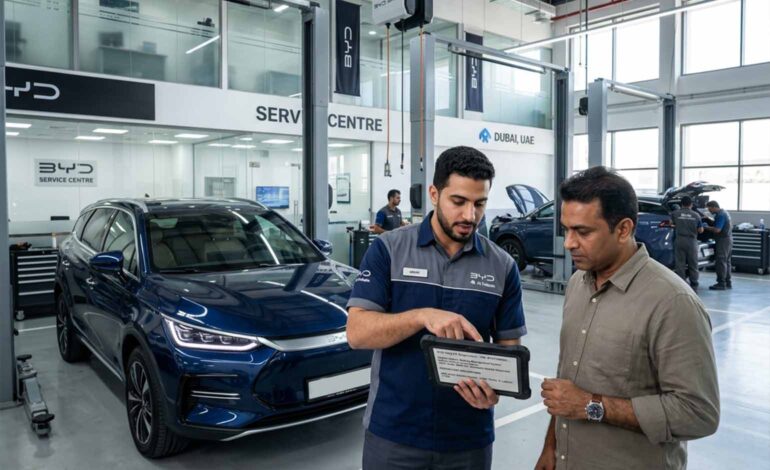
Chinese car brands have become a serious force in the UAE, offering electric vehicles, plug-in hybrids, family SUVs and technology-rich saloons at increasingly competitive prices. Yet the strength of a new-car warranty depends on more than the number of years printed in an advertisement.
The main Chinese car warranty risks in the UAE involve unclear exclusions, missed servicing requirements, parallel imports, limited parts support and disagreements over whether a fault resulted from manufacturing, maintenance, an accident or an unauthorised repair.
Agency repair still matters because an authorised distributor can provide manufacturer-approved diagnostics, documented software updates, genuine parts and a clearer route for warranty claims. That does not mean every independent workshop is unsuitable or that every agency claim will be approved. It means owners need to understand the written warranty before choosing where the vehicle is serviced or repaired.
A long warranty does not mean every repair is covered
Some Chinese manufacturers promote lengthy regional warranties to reassure buyers about reliability and long-term ownership. These programmes can offer meaningful protection, but the headline duration rarely applies equally to every component.
The main vehicle warranty may be different from the cover provided for the battery, electric drive system, infotainment equipment, paintwork, air-conditioning components and consumable parts. Coverage can also be limited by mileage, ownership type, servicing history or vehicle use.
MG Middle East, for example, states that maintaining warranty validity in the GCC requires a complete and accurate service history that follows the recommended servicing plan. It also specifies the use of parts meeting genuine original equipment specifications and authorised fluids. Owners are directed to their warranty booklet or authorised dealer for the complete conditions.
BYD UAE states that a comprehensive warranty policy is available, but directs customers to the owner’s manual for its detailed provisions. This highlights why buyers should request the actual warranty documentation rather than relying only on showroom advertising or a salesperson’s summary.
Before accepting a warranty as a reason to buy a particular model, owners should establish exactly what the promise includes:
- Separate the vehicle warranty from component-specific cover. The traction battery, electric motors, 12-volt battery, multimedia system and paint may each have different limits. Buyers should request written confirmation of the applicable period, mileage ceiling and exclusions for their exact UAE model.
- Check whether the warranty reduces or changes over time. Some components may receive full protection only during an initial period, followed by more limited cover. A seven-year headline warranty does not automatically mean every electronic or mechanical part remains protected for seven years.
- Read the definition of wear and tear. Brake components, tyres, wiper blades, filters and suspension items affected by normal use are commonly treated differently from manufacturing defects. Disputes can arise when the owner regards a failure as premature but the warranty provider considers it normal deterioration.
Servicing conditions can decide whether a claim succeeds
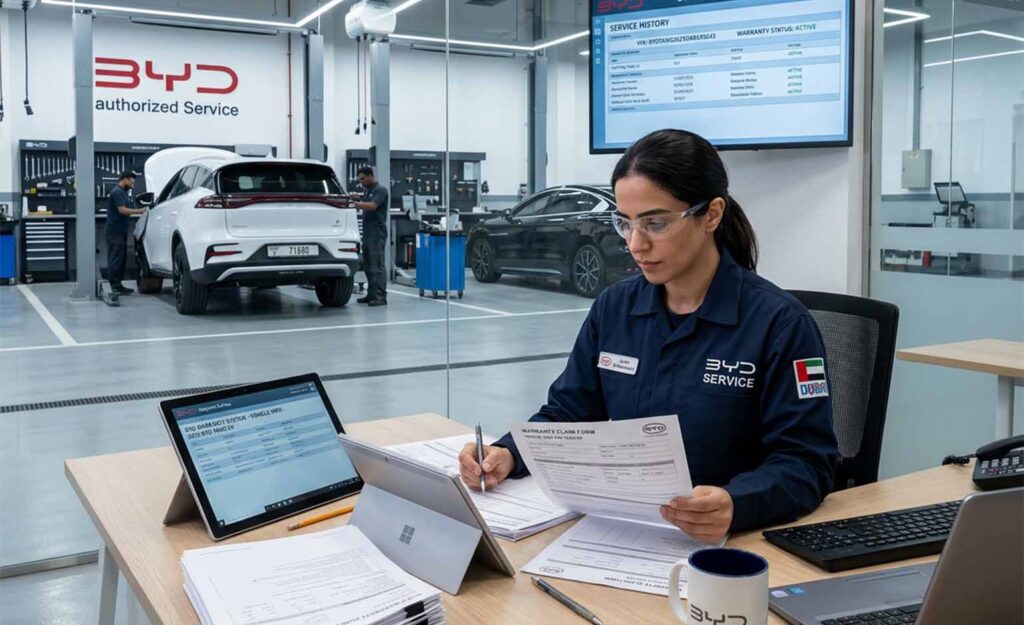
A warranty is a contract with conditions attached. Following the service schedule, using the correct fluids and keeping invoices may be just as important as reporting a defect promptly.
UAE driving can be demanding on cooling systems, batteries, air filters, tyres and air-conditioning equipment. High ambient temperatures, fine dust, congestion and extended motorway use can expose weaknesses that may not appear during milder laboratory or development conditions.
An owner who misses a scheduled service or uses an unsuitable coolant may face questions if the engine, hybrid system or battery cooling circuit later develops a fault. The claim should still be assessed according to the warranty terms and the cause of failure, but incomplete maintenance records make the owner’s position harder to prove.
Service intervals must match the UAE vehicle
Owners should follow the interval stated for the exact model and market rather than relying on guidance found on an overseas website. The same vehicle name can be sold with different engines, batteries, software versions or maintenance requirements in different countries.
Driving patterns may also place a car under severe-use conditions. Frequent short journeys, prolonged idling, dusty environments and heavy loads can require closer attention even when the standard schedule has not yet expired.
Paperwork protects more than resale value
Digital service records, stamped booklets and detailed invoices create a traceable maintenance history. They can help establish that the correct work was completed at the required mileage and that approved parts or fluids were used.
Good records also matter when the car is sold. A future buyer may be more willing to pay for a Chinese vehicle if the remaining warranty can be verified and the service history is complete.
Modifications create avoidable uncertainty
Aftermarket suspension changes, electrical accessories, performance tuning, non-approved chargers and alterations to high-voltage systems can complicate warranty assessments. This does not automatically establish that every unrelated fault is excluded, but the manufacturer or distributor may reject a claim when it can show a connection between the modification and the damage.
Owners planning modifications should obtain written guidance from the authorised UAE distributor beforehand. Verbal approval from a salesperson, accessory shop or unrelated workshop may be difficult to rely on later.
Why agency repair still matters for Chinese cars
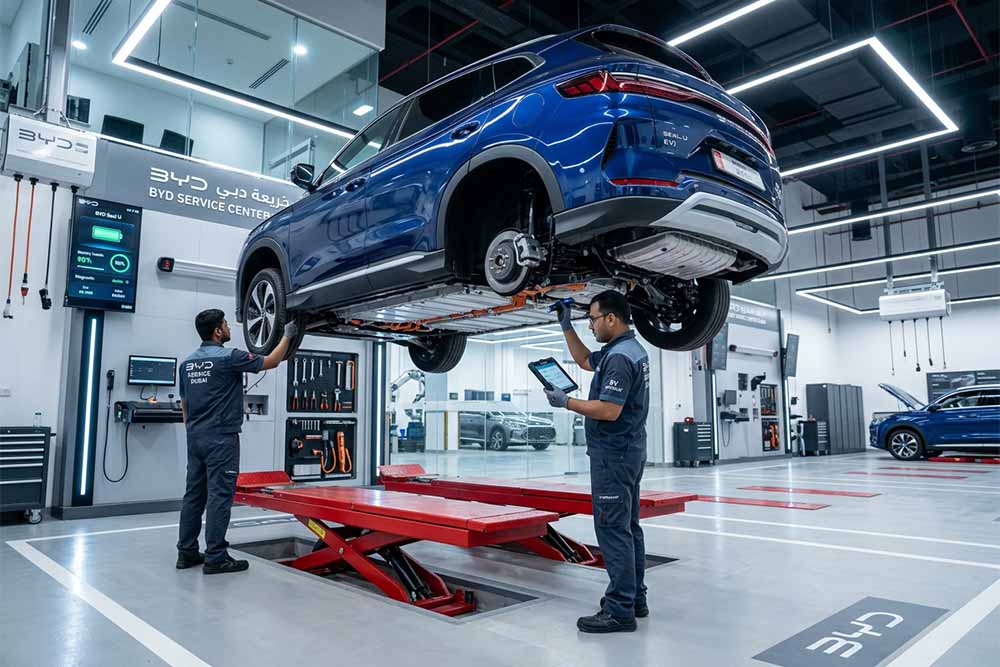
An authorised agency workshop is connected to the official distributor and manufacturer support network. Its value is most apparent when a repair involves software, safety systems, complex diagnostics or warranty authorisation rather than routine mechanical work.
MG Middle East says authorised centres use certified technicians, approved diagnostic equipment and genuine parts. It also links authorised servicing with protecting warranty validity, vehicle performance and resale value.
BYD’s regional service information similarly refers owners to maintenance resources, manuals and genuine spare parts, while its UAE operation provides official customer care and roadside-assistance channels.
Agency repair can provide several practical advantages:
- The workshop can access model-specific diagnostic systems. Modern Chinese vehicles may use proprietary software to identify faults, programme replacement modules and update control units. A generic scanner may read basic fault codes without providing the guided tests or calibration procedures required for a complete repair.
- Warranty approval can begin within the authorised network. The agency can record the complaint, collect diagnostic evidence and communicate with the regional distributor or manufacturer. This creates a more direct process than asking an independent workshop to diagnose a defect and then presenting that diagnosis to the warranty provider.
- Safety campaigns and software updates can be checked together. An authorised centre should be able to confirm whether a vehicle is affected by a recognised campaign or manufacturer action. The UAE Ministry of Economy and Tourism also maintains automotive recall information as part of its consumer-protection activities.
Parallel imports carry a different level of warranty risk
Not every Chinese car sold in the UAE enters through the manufacturer’s authorised local distributor. Parallel-import vehicles can offer unusual specifications, earlier availability or attractive prices, but their warranty position requires careful investigation.
A warranty issued by an overseas dealer, private importer or third-party provider is not necessarily the same as an official UAE manufacturer-backed warranty. The local authorised distributor may have no contractual obligation to perform free repairs on a vehicle it did not supply.
This becomes particularly important with Chinese-market EVs. A vehicle may have charging hardware, connected services, language settings, navigation functions or software that differ from the official UAE version.
Before buying a parallel import, the customer should confirm the following in writing:
- Identify the company legally responsible for the warranty. The sales invoice should name the provider and explain where claims will be handled. Buyers should not assume that an international manufacturer warranty is automatically valid through every UAE distributor.
- Confirm access to parts and technical support. Ask whether the seller stocks body panels, electronic modules, battery components and charging equipment for that exact specification. A promise to order parts after a failure is not the same as an established local supply chain.
- Test charging and connected features before purchase. Charging connector compatibility alone does not guarantee access to every UAE charger or digital service. Owners should verify app support, over-the-air updates, mobile connectivity and navigation functions rather than accepting broad assurances.
EV and hybrid warranties need extra scrutiny
Drivers whose vehicles do not receive full manufacturer-backed regional protection may also consider separate imported car warranty plans in the UAE, but the contract must still be examined carefully. GE Warranty provides plans covering listed mechanical and electrical components for eligible imported vehicles. Buyers should compare covered parts, exclusions, claim limits, repair-network requirements and transfer conditions before purchasing, rather than treating any third-party warranty as equivalent to an official manufacturer warranty.
Chinese brands have helped expand the UAE’s choice of battery-electric and plug-in hybrid vehicles. These powertrains bring additional warranty questions that do not apply in exactly the same way to conventional petrol cars.
A high-voltage battery warranty may cover manufacturing defects but not guarantee that the battery will retain its original usable capacity indefinitely. Buyers should ask whether a minimum state-of-health threshold is included and how degradation will be measured.
Thermal management is particularly relevant in the Gulf. Battery performance and charging speed can be affected by heat, while a fault in the cooling circuit may require specialised diagnosis.
Owners considering a Chinese EV or hybrid should examine three areas closely:
- Battery degradation and failure are not the same issue. Gradual capacity loss may be considered normal until it crosses a threshold defined by the warranty. The owner should request the threshold, testing procedure and available remedy in writing.
- High-voltage repairs require trained personnel and suitable facilities. Agency technicians should have access to isolation procedures, protective equipment and manufacturer guidance for the vehicle. An incorrect intervention can create safety risks and may affect later warranty claims.
- Software is part of the ownership package. Charging behaviour, battery management, driver-assistance systems and infotainment can depend on software updates. Buyers should establish whether UAE updates are included, how long connected support is expected and whether imported versions can receive local fixes.
Accident repairs can complicate future warranty claims
The distinction between mechanical warranty work and accident repair is important. Damage caused by a collision, flood, improper recovery or external impact is generally handled through insurance rather than a manufacturer warranty.
Problems can develop later if accident repairs are completed without the correct structural measurements, sensor calibration or battery inspection. A manufacturer may dispute responsibility for a subsequent fault if earlier damage or non-approved repair work contributed to it.
This matters in Dubai and Abu Dhabi, where vehicles regularly combine dense city traffic with fast multi-lane roads. Even a relatively minor collision can affect parking sensors, cameras, radar units and electronic control modules.
Owners should consider agency repair or a manufacturer-approved accident centre when:
- The impact involves the battery floor or high-voltage components. External damage may not be obvious, and a specialist inspection could be needed before the car is returned to service. The insurer and repairer should document the checks performed.
- Driver-assistance sensors have been moved or replaced. Cameras and radar systems may require static or dynamic calibration after windscreen, bumper, suspension or body repairs. A warning light disappearing does not confirm that the system is correctly aligned.
- The vehicle remains within its original warranty period. A documented repair using approved procedures can reduce uncertainty if an associated problem appears later. Owners should retain the insurance report, repair invoice, alignment data and calibration records.
UAE consumer law provides protection, but evidence still matters
Federal Decree-Law No. 15 of 2020 on Consumer Protection defines a warranty as an undertaking that a product is free from defects or malfunctions and conforms to applicable specifications, with obligations that can include repair, replacement or re-performing a service within a specified period.
The law and its executive regulations address supplier responsibilities relating to warranties, repairs, spare parts and substitute goods. The Ministry of Economy and Tourism has stated that the framework includes obligations concerning the repair of products covered by warranty.
However, consumer protection does not remove the need to follow the contract or document a dispute. Owners should keep the purchase agreement, warranty booklet, service history, inspection reports and correspondence.
When a disagreement arises, a sensible sequence is to:
- Report the fault to the authorised distributor in writing and request a job card describing the symptoms accurately.
- Ask for the diagnostic conclusion and reason for any rejected claim in writing, including the warranty clause being applied.
- Collect service invoices, photographs, warning messages and previous repair records that support the case.
- Escalate the matter through the distributor’s customer-care process before approaching the relevant consumer-protection authority.
The Ministry of Economy and Tourism provides a consumer complaint service that accepts supporting complaint documents and can refer cases to the competent authority. Local economic departments may also handle complaints depending on the emirate and transaction.
Could independent servicing automatically cancel the warranty?
It is unsafe to make a universal claim that any visit to an independent garage automatically cancels an entire UAE vehicle warranty. The outcome depends on the written terms, the work completed, the evidence available and whether the disputed failure is connected to servicing, parts or modifications.
At the same time, owners should not assume they can disregard the manufacturer’s maintenance conditions without consequences. MG Middle East expressly requires servicing in line with its recommended plan, a complete history and suitable parts and fluids for warranty validity in the GCC. Other brands may use different wording and conditions.
Routine independent maintenance can appear cheaper, but the saving should be weighed against access to technical campaigns, software systems and warranty documentation. During the original warranty period, agency servicing often provides the clearest evidence that the vehicle has been maintained according to the distributor’s requirements.
After the warranty expires, a reputable specialist may offer a sensible alternative, particularly for routine mechanical work. The workshop should still have suitable diagnostic equipment, technical knowledge and access to quality parts for the specific Chinese brand.
The buyer checks that matter before signing
The best time to investigate a Chinese car warranty is before paying a deposit. Buyers should ask the dealer to provide documents rather than relying on promotional claims.
A proper pre-purchase review should confirm:
- Who backs the warranty. Establish whether it is funded by the manufacturer, authorised UAE distributor, selling dealer or an external warranty company. The identity of the responsible party affects where the car can be repaired and how disputes are handled.
- Which components have shorter coverage. Request separate terms for the engine, gearbox, hybrid equipment, high-voltage battery, electric motors, infotainment system, paint and 12-volt battery. Ask whether commercial use, ride-hailing or a change of ownership alters the cover.
- What servicing conditions apply. Confirm the mileage and time intervals, permitted service locations, accepted parts and fluids, and tolerance for a late service. Request written clarification if the salesperson gives an answer that is not contained in the booklet.
- Whether the warranty transfers to the next owner. Transferable cover can support confidence in the used-car market, but transfer may require inspections, fees or a complete agency history. The exact position must be checked for the individual brand and vehicle.
- Where major repairs will be completed. A sales showroom does not prove the existence of a fully equipped workshop. Visit or identify the authorised service facility and ask about diagnostics, body repair, battery work and parts availability.
The real value of a warranty appears after the warning light
Chinese cars can offer strong equipment levels, competitive pricing and increasingly sophisticated powertrains. Their warranties can also provide worthwhile protection when the vehicle is supplied through an established distributor and maintained according to clearly documented conditions.
The risk comes from treating a long warranty as a blanket promise. UAE buyers need to know who supports the vehicle, which components are covered, where repairs will be completed and what evidence must be maintained.
Agency repair still matters most while the car remains under manufacturer-backed cover or requires complex electronic, software, battery or safety-system work. The higher workshop rate may be balanced by direct access to technical information, genuine parts, warranty approval and a service record that supports future resale.
For buyers comparing Chinese models in the UAE, aftersales infrastructure deserves the same attention as price, power, screen size and claimed driving range. A warranty is only valuable when the company behind it has the tools, parts and local presence required to honour it.